

Current Issue
Sana'a University Journal of Applied Sciences and Technology
Vol. 2 No. 2 (2024)
2024-05-11
11 Articles
The second volume - the second issue in the Sana'a University Journal of Applied Sciences and Technology
Article
11 Articles

How to Cite This Article
Mahmood A. H. Khaled, Kawkab A. M. Alsa'adi, Ibrahim G. H Loqman (2024). Solitary waves and double layers of dust-acoustic waves propagating in a non-ideal dusty plasma. Sana'a University Journal of Applied Sciences and Technology, 107-115. DOI: https://doi.org/10.59628/jast.v2i2.938
Mahmood A. H. Khaled, Kawkab A. M. Alsa'adi, Ibrahim G. H Loqman . “Solitary waves and double layers of dust-acoustic waves propagating in a non-ideal dusty plasma.” Sana'a University Journal of Applied Sciences and Technology, 2024, pp. 107-115. https://doi.org/10.59628/jast.v2i2.938. Accessed 27 Oct. 2026.
Mahmood A. H. Khaled, Kawkab A. M. Alsa'adi, Ibrahim G. H Loqman . 2024. “Solitary waves and double layers of dust-acoustic waves propagating in a non-ideal dusty plasma.” Sana'a University Journal of Applied Sciences and Technology : 107-115. DOI: https://doi.org/10.59628/jast.v2i2.938
Mahmood A. H. Khaled, Kawkab A. M. Alsa'adi, Ibrahim G. H Loqman (2024) ‘Solitary waves and double layers of dust-acoustic waves propagating in a non-ideal dusty plasma’, Sana'a University Journal of Applied Sciences and Technology, pp. 107-115. doi: 10.59628/jast.v2i2.938
@article{jast2024_art938,
    author  = {Mahmood A. H. Khaled, Kawkab A. M. Alsa'adi, Ibrahim G. H Loqman },
    title   = {Solitary waves and double layers of dust-acoustic waves propagating in a non-ideal dusty plasma},
    journal = {Sana'a University Journal of Applied Sciences and Technology},    year    = {2024},    month   = {May},    pages   = {107-115},    doi     = {10.59628/jast.v2i2.938},
    url     = {https://doi.org/10.59628/jast.v2i2.938},}
Citation copied!
Contact Authors
Solitary waves and double layers of dust-acoustic waves propagating in a non-ideal dusty plasma
Email copied!

Synthesis and Characterization of (CdO- CuOCo3O4) Mixed Metal Oxides Nanocomposite
Shadha Nasser Aziz, A.M. Abdulwahab, Thana Shuga Aldeen
116-123
2024-05-05
Abstract
The main goals of this study are to synthesize a mixed metal oxide nanocomposite (NC), CdO-CuO-Co3O4, and to analyze its structural, morphological, optical, and electrical properties using X-ray diffraction (XRD), total reflection X-ray fluorescence (TXRF), transmission electron microscopy (TEM), diffuse reflectance spectroscopy (DRS), and DC electrical resistivity. According to the XRD analysis, CuO nanoparticles (NPs) have a monoclinic structure, while CdO and Co3O4 (NPs) have cubic structures. The TEM images revealed a decrease in the particle size of CdO-CuO-Co3O4 (NC) compared with that of the NPs. The optical properties of CdO-CuO- Co3O4 (NC) were examined using a DRS in the wavelength range of 400-700 nm. The DC electrical resistivity results showed the semiconducting electrical behaviors of the samples.
Keywords
CdO-CuO-Co3O4
nanocomposites (NC)
TEM
Optical band gap
Electrical resistivity
How to Cite This Article
Shadha Nasser Aziz, A.M. Abdulwahab, Thana Shuga Aldeen (2024). Synthesis and Characterization of (CdO- CuOCo3O4) Mixed Metal Oxides Nanocomposite. Sana'a University Journal of Applied Sciences and Technology, 116-123. DOI: https://doi.org/10.59628/jast.v2i2.874
Shadha Nasser Aziz, A.M. Abdulwahab, Thana Shuga Aldeen . “Synthesis and Characterization of (CdO- CuOCo3O4) Mixed Metal Oxides Nanocomposite.” Sana'a University Journal of Applied Sciences and Technology, 2024, pp. 116-123. https://doi.org/10.59628/jast.v2i2.874. Accessed 27 Oct. 2026.
Shadha Nasser Aziz, A.M. Abdulwahab, Thana Shuga Aldeen . 2024. “Synthesis and Characterization of (CdO- CuOCo3O4) Mixed Metal Oxides Nanocomposite.” Sana'a University Journal of Applied Sciences and Technology : 116-123. DOI: https://doi.org/10.59628/jast.v2i2.874
Shadha Nasser Aziz, A.M. Abdulwahab, Thana Shuga Aldeen (2024) ‘Synthesis and Characterization of (CdO- CuOCo3O4) Mixed Metal Oxides Nanocomposite’, Sana'a University Journal of Applied Sciences and Technology, pp. 116-123. doi: 10.59628/jast.v2i2.874
@article{jast2024_art874,
    author  = {Shadha Nasser Aziz, A.M. Abdulwahab, Thana Shuga Aldeen },
    title   = {Synthesis and Characterization of (CdO- CuOCo3O4) Mixed Metal Oxides Nanocomposite},
    journal = {Sana'a University Journal of Applied Sciences and Technology},    year    = {2024},    month   = {May},    pages   = {116-123},    doi     = {10.59628/jast.v2i2.874},
    url     = {https://doi.org/10.59628/jast.v2i2.874},}
Citation copied!
Contact Authors
Synthesis and Characterization of (CdO- CuOCo3O4) Mixed Metal Oxides Nanocomposite
Email copied!
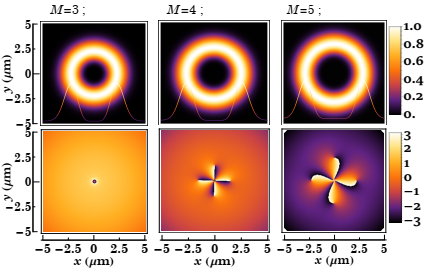
Propagation intensity and phase distribution of a Partially Coherent Lorentz–Gauss Vortex Beam in a Gradient-Index Medium
Mohammed S. Qusailah, Abdu A. Alkelly, Wafa’a A. Al-Bahry
124-133
2024-05-05
Abstract
The study focused on examining the characteristics of partially coherent Lorentz-Gauss vortex beams in a medium featuring a gradient refractive index. The study employed the ABCD matrix, deriving analytical expressions for the cross-spectral density function based on the extended Huygens-Fresnel principle and the relationship between the Hermitian Gaussian function and Lorentz distribution. The findings revealed that the topological charge, coherence length, and gradient refractive index coefficient are pivotal factors influencing the beam’s behaviour in the medium. An increase in topological charge led to an expansion of the dark spot in intensity, while the gradient refractive index plays a crucial role in altering the size and shape of the intensity periodically in the medium and does not affect the dark spot in the middle of the beam. The findings from this study hold potential for applications in remote sensing and optical communications, making them valuable for further research endeavors.
Keywords
Partially Coherent
Lorentz–Gauss Vortex Beam
Gradient-Index Medium
How to Cite This Article
Mohammed S. Qusailah, Abdu A. Alkelly, Wafa’a A. Al-Bahry (2024). Propagation intensity and phase distribution of a Partially Coherent Lorentz–Gauss Vortex Beam in a Gradient-Index Medium. Sana'a University Journal of Applied Sciences and Technology, 124-133. DOI: https://doi.org/10.59628/jast.v2i2.897
Mohammed S. Qusailah, Abdu A. Alkelly, Wafa’a A. Al-Bahry . “Propagation intensity and phase distribution of a Partially Coherent Lorentz–Gauss Vortex Beam in a Gradient-Index Medium.” Sana'a University Journal of Applied Sciences and Technology, 2024, pp. 124-133. https://doi.org/10.59628/jast.v2i2.897. Accessed 27 Oct. 2026.
Mohammed S. Qusailah, Abdu A. Alkelly, Wafa’a A. Al-Bahry . 2024. “Propagation intensity and phase distribution of a Partially Coherent Lorentz–Gauss Vortex Beam in a Gradient-Index Medium.” Sana'a University Journal of Applied Sciences and Technology : 124-133. DOI: https://doi.org/10.59628/jast.v2i2.897
Mohammed S. Qusailah, Abdu A. Alkelly, Wafa’a A. Al-Bahry (2024) ‘Propagation intensity and phase distribution of a Partially Coherent Lorentz–Gauss Vortex Beam in a Gradient-Index Medium’, Sana'a University Journal of Applied Sciences and Technology, pp. 124-133. doi: 10.59628/jast.v2i2.897
@article{jast2024_art897,
    author  = {Mohammed S. Qusailah, Abdu A. Alkelly, Wafa’a A. Al-Bahry },
    title   = {Propagation intensity and phase distribution of a Partially Coherent Lorentz–Gauss Vortex Beam in a Gradient-Index Medium},
    journal = {Sana'a University Journal of Applied Sciences and Technology},    year    = {2024},    month   = {May},    pages   = {124-133},    doi     = {10.59628/jast.v2i2.897},
    url     = {https://doi.org/10.59628/jast.v2i2.897},}
Citation copied!
Contact Authors
Propagation intensity and phase distribution of a Partially Coherent Lorentz–Gauss Vortex Beam in a Gradient-Index Medium
Email copied!
Factors Influencing the Adoption of Mobile Banking Applications in Yemen Using an Extended Technology Acceptance Model
Ibrahim Ahmed Al-Baltah, Sultan Yahya Al-Sultan, Marwa Abdulrahman Al-hadi, Ammar Thabit Zahary
134-146
2024-05-05
Abstract
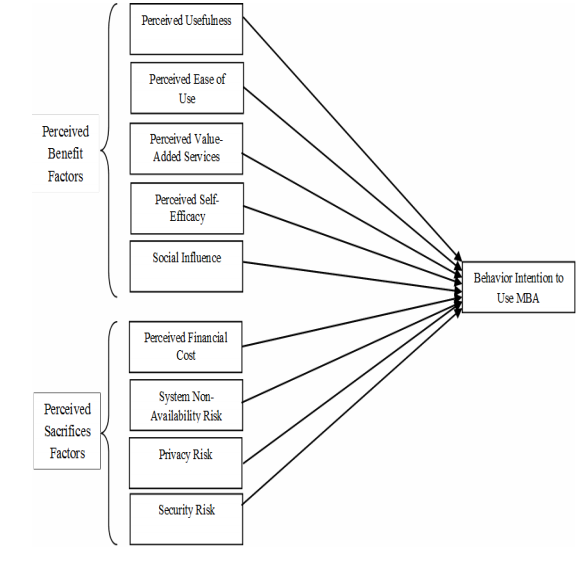
In the Yemeni environment, the adoption rate of Mobile Banking Applications (MBA) is lower than expected by banks, and there is a lack of studies that have examined MBA adoption in Yemen. The rapid development in wireless technology and the widespread use of cell phones have motivated banks to invest their budget in building Mobile Banking Applications (MBA). However, the adoption rate of MBA in Yemen falls short of banks’ expectations, and there is a scarcity of studies investigating the factors related to MBA adoption. Therefore, this study aims to extend the current understanding of MBA adoption by proposing a theoretical model to investigate the factors influencing Yemeni customers’ adoption of MBA. The proposed model extends the Technology Acceptance Model (TAM). Data were collected through a survey questionnaire completed by 473 participants. This study empirically concludes that individuals’ intention to adopt MBA is significantly and positively influencedby perceived usefulness, perceived ease of use, perceived value-added services, perceived self-efficacy, social influence, financial cost, perceived system non-availability risk, perceived privacy risk, and perceived security risk.
Keywords
Mobile Banking Applications
TAM
Perceived Benefits
Perceived Sacrifices
Behavior Intention to Use
Structured Equation Modeling (SEM)
How to Cite This Article
Ibrahim Ahmed Al-Baltah, Sultan Yahya Al-Sultan, Marwa Abdulrahman Al-hadi, Ammar Thabit Zahary (2024). Factors Influencing the Adoption of Mobile Banking Applications in Yemen Using an Extended Technology Acceptance Model. Sana'a University Journal of Applied Sciences and Technology, 134-146. DOI: https://doi.org/10.59628/jast.v2i2.890
Ibrahim Ahmed Al-Baltah, Sultan Yahya Al-Sultan, Marwa Abdulrahman Al-hadi, Ammar Thabit Zahary . “Factors Influencing the Adoption of Mobile Banking Applications in Yemen Using an Extended Technology Acceptance Model.” Sana'a University Journal of Applied Sciences and Technology, 2024, pp. 134-146. https://doi.org/10.59628/jast.v2i2.890. Accessed 27 Oct. 2026.
Ibrahim Ahmed Al-Baltah, Sultan Yahya Al-Sultan, Marwa Abdulrahman Al-hadi, Ammar Thabit Zahary . 2024. “Factors Influencing the Adoption of Mobile Banking Applications in Yemen Using an Extended Technology Acceptance Model.” Sana'a University Journal of Applied Sciences and Technology : 134-146. DOI: https://doi.org/10.59628/jast.v2i2.890
Ibrahim Ahmed Al-Baltah, Sultan Yahya Al-Sultan, Marwa Abdulrahman Al-hadi, Ammar Thabit Zahary (2024) ‘Factors Influencing the Adoption of Mobile Banking Applications in Yemen Using an Extended Technology Acceptance Model’, Sana'a University Journal of Applied Sciences and Technology, pp. 134-146. doi: 10.59628/jast.v2i2.890
@article{jast2024_art890,
    author  = {Ibrahim Ahmed Al-Baltah, Sultan Yahya Al-Sultan, Marwa Abdulrahman Al-hadi, Ammar Thabit Zahary },
    title   = {Factors Influencing the Adoption of Mobile Banking Applications in Yemen Using an Extended Technology Acceptance Model},
    journal = {Sana'a University Journal of Applied Sciences and Technology},    year    = {2024},    month   = {May},    pages   = {134-146},    doi     = {10.59628/jast.v2i2.890},
    url     = {https://doi.org/10.59628/jast.v2i2.890},}
Citation copied!
Contact Authors
Factors Influencing the Adoption of Mobile Banking Applications in Yemen Using an Extended Technology Acceptance Model
Email copied!
A Promising Smart Healthcare Monitoring Model based on Internet of Things and Deep Learning Techniques
Marwa Abdulrahman Al-Hadi, Ghaleb Hamoud Al-Gaphari, Ibrahim Ahmed Al-Baltah, Francisco Bacallao Julian
147-153
2024-05-05
Abstract
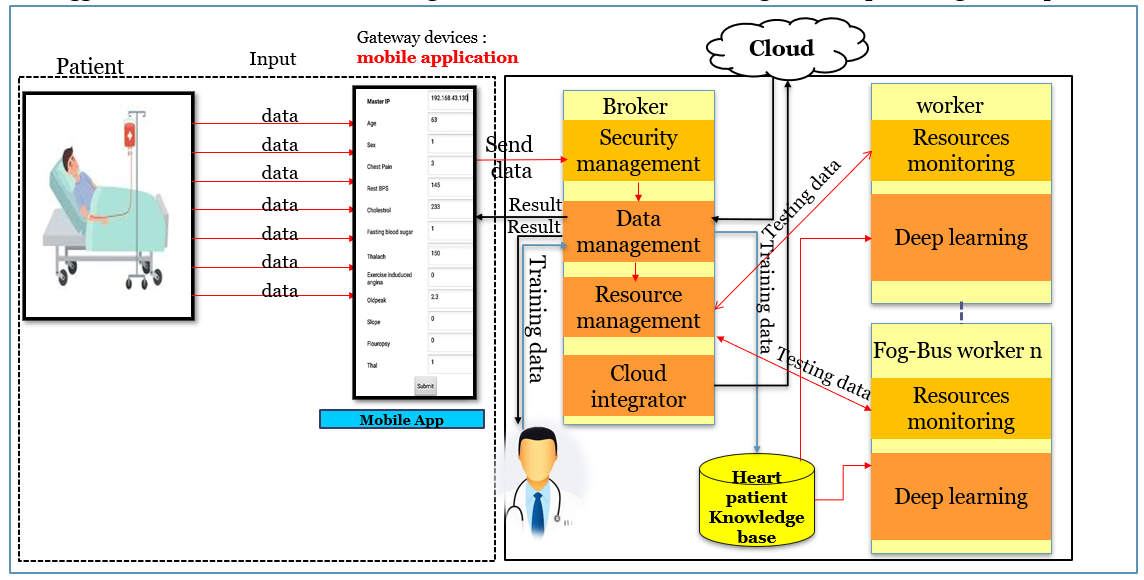
Using Internet of Things (IoT) and deep learning techniques in the healthcare sector has gained significant momentum in recent years. These technologies have the potential to transform traditional healthcare monitoring systems into real-time data collection, analysis, and decision-making capabilities. While several models have been developed to assist people with heart diseases, numerous obstacles still impede the effectiveness of the current solutions, such as power consumption, latency, accuracy, and scalability. Therefore, this study aims to develop a promising smart healthcare monitoring model that integrates IoT and deep learning techniques for saving patient lives. In addition, it clarifies the current research gap. The methodology used in this study was a literature review, which was conducted to identify relevant studies on IoT and deep learning applications in healthcare and find the gaps in each. This model consists of three main components: data acquisition through IoT devices, data processing using deep learning algorithms, and decision-making based on analyzed data. Moreover, it showed an unstable rate of accuracy in the current studies, which were taken from 2021 to 2023. In the future, our proposed smart healthcare monitoring model will solve that gap, which is already available in the current studies, and that will be proven using real-time materials such as Arduino and heart disease sensors.
Keywords
IoT
Deep learningy
Prediction
Healthcare
Smart healthcare monitoring model
How to Cite This Article
Marwa Abdulrahman Al-Hadi, Ghaleb Hamoud Al-Gaphari, Ibrahim Ahmed Al-Baltah, Francisco Bacallao Julian (2024). A Promising Smart Healthcare Monitoring Model based on Internet of Things and Deep Learning Techniques. Sana'a University Journal of Applied Sciences and Technology, 147-153. DOI: https://doi.org/10.59628/jast.v2i2.811
Marwa Abdulrahman Al-Hadi, Ghaleb Hamoud Al-Gaphari, Ibrahim Ahmed Al-Baltah, Francisco Bacallao Julian . “A Promising Smart Healthcare Monitoring Model based on Internet of Things and Deep Learning Techniques.” Sana'a University Journal of Applied Sciences and Technology, 2024, pp. 147-153. https://doi.org/10.59628/jast.v2i2.811. Accessed 27 Oct. 2026.
Marwa Abdulrahman Al-Hadi, Ghaleb Hamoud Al-Gaphari, Ibrahim Ahmed Al-Baltah, Francisco Bacallao Julian . 2024. “A Promising Smart Healthcare Monitoring Model based on Internet of Things and Deep Learning Techniques.” Sana'a University Journal of Applied Sciences and Technology : 147-153. DOI: https://doi.org/10.59628/jast.v2i2.811
Marwa Abdulrahman Al-Hadi, Ghaleb Hamoud Al-Gaphari, Ibrahim Ahmed Al-Baltah, Francisco Bacallao Julian (2024) ‘A Promising Smart Healthcare Monitoring Model based on Internet of Things and Deep Learning Techniques’, Sana'a University Journal of Applied Sciences and Technology, pp. 147-153. doi: 10.59628/jast.v2i2.811
@article{jast2024_art811,
    author  = {Marwa Abdulrahman Al-Hadi, Ghaleb Hamoud  Al-Gaphari, Ibrahim Ahmed Al-Baltah, Francisco Bacallao Julian },
    title   = {A Promising Smart Healthcare Monitoring Model based on Internet of Things and Deep Learning Techniques},
    journal = {Sana'a University Journal of Applied Sciences and Technology},    year    = {2024},    month   = {May},    pages   = {147-153},    doi     = {10.59628/jast.v2i2.811},
    url     = {https://doi.org/10.59628/jast.v2i2.811},}
Citation copied!
Contact Authors
A Promising Smart Healthcare Monitoring Model based on Internet of Things and Deep Learning Techniques
Email copied!

Antioxidant and antimicrobial of three extracts of Caralluma deflersiana Laver
Bushra M. al-attab, Maher A. Almaqtari, Ahmed Yahya Mubarak
154-157
2024-05-05
Abstract
This study focused on one traditional herb used in Yemen, Caralluma deflersiana. The antioxidant activity of the extracts was examined using the bipyridine-ferric reducing antioxidant capacity assay, as well as the antibacterial activity against S. aureus, P. aeruginosa, E. coli, and C. albicans microbial strains using the agar diffusion method. The highest antioxidant activity was observed for the ethyl acetate extract. 370 µg ASA/mg ascorbic equivalent µg ASA/mg (p< 0.05). Acetone and chloroform extracts showed decreased activity and 340 and 305 ascorbic equivalents µg ASA/mg, respectively. The three extracts inhibited the growth of the three bacterial and one fungal species, with MIC values ranging from 55.0- 80.7 µg/ml. The selected extracts may be developed to explore new pharmacological possibilities for their application.
Keywords
Caralluma deflersiana
Antioxidant
Antimicrobial
Amran
Yemen
How to Cite This Article
Bushra M. al-attab, Maher A. Almaqtari, Ahmed Yahya Mubarak (2024). Antioxidant and antimicrobial of three extracts of Caralluma deflersiana Laver. Sana'a University Journal of Applied Sciences and Technology, 154-157. DOI: https://doi.org/10.59628/jast.v2i2.862
Bushra M. al-attab, Maher A. Almaqtari, Ahmed Yahya Mubarak . “Antioxidant and antimicrobial of three extracts of Caralluma deflersiana Laver.” Sana'a University Journal of Applied Sciences and Technology, 2024, pp. 154-157. https://doi.org/10.59628/jast.v2i2.862. Accessed 27 Oct. 2026.
Bushra M. al-attab, Maher A. Almaqtari, Ahmed Yahya Mubarak . 2024. “Antioxidant and antimicrobial of three extracts of Caralluma deflersiana Laver.” Sana'a University Journal of Applied Sciences and Technology : 154-157. DOI: https://doi.org/10.59628/jast.v2i2.862
Bushra M. al-attab, Maher A. Almaqtari, Ahmed Yahya Mubarak (2024) ‘Antioxidant and antimicrobial of three extracts of Caralluma deflersiana Laver’, Sana'a University Journal of Applied Sciences and Technology, pp. 154-157. doi: 10.59628/jast.v2i2.862
@article{jast2024_art862,
    author  = {Bushra M. al-attab, Maher A. Almaqtari, Ahmed Yahya Mubarak },
    title   = {Antioxidant and antimicrobial of three extracts of Caralluma deflersiana Laver},
    journal = {Sana'a University Journal of Applied Sciences and Technology},    year    = {2024},    month   = {May},    pages   = {154-157},    doi     = {10.59628/jast.v2i2.862},
    url     = {https://doi.org/10.59628/jast.v2i2.862},}
Citation copied!
Contact Authors
Antioxidant and antimicrobial of three extracts of Caralluma deflersiana Laver
Email copied!

IP and ICN Networking in D2D_IoT Communications: A Comparative Study
Mansoor N. Ali, Ammar T. Zahary, Manal A. Areqi
158-167
2024-05-05
Abstract
Device-to-device Internet of Things (D2D_IoT) communications are promising and futuristic communications that contribute to reducing pressure on the network. Recently, the research community proposed information-centric networks (ICN) to achieve D2D_IoT communications. This paper will provide a qualitative comparison between Internet Protocol (IP) and ICN networks. The paper will compare naming, messaging, routing, caching, and security. ICN is more suitable for the D2D_IoT due to its compatibility with its design and the requirements of IoT applications, making it a promising solution for IoT networks.
Keywords
D2D
IoT
communication
IP
ICN
ICN architecture
How to Cite This Article
Mansoor N. Ali, Ammar T. Zahary, Manal A. Areqi (2024). IP and ICN Networking in D2D_IoT Communications: A Comparative Study. Sana'a University Journal of Applied Sciences and Technology, 158-167. DOI: https://doi.org/10.59628/jast.v2i2.940
Mansoor N. Ali, Ammar T. Zahary, Manal A. Areqi . “IP and ICN Networking in D2D_IoT Communications: A Comparative Study.” Sana'a University Journal of Applied Sciences and Technology, 2024, pp. 158-167. https://doi.org/10.59628/jast.v2i2.940. Accessed 27 Oct. 2026.
Mansoor N. Ali, Ammar T. Zahary, Manal A. Areqi . 2024. “IP and ICN Networking in D2D_IoT Communications: A Comparative Study.” Sana'a University Journal of Applied Sciences and Technology : 158-167. DOI: https://doi.org/10.59628/jast.v2i2.940
Mansoor N. Ali, Ammar T. Zahary, Manal A. Areqi (2024) ‘IP and ICN Networking in D2D_IoT Communications: A Comparative Study’, Sana'a University Journal of Applied Sciences and Technology, pp. 158-167. doi: 10.59628/jast.v2i2.940
@article{jast2024_art940,
    author  = {Mansoor N.  Ali, Ammar T. Zahary, Manal A. Areqi },
    title   = {IP and ICN Networking in D2D_IoT Communications: A Comparative Study},
    journal = {Sana'a University Journal of Applied Sciences and Technology},    year    = {2024},    month   = {May},    pages   = {158-167},    doi     = {10.59628/jast.v2i2.940},
    url     = {https://doi.org/10.59628/jast.v2i2.940},}
Citation copied!
Contact Authors
IP and ICN Networking in D2D_IoT Communications: A Comparative Study
Email copied!
Carbapenem-Resistant Klebsiella pneumoniae in Yemeni Patients: Prevalence, Phenotypes, and Resistance Profile to Last-Resort Antibiotics
Abdulrahman A. Humaid, Maher Ali Al-maqtari, Abdulkarim Kassem Alzomor, Anes A.M. Thabit
168-174
2024-05-05
Abstract
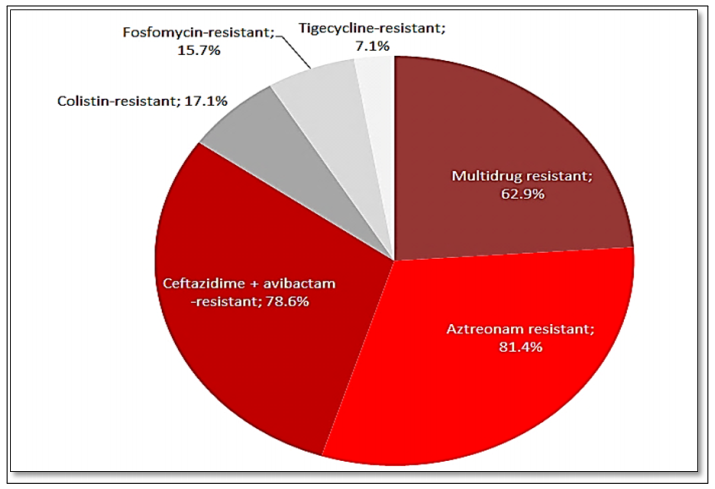
The spread of carbapenem-resistant Klebsiella pneumoniae (CRKp), which is one of the top pathogens in the WHO list of antibiotic-resistant bacteria, is a true threat to human life. This study aimed to determine the prevalence, carbapenemase phenotypes, and resistance to last-resort antibiotics of CRKp isolated from clinical specimens of inpatients and outpatients in 3 health-service facilities in Sana‘a-Yemen between December 2020 and November 2022. The carbapenemases produced by these isolates were phenotyped by mCIM and eCIM, and the susceptibility of the isolates to last-resort antibiotics was determined using the disk diffusion method. A total of 140 CRKp isolates were recovered in this study, mostly from urine specimens (35 %), from inpatients hospitalized in the gynecology ward (30%) and intensive care units (22.9 %). Differences in CRKp prevalence were insignificant between females and males and between age ranges but significant between urban and rural residents. Moreover, 75.7% of CRKp isolates were producers of metallo-β-lactamases and 81.4, 78.6 %, 17.1%, 15.7 %, and 7.1% of these isolates were resistant to aztreonam, ceftazidime+ avibactam, colistin, fosfomycin, and tigecycline, respectively. In conclusion, there is a considerable prevalence of CRKp isolates among Yemeni patients. These isolates are mostly metallo β-lactamase producers and have remarkable resistance to most lastresort antibiotics. Accordingly, there is a need to establish and employ urgent control and prevention measures to diminish the spread of CRKp and limit its emergent resistance to last-resort antibiotics in our community.
Keywords
Carbapenem-Resistant
Klebsiella Pneumoniae
Prevalence
Yemen
Metallo-β-lactamases
Last-Resort Antibiotics
How to Cite This Article
Abdulrahman A. Humaid, Maher Ali Al-maqtari, Abdulkarim Kassem Alzomor, Anes A.M. Thabit (2024). Carbapenem-Resistant Klebsiella pneumoniae in Yemeni Patients: Prevalence, Phenotypes, and Resistance Profile to Last-Resort Antibiotics. Sana'a University Journal of Applied Sciences and Technology, 168-174. DOI: https://doi.org/10.59628/jast.v2i2.838
Abdulrahman A. Humaid, Maher Ali Al-maqtari, Abdulkarim Kassem Alzomor, Anes A.M. Thabit . “Carbapenem-Resistant Klebsiella pneumoniae in Yemeni Patients: Prevalence, Phenotypes, and Resistance Profile to Last-Resort Antibiotics.” Sana'a University Journal of Applied Sciences and Technology, 2024, pp. 168-174. https://doi.org/10.59628/jast.v2i2.838. Accessed 27 Oct. 2026.
Abdulrahman A. Humaid, Maher Ali Al-maqtari, Abdulkarim Kassem Alzomor, Anes A.M. Thabit . 2024. “Carbapenem-Resistant Klebsiella pneumoniae in Yemeni Patients: Prevalence, Phenotypes, and Resistance Profile to Last-Resort Antibiotics.” Sana'a University Journal of Applied Sciences and Technology : 168-174. DOI: https://doi.org/10.59628/jast.v2i2.838
Abdulrahman A. Humaid, Maher Ali Al-maqtari, Abdulkarim Kassem Alzomor, Anes A.M. Thabit (2024) ‘Carbapenem-Resistant Klebsiella pneumoniae in Yemeni Patients: Prevalence, Phenotypes, and Resistance Profile to Last-Resort Antibiotics’, Sana'a University Journal of Applied Sciences and Technology, pp. 168-174. doi: 10.59628/jast.v2i2.838
@article{jast2024_art838,
    author  = {Abdulrahman A. Humaid, Maher Ali Al-maqtari, Abdulkarim Kassem Alzomor, Anes A.M.  Thabit },
    title   = {Carbapenem-Resistant Klebsiella pneumoniae in Yemeni Patients: Prevalence, Phenotypes, and Resistance Profile to Last-Resort Antibiotics},
    journal = {Sana'a University Journal of Applied Sciences and Technology},    year    = {2024},    month   = {May},    pages   = {168-174},    doi     = {10.59628/jast.v2i2.838},
    url     = {https://doi.org/10.59628/jast.v2i2.838},}
Citation copied!
Contact Authors
Carbapenem-Resistant Klebsiella pneumoniae in Yemeni Patients: Prevalence, Phenotypes, and Resistance Profile to Last-Resort Antibiotics
Email copied!

اختيار أولي لمواقع سدود باستخدام الاستشعار عن بُعد، نُظم المعلومات الجغرافية وعملية التحليل الهرمي في مديرية الحصين، محافظة الضالع، اليمن
Ibrahim Al-Akhaly, Badran
175-196
2024-05-05
Abstract
هدفت هذه الدراسة لاختيار مواقع محتملة لبناء السدود بمديرية الحصين، محافظة الضالع، اليمن، باستخدام الاستشعار عن ُبعد، ُنظم المعلومات الجغرافية، وعملية التحليل الهرمي. ُبنِيت قاعدة بيانات للمديرية، ارتفاعاتها تتراوح ما بين 1076و2385م، و % 35من أراضيها منبسطة. المعدل السنوي لهطول الأمطار يتراوح ما بين 227و404مم. صخورها متباينة. مواقع السدود المحتملة ُحددت ِاعتماًدا على المعايير العامة لمنظمة الفاو، المعايير الواردة في الدراسات السابقة، ومعايير مقترحة من خبراء ومختصين بهذا المجال، ُحللِت تِلك المعايير إحصائًيا واُعتمدت سبعة منها، ُعملت خرائط للمعايير المختارة، ثم أُعيد تصنيفها بنا ًء على درجة الملائمة المكانية كمواقع لسدود محتملة بمقياس ُموَّحد، بعد دمج طبقات كل المعايير المعاد تصنيفها والمضروبة بأوزانها النسبية توصلنا لخريطة ملاءمة مكانية لمواقع السدود المحتملة ُوصَّنفَت لخمس فئات؛ وتَبين أن %0.14من مساحة المديرية عالية الملائمة، و %31.72 ملائِمة، %62.30متوسطة الملائمة، و %5.71ضعيفة الملائمة، و %0.13 غير ملائِمة. نوصي بالمواقع عالية الملائمة الواقعة في سيلة أوفينة، وادي الذحلة، وشكع.
.
Keywords
التحليل الهرمي
السدود
نُظم المعلومات الجغرافية
الاستشعار عن بُعد
اليمن
How to Cite This Article
Ibrahim Al-Akhaly, Badran (2024). اختيار أولي لمواقع سدود باستخدام الاستشعار عن بُعد، نُظم المعلومات الجغرافية وعملية التحليل الهرمي في مديرية الحصين، محافظة الضالع، اليمن. Sana'a University Journal of Applied Sciences and Technology, 175-196. DOI: https://doi.org/10.59628/jast.v2i2.886
Ibrahim Al-Akhaly, Badran . “اختيار أولي لمواقع سدود باستخدام الاستشعار عن بُعد، نُظم المعلومات الجغرافية وعملية التحليل الهرمي في مديرية الحصين، محافظة الضالع، اليمن.” Sana'a University Journal of Applied Sciences and Technology, 2024, pp. 175-196. https://doi.org/10.59628/jast.v2i2.886. Accessed 27 Oct. 2026.
Ibrahim Al-Akhaly, Badran . 2024. “اختيار أولي لمواقع سدود باستخدام الاستشعار عن بُعد، نُظم المعلومات الجغرافية وعملية التحليل الهرمي في مديرية الحصين، محافظة الضالع، اليمن.” Sana'a University Journal of Applied Sciences and Technology : 175-196. DOI: https://doi.org/10.59628/jast.v2i2.886
Ibrahim Al-Akhaly, Badran (2024) ‘اختيار أولي لمواقع سدود باستخدام الاستشعار عن بُعد، نُظم المعلومات الجغرافية وعملية التحليل الهرمي في مديرية الحصين، محافظة الضالع، اليمن’, Sana'a University Journal of Applied Sciences and Technology, pp. 175-196. doi: 10.59628/jast.v2i2.886
@article{jast2024_art886,
    author  = {Ibrahim Al-Akhaly, Badran },
    title   = {اختيار أولي لمواقع سدود باستخدام الاستشعار عن بُعد، نُظم المعلومات الجغرافية وعملية التحليل الهرمي في مديرية الحصين، محافظة الضالع، اليمن},
    journal = {Sana'a University Journal of Applied Sciences and Technology},    year    = {2024},    month   = {May},    pages   = {175-196},    doi     = {10.59628/jast.v2i2.886},
    url     = {https://doi.org/10.59628/jast.v2i2.886},}
Citation copied!
Contact Authors
اختيار أولي لمواقع سدود باستخدام الاستشعار عن بُعد، نُظم المعلومات الجغرافية وعملية التحليل الهرمي في مديرية الحصين، محافظة الضالع، اليمن
Email copied!

Intensity distribution of the partially coherent Gaussian Schell vortex beam diffracted by classical axicon
Shukri A. M. kaid, Hatim O. Al-Nadary, Mohammad S. Qusailah , Abdu A. Alkelly
197-204
2024-05-05
Abstract
Based on the mathematical framework of the partially coherent Gaussian Schell model vortex (PCGSMV) beam and the Huygens-Fresnel integral, we conducted a study to analyze the intensity distribution and depth of focus (DOF) of the PCGSMV beam as it propagates through a classical axicon. Our numerical results indicate the influence of factors such as the beam width, spatial degree of coherence, topological charge, and axicon base angle on the intensity distribution and DOF. In addition, we investigated the relationship between the beam spot size and propagation distance, as well as the effects of the spatial degree of coherence and propagation distance on the intensity profile. Our findings highlight the importance of the intensity values along the DOF for various applications, including the optical trapping and manipulation of micro-particles.
Keywords
Gaussian Schell model
vortex beam
Huygens-Fresnel integral
depth of focus
classical axicon
How to Cite This Article
Shukri A. M. kaid, Hatim O. Al-Nadary, Mohammad S. Qusailah , Abdu A. Alkelly (2024). Intensity distribution of the partially coherent Gaussian Schell vortex beam diffracted by classical axicon. Sana'a University Journal of Applied Sciences and Technology, 197-204. DOI: https://doi.org/10.59628/jast.v2i2.899
Shukri A. M. kaid, Hatim O. Al-Nadary, Mohammad S. Qusailah , Abdu A. Alkelly . “Intensity distribution of the partially coherent Gaussian Schell vortex beam diffracted by classical axicon.” Sana'a University Journal of Applied Sciences and Technology, 2024, pp. 197-204. https://doi.org/10.59628/jast.v2i2.899. Accessed 27 Oct. 2026.
Shukri A. M. kaid, Hatim O. Al-Nadary, Mohammad S. Qusailah , Abdu A. Alkelly . 2024. “Intensity distribution of the partially coherent Gaussian Schell vortex beam diffracted by classical axicon.” Sana'a University Journal of Applied Sciences and Technology : 197-204. DOI: https://doi.org/10.59628/jast.v2i2.899
Shukri A. M. kaid, Hatim O. Al-Nadary, Mohammad S. Qusailah , Abdu A. Alkelly (2024) ‘Intensity distribution of the partially coherent Gaussian Schell vortex beam diffracted by classical axicon’, Sana'a University Journal of Applied Sciences and Technology, pp. 197-204. doi: 10.59628/jast.v2i2.899
@article{jast2024_art899,
    author  = {Shukri A. M. kaid, Hatim  O. Al-Nadary, Mohammad S.  Qusailah , Abdu A. Alkelly  },
    title   = {Intensity distribution of the partially coherent Gaussian Schell vortex beam diffracted by classical axicon},
    journal = {Sana'a University Journal of Applied Sciences and Technology},    year    = {2024},    month   = {May},    pages   = {197-204},    doi     = {10.59628/jast.v2i2.899},
    url     = {https://doi.org/10.59628/jast.v2i2.899},}
Citation copied!
Contact Authors
Intensity distribution of the partially coherent Gaussian Schell vortex beam diffracted by classical axicon
Email copied!

Axiomatic of Neutrosophic Groups
Adel Mohammed Al-Odhari
205-214
2024-05-05
Abstract
The aim of this article is to; present a neutrosophic group according to axioms such as classical group theory and the neutrosophic set, and to study some properties and theorems related to the neutrosophic group. The new concept of the neutrosophic set is a new approach that is suitable for mathematical problems related to philosophical concepts, such as uncertainty and indeterminacy, in which human knowledge and human evaluation are necessary. Neutrosophic algebra is a branch of neutrosophic set theory, and in 2004, Kandasamy and Smarandache introduced basic neutrosophic algebraic structures and their applications to fuzzy and neutrosophic models; in 2006, Kandasamy and Smarandache presented neutrosophic algebraic structures and neutrosophic N-algebraic structures; in 2019, Smarandache introduced new fields of research in Neutrosophy, which he called Neutro-Structures and Anti-Structures. In 2020, Agboola presented an Introduction to the neutrosophic group by a different presentation.
Keywords
Neutrosophic Groups
Netrosohic Integer Group of Modulation
Properties of Neutrosophic Groups
How to Cite This Article
Adel Mohammed Al-Odhari (2024). Axiomatic of Neutrosophic Groups. Sana'a University Journal of Applied Sciences and Technology, 205-214. DOI: https://doi.org/10.59628/jast.v2i2.793
Adel Mohammed Al-Odhari . “Axiomatic of Neutrosophic Groups.” Sana'a University Journal of Applied Sciences and Technology, 2024, pp. 205-214. https://doi.org/10.59628/jast.v2i2.793. Accessed 27 Oct. 2026.
Adel Mohammed Al-Odhari . 2024. “Axiomatic of Neutrosophic Groups.” Sana'a University Journal of Applied Sciences and Technology : 205-214. DOI: https://doi.org/10.59628/jast.v2i2.793
Adel Mohammed Al-Odhari (2024) ‘Axiomatic of Neutrosophic Groups’, Sana'a University Journal of Applied Sciences and Technology, pp. 205-214. doi: 10.59628/jast.v2i2.793
@article{jast2024_art793,
    author  = {Adel Mohammed Al-Odhari  },
    title   = {Axiomatic of Neutrosophic Groups},
    journal = {Sana'a University Journal of Applied Sciences and Technology},    year    = {2024},    month   = {May},    pages   = {205-214},    doi     = {10.59628/jast.v2i2.793},
    url     = {https://doi.org/10.59628/jast.v2i2.793},}
Citation copied!
Contact Authors
Axiomatic of Neutrosophic Groups
Email copied!
