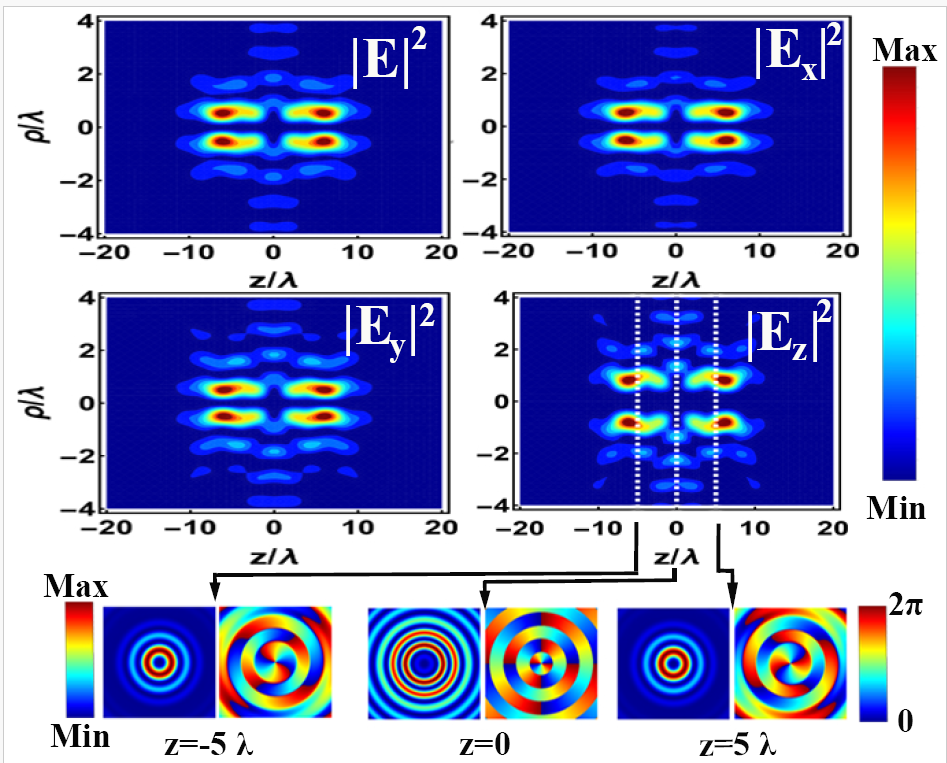
The focus shaping of light beams is crucial for a range of optical applications, including trapping, imaging, and material processing. In this work, based on the vector diffraction theory, the focus shaping of a circularly polarized Laguerre–Gaussian vortex beam by a binary axicon was investigated. By analyzing the effects of beam parameters such as order p, topological charge m, truncation parameter β, and optical system characteristics including obstruction δ and NA, this study demonstrates how these factors influence the focal intensity distribution. By appropriately choosing specific parameters, different focal shapes, such as multifoci and double spots, were formed in the focal region of the binary axicon. The findings underscore the potential of binary axicons as versatile tools for advanced focus engineering in optical trapping and particle manipulation.
Hassan T. Al-Ahsab, Mingjian Cheng, Ibrahim G. H. Loqman, Shukri Kaid, Abdu A. Alkelly (2025). Enhanced Focus Shaping of Circularly Polarized Laguerre–Gaussian Vortex Beams Using a Binary Axicon. Sana'a University Journal of Applied Sciences and Technology, 885- 890. DOI: https://doi.org/10.59628/jast.v3i3.1761
Hassan T. Al-Ahsab, Mingjian Cheng, Ibrahim G. H. Loqman, Shukri Kaid, Abdu A. Alkelly . “Enhanced Focus Shaping of Circularly Polarized Laguerre–Gaussian Vortex Beams Using a Binary Axicon.” Sana'a University Journal of Applied Sciences and Technology, 2025, pp. 885- 890. https://doi.org/10.59628/jast.v3i3.1761. Accessed 31 Oct. 2026.
Hassan T. Al-Ahsab, Mingjian Cheng, Ibrahim G. H. Loqman, Shukri Kaid, Abdu A. Alkelly . 2025. “Enhanced Focus Shaping of Circularly Polarized Laguerre–Gaussian Vortex Beams Using a Binary Axicon.” Sana'a University Journal of Applied Sciences and Technology : 885- 890. DOI: https://doi.org/10.59628/jast.v3i3.1761
Hassan T. Al-Ahsab, Mingjian Cheng, Ibrahim G. H. Loqman, Shukri Kaid, Abdu A. Alkelly (2025) ‘Enhanced Focus Shaping of Circularly Polarized Laguerre–Gaussian Vortex Beams Using a Binary Axicon’, Sana'a University Journal of Applied Sciences and Technology, pp. 885- 890. doi: 10.59628/jast.v3i3.1761
@article{jast2025_art1761,
    author  = {Hassan T. Al-Ahsab, Mingjian Cheng, Ibrahim G. H. Loqman, Shukri Kaid, Abdu A. Alkelly },
    title   = {Enhanced Focus Shaping of Circularly Polarized Laguerre–Gaussian Vortex Beams Using a Binary Axicon},
    journal = {Sana'a University Journal of Applied Sciences and Technology},    year    = {2025},    month   = {June},    pages   = {885- 890},    doi     = {10.59628/jast.v3i3.1761},
    url     = {https://doi.org/10.59628/jast.v3i3.1761},}
Enhanced Focus Shaping of Circularly Polarized Laguerre–Gaussian Vortex Beams Using a Binary Axicon

Based on the mathematical framework of the partially coherent Gaussian Schell model vortex (PCGSMV) beam and the Huygens-Fresnel integral, we conducted a study to analyze the intensity distribution and depth of focus (DOF) of the PCGSMV beam as it propagates through a classical axicon. Our numerical results indicate the influence of factors such as the beam width, spatial degree of coherence, topological charge, and axicon base angle on the intensity distribution and DOF. In addition, we investigated the relationship between the beam spot size and propagation distance, as well as the effects of the spatial degree of coherence and propagation distance on the intensity profile. Our findings highlight the importance of the intensity values along the DOF for various applications, including the optical trapping and manipulation of micro-particles.
Shukri A. M. kaid, Hatim O. Al-Nadary, Mohammad S. Qusailah , Abdu A. Alkelly (2024). Intensity distribution of the partially coherent Gaussian Schell vortex beam diffracted by classical axicon. Sana'a University Journal of Applied Sciences and Technology, 197-204. DOI: https://doi.org/10.59628/jast.v2i2.899
Shukri A. M. kaid, Hatim O. Al-Nadary, Mohammad S. Qusailah , Abdu A. Alkelly . “Intensity distribution of the partially coherent Gaussian Schell vortex beam diffracted by classical axicon.” Sana'a University Journal of Applied Sciences and Technology, 2024, pp. 197-204. https://doi.org/10.59628/jast.v2i2.899. Accessed 31 Oct. 2026.
Shukri A. M. kaid, Hatim O. Al-Nadary, Mohammad S. Qusailah , Abdu A. Alkelly . 2024. “Intensity distribution of the partially coherent Gaussian Schell vortex beam diffracted by classical axicon.” Sana'a University Journal of Applied Sciences and Technology : 197-204. DOI: https://doi.org/10.59628/jast.v2i2.899
Shukri A. M. kaid, Hatim O. Al-Nadary, Mohammad S. Qusailah , Abdu A. Alkelly (2024) ‘Intensity distribution of the partially coherent Gaussian Schell vortex beam diffracted by classical axicon’, Sana'a University Journal of Applied Sciences and Technology, pp. 197-204. doi: 10.59628/jast.v2i2.899
@article{jast2024_art899,
    author  = {Shukri A. M. kaid, Hatim  O. Al-Nadary, Mohammad S.  Qusailah , Abdu A. Alkelly  },
    title   = {Intensity distribution of the partially coherent Gaussian Schell vortex beam diffracted by classical axicon},
    journal = {Sana'a University Journal of Applied Sciences and Technology},    year    = {2024},    month   = {May},    pages   = {197-204},    doi     = {10.59628/jast.v2i2.899},
    url     = {https://doi.org/10.59628/jast.v2i2.899},}
Intensity distribution of the partially coherent Gaussian Schell vortex beam diffracted by classical axicon

Theoretically, this study investigates the optical forces induced by a pulsed LG0l modes on nano-dielectric spheres with low and high refractive indices. We analyze how trapping efficiency depends on the particle’s refractive index and the beam’s azimuthal mode in terms of force magnitude, effective trapping region, and the number of trapping zones. The theoretical model considers dielectric spheres immersed in an oil medium and irradiated by the beam. The results demonstrate that a pulsed LG0l beam achieves higher and more stable trapping efficiency for small azimuthal mode values, short pulse duration, and particles with high refractive indices. Theoretical analysis suggests that the LG0l mode enables 2D trapping of particles with bottle-beam-like control.
G. A. Alakhaly, F. M. Thabit, M. A. Shukri (2025). Optical Forces Induced by a Pulsed LG0l modes on a Nano-Dielectric Spheres. Sana'a University Journal of Applied Sciences and Technology, 1222-1228. DOI: https://doi.org/10.59628/jast.v3i5.2226
G. A. Alakhaly, F. M. Thabit, M. A. Shukri . “Optical Forces Induced by a Pulsed LG0l modes on a Nano-Dielectric Spheres.” Sana'a University Journal of Applied Sciences and Technology, 2025, pp. 1222-1228. https://doi.org/10.59628/jast.v3i5.2226. Accessed 31 Oct. 2026.
G. A. Alakhaly, F. M. Thabit, M. A. Shukri . 2025. “Optical Forces Induced by a Pulsed LG0l modes on a Nano-Dielectric Spheres.” Sana'a University Journal of Applied Sciences and Technology : 1222-1228. DOI: https://doi.org/10.59628/jast.v3i5.2226
G. A. Alakhaly, F. M. Thabit, M. A. Shukri (2025) ‘Optical Forces Induced by a Pulsed LG0l modes on a Nano-Dielectric Spheres’, Sana'a University Journal of Applied Sciences and Technology, pp. 1222-1228. doi: 10.59628/jast.v3i5.2226
@article{jast2025_art2226,
    author  = {G. A. Alakhaly, F. M. Thabit, M. A.  Shukri  },
    title   = {Optical Forces Induced by a Pulsed LG0l modes on a Nano-Dielectric Spheres},
    journal = {Sana'a University Journal of Applied Sciences and Technology},    year    = {2025},    month   = {October},    pages   = {1222-1228},    doi     = {10.59628/jast.v3i5.2226},
    url     = {https://doi.org/10.59628/jast.v3i5.2226},}
Optical Forces Induced by a Pulsed LG0l modes on a Nano-Dielectric Spheres

This study examined the propagation characteristics of partially coherent pin-like optical (PCPO) vortex beams carrying orbital angular momentum (OAM) within turbulent biological tissues. The objective of this study was to assess the potential of these nanoparticles for deep-tissue optical communication and imaging. By incorporating the biological tissue turbulence spectrum into the analytical framework, we extended the established analytical expressions that describe the evolution of the OAM mode spectrum, spiral spectrum, and channel capacity of PCPO beams in inhomogeneous biological media, which were modeled using fractal-based turbulence power spectra. Numerical simulations were conducted for several representative tissues, including the upper dermis, deep dermis, liver parenchyma, and intestinal epithelium, to assess the impact of tissue heterogeneity parameters, spatial coherence length, and topological charge on beam stability. The findings indicate that the probability of OAM detection diminishes with propagation distance and increasing topological charge, whereas a greater spatial coherence length and larger characteristic heterogeneity length enhance the channel capacity. Biological tissues with higher fractal dimensions and lower correlation lengths exhibit more pronounced turbulence-induced degradation. When the coherence length exceeds approximately 10 μm, the detection probability becomes nearly invariant with distance, suggesting a regime of enhanced robustness. These results provide quantitative insights into the feasibility and limitations of employing partially coherent OAM beams for optical information transfer in biological tissues and offer theoretical guidance for designing OAM-based biomedical photonic systems.
Wafa’a A.Al-Bahry, Hassan T. Al-Ahsab, Mohammed S. Qusailah, Abdu A. Alkelly (2026). Propagation Characteristics of Partially Coherent Pin-Like Vortex Beams in Turbulent Biological tissues. Sana'a University Journal of Applied Sciences and Technology, 2424-2435. DOI: https://doi.org/10.59628/jast.v4i7.3263
Wafa’a A.Al-Bahry, Hassan T. Al-Ahsab, Mohammed S. Qusailah, Abdu A. Alkelly . “Propagation Characteristics of Partially Coherent Pin-Like Vortex Beams in Turbulent Biological tissues.” Sana'a University Journal of Applied Sciences and Technology, 2026, pp. 2424-2435. https://doi.org/10.59628/jast.v4i7.3263. Accessed 31 Oct. 2026.
Wafa’a A.Al-Bahry, Hassan T. Al-Ahsab, Mohammed S. Qusailah, Abdu A. Alkelly . 2026. “Propagation Characteristics of Partially Coherent Pin-Like Vortex Beams in Turbulent Biological tissues.” Sana'a University Journal of Applied Sciences and Technology : 2424-2435. DOI: https://doi.org/10.59628/jast.v4i7.3263
Wafa’a A.Al-Bahry, Hassan T. Al-Ahsab, Mohammed S. Qusailah, Abdu A. Alkelly (2026) ‘Propagation Characteristics of Partially Coherent Pin-Like Vortex Beams in Turbulent Biological tissues’, Sana'a University Journal of Applied Sciences and Technology, pp. 2424-2435. doi: 10.59628/jast.v4i7.3263
@article{jast2026_art3263,
    author  = {Wafa’a A.Al-Bahry, Hassan T. Al-Ahsab, Mohammed S. Qusailah, Abdu A. Alkelly },
    title   = {Propagation Characteristics of Partially Coherent Pin-Like Vortex Beams in Turbulent Biological tissues},
    journal = {Sana'a University Journal of Applied Sciences and Technology},    year    = {2026},    month   = {July},    pages   = {2424-2435},    doi     = {10.59628/jast.v4i7.3263},
    url     = {https://doi.org/10.59628/jast.v4i7.3263},}
Propagation Characteristics of Partially Coherent Pin-Like Vortex Beams in Turbulent Biological tissues
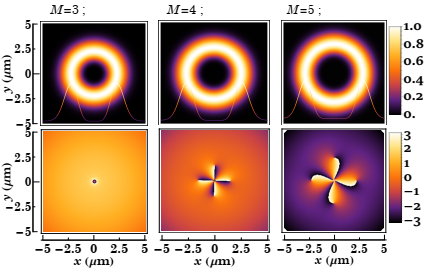
The study focused on examining the characteristics of partially coherent Lorentz-Gauss vortex beams in a medium featuring a gradient refractive index. The study employed the ABCD matrix, deriving analytical expressions for the cross-spectral density function based on the extended Huygens-Fresnel principle and the relationship between the Hermitian Gaussian function and Lorentz distribution. The findings revealed that the topological charge, coherence length, and gradient refractive index coefficient are pivotal factors influencing the beam’s behaviour in the medium. An increase in topological charge led to an expansion of the dark spot in intensity, while the gradient refractive index plays a crucial role in altering the size and shape of the intensity periodically in the medium and does not affect the dark spot in the middle of the beam. The findings from this study hold potential for applications in remote sensing and optical communications, making them valuable for further research endeavors.
Mohammed S. Qusailah, Abdu A. Alkelly, Wafa’a A. Al-Bahry (2024). Propagation intensity and phase distribution of a Partially Coherent Lorentz–Gauss Vortex Beam in a Gradient-Index Medium. Sana'a University Journal of Applied Sciences and Technology, 124-133. DOI: https://doi.org/10.59628/jast.v2i2.897
Mohammed S. Qusailah, Abdu A. Alkelly, Wafa’a A. Al-Bahry . “Propagation intensity and phase distribution of a Partially Coherent Lorentz–Gauss Vortex Beam in a Gradient-Index Medium.” Sana'a University Journal of Applied Sciences and Technology, 2024, pp. 124-133. https://doi.org/10.59628/jast.v2i2.897. Accessed 31 Oct. 2026.
Mohammed S. Qusailah, Abdu A. Alkelly, Wafa’a A. Al-Bahry . 2024. “Propagation intensity and phase distribution of a Partially Coherent Lorentz–Gauss Vortex Beam in a Gradient-Index Medium.” Sana'a University Journal of Applied Sciences and Technology : 124-133. DOI: https://doi.org/10.59628/jast.v2i2.897
Mohammed S. Qusailah, Abdu A. Alkelly, Wafa’a A. Al-Bahry (2024) ‘Propagation intensity and phase distribution of a Partially Coherent Lorentz–Gauss Vortex Beam in a Gradient-Index Medium’, Sana'a University Journal of Applied Sciences and Technology, pp. 124-133. doi: 10.59628/jast.v2i2.897
@article{jast2024_art897,
    author  = {Mohammed S. Qusailah, Abdu A. Alkelly, Wafa’a A. Al-Bahry },
    title   = {Propagation intensity and phase distribution of a Partially Coherent Lorentz–Gauss Vortex Beam in a Gradient-Index Medium},
    journal = {Sana'a University Journal of Applied Sciences and Technology},    year    = {2024},    month   = {May},    pages   = {124-133},    doi     = {10.59628/jast.v2i2.897},
    url     = {https://doi.org/10.59628/jast.v2i2.897},}
Propagation intensity and phase distribution of a Partially Coherent Lorentz–Gauss Vortex Beam in a Gradient-Index Medium
Nothing has been published in this category yet.

Sana'a University Journal
of Applied Sciences and Technology
A peer-reviewed, open-access journal publishing high-quality research in applied sciences, engineering, and technology since 2023.
