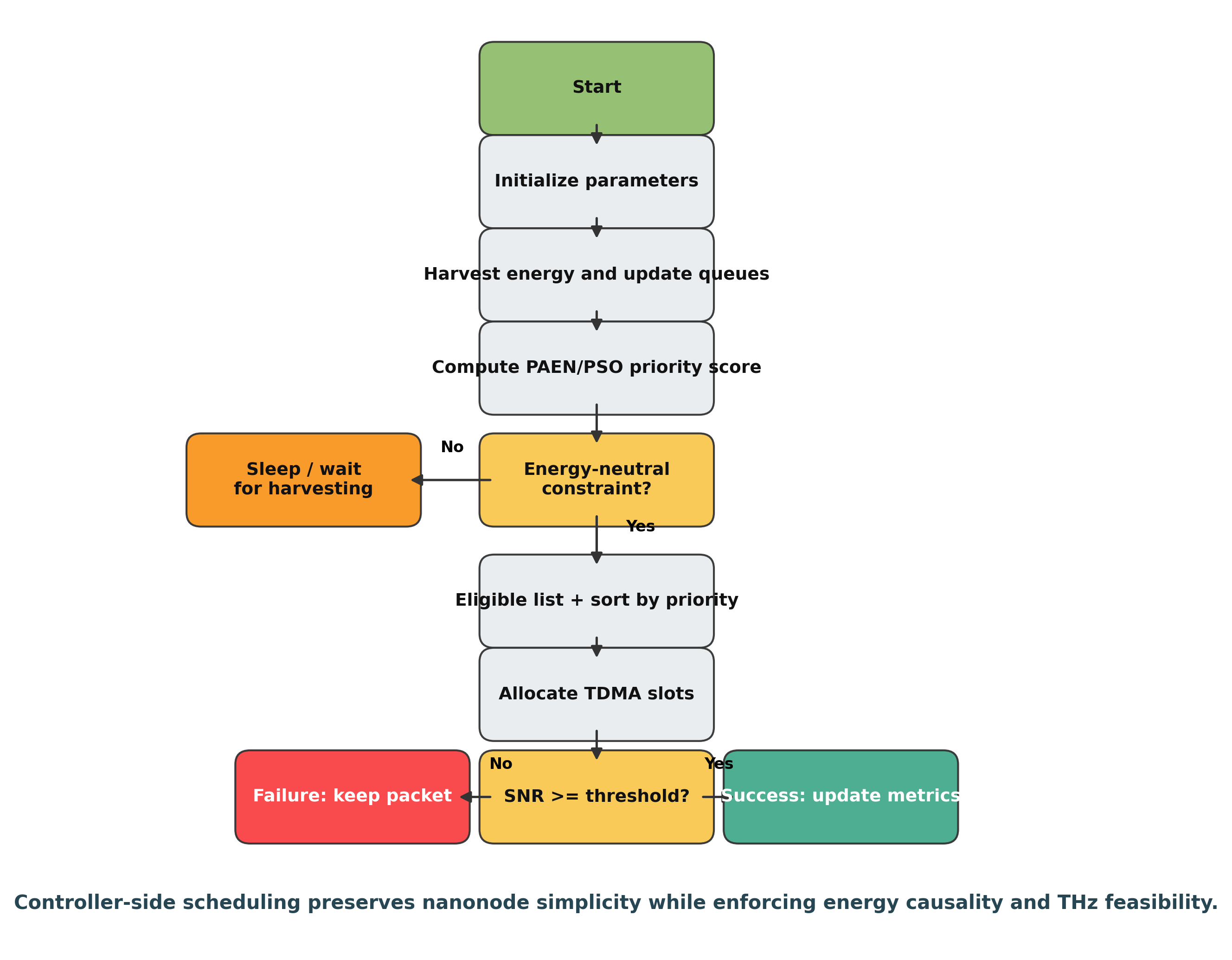
Energy-harvested Internet of Nano Things (IoHNT) systems can enable self-sustainable nanoscale sensing in biomedical monitoring, environmental surveillance, smart materials, and industrial nano-inspection. However, nanodevices have extremely limited energy buffers, and terahertz (THz) nanocommunication is strongly affected by distance-dependent spreading loss and molecular absorption. These coupled restrictions require medium access control decisions that jointly consider energy availability, traffic state, packet urgency, and THz link quality. This paper presents a revised and strengthened cross-layer energy-neutral communication framework for harvested-energy IoNT over THz nanonetworks. The baseline Priority-Aware Energy-Neutral TDMA () protocol ranks nanonodes using residual energy, queue backlog, packet age, and THz distance while allowing transmission only when the energy-neutrality constraint is satisfied. To address the dependence on manually selected priority weights, a Particle Swarm Optimization (PSO)-based extension, named , is introduced to optimize the scheduling weights under high-traffic and low-harvesting conditions. MATLAB simulations with 30 independent runs and 95% confidence intervals compare random access, conventional TDMA, CEH-TDMA-like scheduling, fixed , adaptive , and . The revised validation adds percentage improvement, Welch statistical significance testing, standardized effect-size interpretation, runtime-complexity comparison, and dense network scalability up to 400 nanonodes. Results show that improves throughput, PDR, delay, energy efficiency, and outage probability compared with fixed , including 14.25% delay reduction and 25.93% outage reduction. The optimized weights emphasize residual energy and THz distance, confirming that energy feasibility and channel quality are the main scheduling drivers in severely constrained IoHNT systems.