Data mining
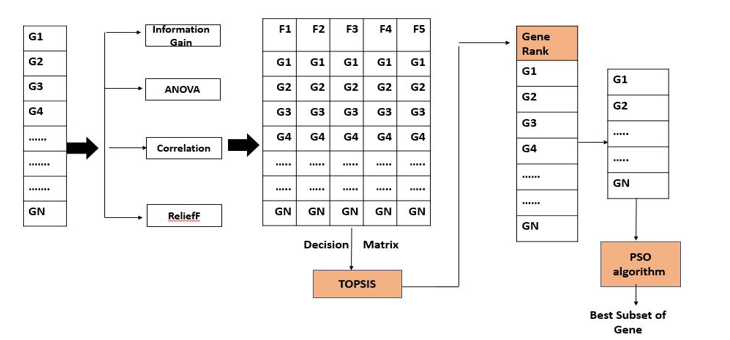
Microarray technology produces data with a large number of dimensions. The abundance of dimensions in the data makes it challenging for machine learning algorithms to extract meaningful information from it. To overcome this limitation, feature selection (FS) techniques can be applied to reduce the dimensionality of the data. FS is a crucial preprocessing step that allows for the handling of high-dimensional data and facilitates more effective and efficient processing. The primary objective of this paper is to develop an efficient FS method that can effectively reduce the dimensionality of microarray data. The Technique for Order Preference by Similarity to Ideal Solution (TOPSIS) is utilized in the first filtering stage to extract informative features. The best feature subset is then determined by using a Particle Swarm Optimization (PSO) algorithm as a wrapper feature selector to identify ideal features. The proposed approach is evaluated using microarray datasets from the Alzheimer’s Disease Neuroimaging Initiative (ADNI) and compared with other algorithms. The experimental findings indicate that the proposed approach outperforms the benchmark methods in terms of classification accuracy.
Heba Al.Marwai, Ghaleb H AL-Gaphari (2024). A hybrid Feature Selection Method Based on Binary PSO Algorithm for Microarray Data Classification. Sana'a University Journal of Applied Sciences and Technology, 375-380. DOI: https://doi.org/10.59628/jast.v2i4.1023
Heba Al.Marwai, Ghaleb H AL-Gaphari . “A hybrid Feature Selection Method Based on Binary PSO Algorithm for Microarray Data Classification.” Sana'a University Journal of Applied Sciences and Technology, 2024, pp. 375-380. https://doi.org/10.59628/jast.v2i4.1023. Accessed 31 Oct. 2026.
Heba Al.Marwai, Ghaleb H AL-Gaphari . 2024. “A hybrid Feature Selection Method Based on Binary PSO Algorithm for Microarray Data Classification.” Sana'a University Journal of Applied Sciences and Technology : 375-380. DOI: https://doi.org/10.59628/jast.v2i4.1023
Heba Al.Marwai, Ghaleb H AL-Gaphari (2024) ‘A hybrid Feature Selection Method Based on Binary PSO Algorithm for Microarray Data Classification’, Sana'a University Journal of Applied Sciences and Technology, pp. 375-380. doi: 10.59628/jast.v2i4.1023
@article{jast2024_art1023,
    author  = {Heba Al.Marwai, Ghaleb H AL-Gaphari },
    title   = {A hybrid Feature Selection Method Based on Binary PSO Algorithm for Microarray Data Classification},
    journal = {Sana'a University Journal of Applied Sciences and Technology},    year    = {2024},    month   = {September},    pages   = {375-380},    doi     = {10.59628/jast.v2i4.1023},
    url     = {https://doi.org/10.59628/jast.v2i4.1023},}
A hybrid Feature Selection Method Based on Binary PSO Algorithm for Microarray Data Classification
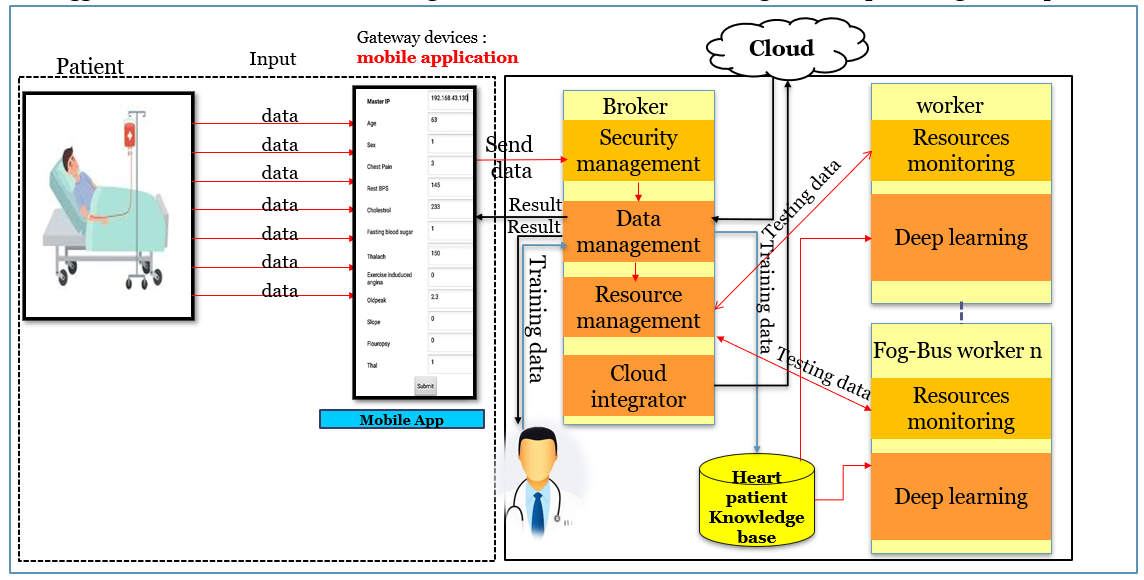
Using Internet of Things (IoT) and deep learning techniques in the healthcare sector has gained significant momentum in recent years. These technologies have the potential to transform traditional healthcare monitoring systems into real-time data collection, analysis, and decision-making capabilities. While several models have been developed to assist people with heart diseases, numerous obstacles still impede the effectiveness of the current solutions, such as power consumption, latency, accuracy, and scalability. Therefore, this study aims to develop a promising smart healthcare monitoring model that integrates IoT and deep learning techniques for saving patient lives. In addition, it clarifies the current research gap. The methodology used in this study was a literature review, which was conducted to identify relevant studies on IoT and deep learning applications in healthcare and find the gaps in each. This model consists of three main components: data acquisition through IoT devices, data processing using deep learning algorithms, and decision-making based on analyzed data. Moreover, it showed an unstable rate of accuracy in the current studies, which were taken from 2021 to 2023. In the future, our proposed smart healthcare monitoring model will solve that gap, which is already available in the current studies, and that will be proven using real-time materials such as Arduino and heart disease sensors.
Marwa Abdulrahman Al-Hadi, Ghaleb Hamoud Al-Gaphari, Ibrahim Ahmed Al-Baltah, Francisco Bacallao Julian (2024). A Promising Smart Healthcare Monitoring Model based on Internet of Things and Deep Learning Techniques. Sana'a University Journal of Applied Sciences and Technology, 147-153. DOI: https://doi.org/10.59628/jast.v2i2.811
Marwa Abdulrahman Al-Hadi, Ghaleb Hamoud Al-Gaphari, Ibrahim Ahmed Al-Baltah, Francisco Bacallao Julian . “A Promising Smart Healthcare Monitoring Model based on Internet of Things and Deep Learning Techniques.” Sana'a University Journal of Applied Sciences and Technology, 2024, pp. 147-153. https://doi.org/10.59628/jast.v2i2.811. Accessed 31 Oct. 2026.
Marwa Abdulrahman Al-Hadi, Ghaleb Hamoud Al-Gaphari, Ibrahim Ahmed Al-Baltah, Francisco Bacallao Julian . 2024. “A Promising Smart Healthcare Monitoring Model based on Internet of Things and Deep Learning Techniques.” Sana'a University Journal of Applied Sciences and Technology : 147-153. DOI: https://doi.org/10.59628/jast.v2i2.811
Marwa Abdulrahman Al-Hadi, Ghaleb Hamoud Al-Gaphari, Ibrahim Ahmed Al-Baltah, Francisco Bacallao Julian (2024) ‘A Promising Smart Healthcare Monitoring Model based on Internet of Things and Deep Learning Techniques’, Sana'a University Journal of Applied Sciences and Technology, pp. 147-153. doi: 10.59628/jast.v2i2.811
@article{jast2024_art811,
    author  = {Marwa Abdulrahman Al-Hadi, Ghaleb Hamoud  Al-Gaphari, Ibrahim Ahmed Al-Baltah, Francisco Bacallao Julian },
    title   = {A Promising Smart Healthcare Monitoring Model based on Internet of Things and Deep Learning Techniques},
    journal = {Sana'a University Journal of Applied Sciences and Technology},    year    = {2024},    month   = {May},    pages   = {147-153},    doi     = {10.59628/jast.v2i2.811},
    url     = {https://doi.org/10.59628/jast.v2i2.811},}
A Promising Smart Healthcare Monitoring Model based on Internet of Things and Deep Learning Techniques
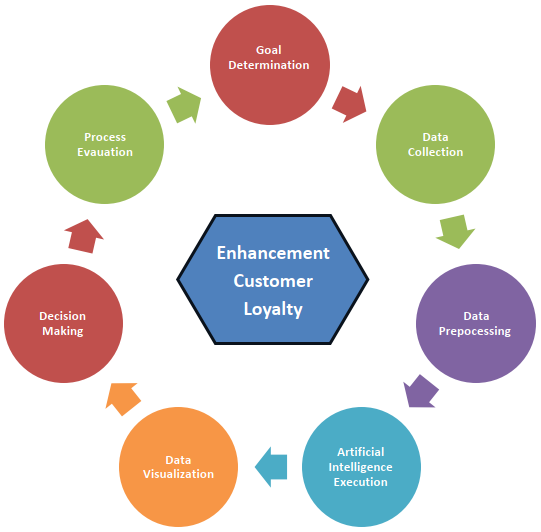
Artificial intelligence (AI) significantly enhances our daily lives, driving many service and financial institutions to seek optimal utilization of it. This paper addresses the problem, which is the inability of some institutions, such as banks, to satisfy customers using outdated methods and solely focusing on acquiring new customers instead of prioritizing customer retention that would be more effective and profitable to them. The main object of this paper is to enhance the quality of service in banks by proposing an intelligent model that leverages customer data to improve services and foster customer loyalty. This paper was motivated by the limited research on customer churn in Yemen and the scarcity of simple intelligent models globally. The methodology employed in this paper includes an in-depth analysis of existing literature on customer churn. Finally, this paper provides a comprehensive and concise conclusion based on the findings.
Sultan Yahya AL-SULTAN, Ibrahim Ahmed Al-Baltah (2024). Enhancement Customer Loyalty Via Data Mining Techniques in Yemeni Banks: Review Study. Sana'a University Journal of Applied Sciences and Technology, 348-354. DOI: https://doi.org/10.59628/jast.v2i4.1059
Sultan Yahya AL-SULTAN, Ibrahim Ahmed Al-Baltah . “Enhancement Customer Loyalty Via Data Mining Techniques in Yemeni Banks: Review Study.” Sana'a University Journal of Applied Sciences and Technology, 2024, pp. 348-354. https://doi.org/10.59628/jast.v2i4.1059. Accessed 31 Oct. 2026.
Sultan Yahya AL-SULTAN, Ibrahim Ahmed Al-Baltah . 2024. “Enhancement Customer Loyalty Via Data Mining Techniques in Yemeni Banks: Review Study.” Sana'a University Journal of Applied Sciences and Technology : 348-354. DOI: https://doi.org/10.59628/jast.v2i4.1059
Sultan Yahya AL-SULTAN, Ibrahim Ahmed Al-Baltah (2024) ‘Enhancement Customer Loyalty Via Data Mining Techniques in Yemeni Banks: Review Study’, Sana'a University Journal of Applied Sciences and Technology, pp. 348-354. doi: 10.59628/jast.v2i4.1059
@article{jast2024_art1059,
    author  = {Sultan Yahya AL-SULTAN, Ibrahim Ahmed Al-Baltah },
    title   = {Enhancement Customer Loyalty Via Data Mining Techniques in Yemeni Banks: Review Study},
    journal = {Sana'a University Journal of Applied Sciences and Technology},    year    = {2024},    month   = {September},    pages   = {348-354},    doi     = {10.59628/jast.v2i4.1059},
    url     = {https://doi.org/10.59628/jast.v2i4.1059},}
Enhancement Customer Loyalty Via Data Mining Techniques in Yemeni Banks: Review Study

Enterprises are human resources that are formed into organizational structures and consume material and financial resources to provide society with service or product. Enterprises are constantly changing to keep pace with the changes that occur in the environment of their services or products. There are several techniques and tools that enable an organization to keep pace with the changes occurring in its environment. One of these techniques is business process re-engineering. Business process re-engineering means making a radical modification in the enterprise’s business processes for the enterprise to continue to keep pace with its changing environment. Business process re-engineering is dangerous if it fails. Failure in the task of business processes re-engineering means that the enterprise cannot keep up with the changes and at the same time cannot remain in the state it was in. There are critical success factors in business process re-engineering. Many efforts tried to employ data mining techniques in business processes re-engineering. In this paper, we will propose assessment model to determine the best association mining technique related to business processes re engineering. The proposed assessment model contents of five stages as the following: Data preparation related to business process re-engineering, Algorithm selection, Implementation of selected algorithms, Evaluate the performance related to business process re-engineering, Determining the results. The proposed model aims to implement and examine a set of correlation and association algorithms on an available data set related to business process re-engineering and compare the results based on business processes re-engineering performance factors. The proposed model also relied on mathematical analysis of the algorithms chosen to be implemented in this study. According to that, the methodology using in this study will be based on two stages: The first stage: The methodology of mathematical theoretical analysis for choosing set of algorithms. The second stage: The methodology of experimental implementation and comparison of results based on business processes re engineering performance standards.
Akram Ali Othman Nasr, Ibrahim Ahmed AL-Baltah (2025). Proposed Assessment Model to Determine the Best Association Mining Technique Related to Business Processes Re-Engineering. Sana'a University Journal of Applied Sciences and Technology, 703-713. DOI: https://doi.org/10.59628/jast.v3i2.1455
Akram Ali Othman Nasr, Ibrahim Ahmed AL-Baltah . “Proposed Assessment Model to Determine the Best Association Mining Technique Related to Business Processes Re-Engineering.” Sana'a University Journal of Applied Sciences and Technology, 2025, pp. 703-713. https://doi.org/10.59628/jast.v3i2.1455. Accessed 31 Oct. 2026.
Akram Ali Othman Nasr, Ibrahim Ahmed AL-Baltah . 2025. “Proposed Assessment Model to Determine the Best Association Mining Technique Related to Business Processes Re-Engineering.” Sana'a University Journal of Applied Sciences and Technology : 703-713. DOI: https://doi.org/10.59628/jast.v3i2.1455
Akram Ali Othman Nasr, Ibrahim Ahmed AL-Baltah (2025) ‘Proposed Assessment Model to Determine the Best Association Mining Technique Related to Business Processes Re-Engineering’, Sana'a University Journal of Applied Sciences and Technology, pp. 703-713. doi: 10.59628/jast.v3i2.1455
@article{jast2025_art1455,
    author  = {Akram Ali Othman Nasr, Ibrahim Ahmed AL-Baltah },
    title   = {Proposed Assessment Model to Determine the Best Association Mining Technique Related to Business Processes Re-Engineering},
    journal = {Sana'a University Journal of Applied Sciences and Technology},    year    = {2025},    month   = {April},    pages   = {703-713},    doi     = {10.59628/jast.v3i2.1455},
    url     = {https://doi.org/10.59628/jast.v3i2.1455},}
Proposed Assessment Model to Determine the Best Association Mining Technique Related to Business Processes Re-Engineering

The development of large language models (LLMs) that are optimized to obey human commands is a significant advancement in the field of artificial intelligence (AI). One such model is ChatGPT (Chat Generative Pre-trained Transformer) from OpenAI, which has shown itself to be an extremely powerful tool for a variety of tasks such as conversation production, code debugging, and answering questions. Despite the fact that these models are praised for their multilingualism, little research has been done on how well they can analyze sentiment, especially in Arabic. We intend to close this gap by thoroughly assessing ChatGPT’s sentiment analysis skills, particularly with regard to Arabic text, in light of this constraint. When developing applications, recognizing the quality of the application and satisfying user needs are essential. Understanding user requirements is crucial to improving the quality of programs. The use of application review-based sentiment analysis (SA) is one efficient method for accomplishing this. The purpose of this study was to evaluate consumer perceptions of mobile banking apps so that they could be updated and maintained appropriately. Since mobile banking apps are now a necessary part of people’s lives, it is essential to examine user reviews of these apps for SA purposes. User reviews of banking mobile apps on the Google Play Store provided the dataset used in this study. We suggest a new active labeling technique for ChatGPT and examine the effects of using the ChatGPT variants for Arabic sentiment analysis (ASA). Using the accuracy, recall, precision, and F-score measures, we assess the performance of four machine learning (ML) approaches: Naive Bayes (NB), K-Nearest Neighbors (K-NN), Support Vector Machine (SVM), and Random Forest (FR). Additionally, we contrast six approaches to data labeling: manual human labeling, ChatGPT labeling by Assistant-Poe, ChatGPT labeling by Bing-Edge, ChatGPT labeling by Assistant-Poe with humans, ChatGPT labeling by Bing-Edge with humans, and ChatGPT labeling by Assistant-Poe with Bing-Edge. Using different Bing-Edge models for ASA, our experimental results demonstrate that the NB approach performed the best, with an accuracy of 91.22%, recall of 89.62%, precision of 88.90%, and F-score of 89.26%. Additionally, we contrast two approaches of data labeling for ASA: human labeling and labeling with Bard Google. Using Bard Google models for ASA, our experimental results demonstrate that the Naive Bayes technique outperformed the others, attaining an accuracy of 98.07%. Furthermore, when compared to alternative labeling techniques, our suggested active labeling strategy with ChatGPT produced greater accuracy. Our research indicates that our suggested active labeling method and the NB technique with multiple Bing-Edge models are useful strategies for ASA using ChatGPT. Our research provides important insights into efficient methods for this endeavor and advances the field of sentiment analysis in Arabic literature. Additionally, compared to other labeling techniques, our suggested active labeling method using Bard Google produced greater accuracy. According to the proposed study, our suggested active labeling strategy and the Naive Bayes technique with Bard Google models are both efficient methods for Arabic sentiment analysis utilizing Bard Google.
Salah Alhagree, Ghaleb Al-Gaphari (2025). Utilizing Machine Learning based on LLM for Arabic Sentiment Analysis in Assessing User Satisfaction with Mobile Banking Apps: A Case Study of Yemeni Banks. Sana'a University Journal of Applied Sciences and Technology, 645-662. DOI: https://doi.org/10.59628/jast.v3i1.1364
Salah Alhagree, Ghaleb Al-Gaphari . “Utilizing Machine Learning based on LLM for Arabic Sentiment Analysis in Assessing User Satisfaction with Mobile Banking Apps: A Case Study of Yemeni Banks.” Sana'a University Journal of Applied Sciences and Technology, 2025, pp. 645-662. https://doi.org/10.59628/jast.v3i1.1364. Accessed 31 Oct. 2026.
Salah Alhagree, Ghaleb Al-Gaphari . 2025. “Utilizing Machine Learning based on LLM for Arabic Sentiment Analysis in Assessing User Satisfaction with Mobile Banking Apps: A Case Study of Yemeni Banks.” Sana'a University Journal of Applied Sciences and Technology : 645-662. DOI: https://doi.org/10.59628/jast.v3i1.1364
Salah Alhagree, Ghaleb Al-Gaphari (2025) ‘Utilizing Machine Learning based on LLM for Arabic Sentiment Analysis in Assessing User Satisfaction with Mobile Banking Apps: A Case Study of Yemeni Banks’, Sana'a University Journal of Applied Sciences and Technology, pp. 645-662. doi: 10.59628/jast.v3i1.1364
@article{jast2025_art1364,
    author  = {Salah Alhagree, Ghaleb Al-Gaphari },
    title   = {Utilizing Machine Learning based on LLM for Arabic Sentiment Analysis in Assessing User Satisfaction with Mobile Banking Apps: A Case Study of Yemeni Banks},
    journal = {Sana'a University Journal of Applied Sciences and Technology},    year    = {2025},    month   = {February},    pages   = {645-662},    doi     = {10.59628/jast.v3i1.1364},
    url     = {https://doi.org/10.59628/jast.v3i1.1364},}
Utilizing Machine Learning based on LLM for Arabic Sentiment Analysis in Assessing User Satisfaction with Mobile Banking Apps: A Case Study of Yemeni Banks
Nothing has been published in this category yet.

Sana'a University Journal
of Applied Sciences and Technology
A peer-reviewed, open-access journal publishing high-quality research in applied sciences, engineering, and technology since 2023.
