
This study characterizes the phytochemical composition of the aqueous gel extract from Aloe perryi Baker, a
medicinal species endemic to Socotra Island, Yemen. The primary objective was to investigate and characterize the functional groups and chemical composition of Aloe perryi aqueous extract as compared with quercetin (standard of flavonoids), gallic acid (standard of phenols), aloin (standard of anthraquinones), and ascorbic acid (standard of antioxidants). Aloe leaves gel was blended, extracted with distilled water using a shaker, filtered, and lyophilized. Then the yield of extract (10%) was subjected to FTIR, GC-MS, and HPLC analysis. FTIR analysis confirmed the presence of phenol & alcohols (OH), alkane (C-H), unsaturated ketone (C=C), carbonyl (C=O), Ether (C-O-C), amine (NH), methyl (CH3) functional groups in the Aloe aqueous extract. GC-MS analysis revealed the presence of alcohols, many alkanes, aldehydes, ketones, aliphatic and aromatic esters, and fatty acids in the Aloe aqueous extract. HPLC emphasized the presence of functional groups by the presence of quercetin (3.59%), gallic acid (5.39%), aloin A (19.27%), and aloin B ( 29.64%) in Aloe extract, but ascorbic acid was not separated during this method. The three approaches (FTIR, GC-MS, HPLC) were complementary to one another in identification and the simple quantification of compounds in Aloe extract.
Anisa H. Almansory, Elham A.S. Al-Shaibani, Fatma M. H. Shediwah, Hassan M. Ibrahim, Abeer O.A. Obeid, Anass A.S. Alnedhary (2026). Analysis of Bioactive Phytochemicals in Aloe perryi Aqueous Leaf Gel Extract Using FT-IR, GC-MS and HPLC Techniques . Sana'a University Journal of Applied Sciences and Technology, 1844-1856. DOI: https://doi.org/10.59628/jast.v4i3.2389
Anisa H. Almansory, Elham A.S. Al-Shaibani, Fatma M. H. Shediwah, Hassan M. Ibrahim, Abeer O.A. Obeid, Anass A.S. Alnedhary . “Analysis of Bioactive Phytochemicals in Aloe perryi Aqueous Leaf Gel Extract Using FT-IR, GC-MS and HPLC Techniques .” Sana'a University Journal of Applied Sciences and Technology, 2026, pp. 1844-1856. https://doi.org/10.59628/jast.v4i3.2389. Accessed 30 Oct. 2026.
Anisa H. Almansory, Elham A.S. Al-Shaibani, Fatma M. H. Shediwah, Hassan M. Ibrahim, Abeer O.A. Obeid, Anass A.S. Alnedhary . 2026. “Analysis of Bioactive Phytochemicals in Aloe perryi Aqueous Leaf Gel Extract Using FT-IR, GC-MS and HPLC Techniques .” Sana'a University Journal of Applied Sciences and Technology : 1844-1856. DOI: https://doi.org/10.59628/jast.v4i3.2389
Anisa H. Almansory, Elham A.S. Al-Shaibani, Fatma M. H. Shediwah, Hassan M. Ibrahim, Abeer O.A. Obeid, Anass A.S. Alnedhary (2026) ‘Analysis of Bioactive Phytochemicals in Aloe perryi Aqueous Leaf Gel Extract Using FT-IR, GC-MS and HPLC Techniques ’, Sana'a University Journal of Applied Sciences and Technology, pp. 1844-1856. doi: 10.59628/jast.v4i3.2389
@article{jast2026_art2389,
    author  = {Anisa H. Almansory, Elham  A.S. Al-Shaibani, Fatma M. H. Shediwah, Hassan M. Ibrahim, Abeer O.A. Obeid, Anass A.S. Alnedhary },
    title   = {Analysis of Bioactive Phytochemicals in  Aloe perryi  Aqueous Leaf Gel Extract Using FT-IR, GC-MS and HPLC Techniques },
    journal = {Sana'a University Journal of Applied Sciences and Technology},    year    = {2026},    month   = {March},    pages   = {1844-1856},    doi     = {10.59628/jast.v4i3.2389},
    url     = {https://doi.org/10.59628/jast.v4i3.2389},}
Analysis of Bioactive Phytochemicals in Aloe perryi Aqueous Leaf Gel Extract Using FT-IR, GC-MS and HPLC Techniques
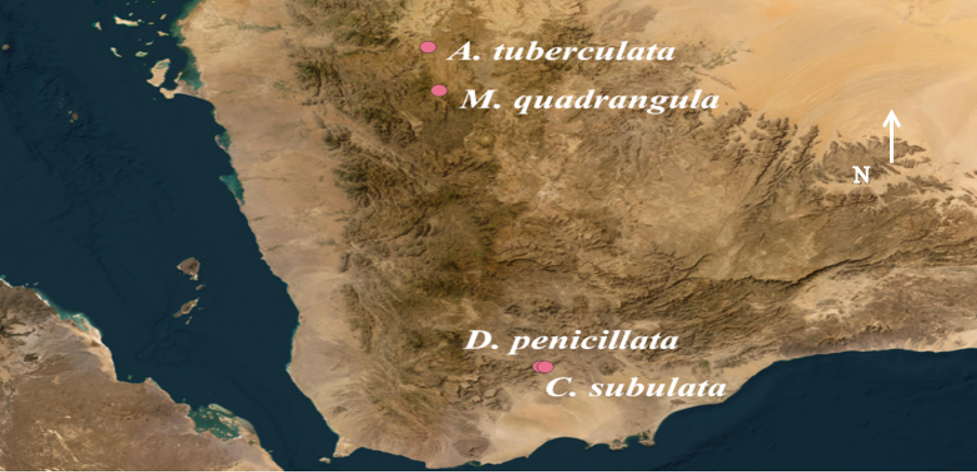
Taxonomic delimitation of the genus Caralluma R.Br. from its segregated genera remains highly problematic due to severe morphological convergence and phenotypic plasticity in their vegetative characters. This study provides a quantitative anatomical characterization of four taxa within the Caralluma segregate complex: Apteranthes tuberculata, Caralluma subulata, Desmidorchis penicillata, and Monolluma quadrangula, to evaluate the systematic utility of the internal stem architecture. The findings revealed that these taxa possess succulent stems partitioned into distinct ribs and sulci, with a single epidermal layer, a specialized cortex, and a central pith. Furthermore, the vascular architecture exhibits a eustelic arrangement, with the internal phloem situated interior to the protoxylem. Quantitative analysis capitalized on these variations and revealed a clear evolutionary trade-off in water-storage strategies: larger, shrubby taxa maximized storage by increasing tissue-layer density, whereas smaller, low-growth taxa relied on cell hypertrophy. Statistical analysis demonstrated that rib cortical layers, pith parenchyma cell areas, and internal phloem distribution were highly significant taxonomic markers. Both cluster analysis (TWCA) and Principal Component Analysis (PCA) successfully resolved the taxa into distinct groups, distinguishing C. subulata as a basal lineage, A. tuberculata as a transitional group, and D. penicillata and M. quadrangula as closely related members of the derived southern clade. Ultimately, these internal structural variations provide a strong anatomical fingerprint for identifying and differentiating these segregated generic lineages.
Hanan A. Saleem, Hassan M. Ibrahim, Arif S. Alhammadi (2026). Integrating Quantitative Stem Anatomy and Multivariate Analyses to Resolve Taxonomic Boundaries within the Caralluma Complex (Apocynaceae). Sana'a University Journal of Applied Sciences and Technology, 2436-2454. DOI: https://doi.org/10.59628/jast.v4i7.3158
Hanan A. Saleem, Hassan M. Ibrahim, Arif S. Alhammadi . “Integrating Quantitative Stem Anatomy and Multivariate Analyses to Resolve Taxonomic Boundaries within the Caralluma Complex (Apocynaceae).” Sana'a University Journal of Applied Sciences and Technology, 2026, pp. 2436-2454. https://doi.org/10.59628/jast.v4i7.3158. Accessed 30 Oct. 2026.
Hanan A. Saleem, Hassan M. Ibrahim, Arif S. Alhammadi . 2026. “Integrating Quantitative Stem Anatomy and Multivariate Analyses to Resolve Taxonomic Boundaries within the Caralluma Complex (Apocynaceae).” Sana'a University Journal of Applied Sciences and Technology : 2436-2454. DOI: https://doi.org/10.59628/jast.v4i7.3158
Hanan A. Saleem, Hassan M. Ibrahim, Arif S. Alhammadi (2026) ‘Integrating Quantitative Stem Anatomy and Multivariate Analyses to Resolve Taxonomic Boundaries within the Caralluma Complex (Apocynaceae)’, Sana'a University Journal of Applied Sciences and Technology, pp. 2436-2454. doi: 10.59628/jast.v4i7.3158
@article{jast2026_art3158,
    author  = {Hanan A. Saleem, Hassan M. Ibrahim, Arif S. Alhammadi },
    title   = {Integrating Quantitative Stem Anatomy and Multivariate Analyses to Resolve Taxonomic Boundaries within the Caralluma Complex (Apocynaceae)},
    journal = {Sana'a University Journal of Applied Sciences and Technology},    year    = {2026},    month   = {July},    pages   = {2436-2454},    doi     = {10.59628/jast.v4i7.3158},
    url     = {https://doi.org/10.59628/jast.v4i7.3158},}
Integrating Quantitative Stem Anatomy and Multivariate Analyses to Resolve Taxonomic Boundaries within the Caralluma Complex (Apocynaceae)
Freshwater bodies in dams play an important role in providing local communities with several needs. Its aquatic ecosystems may help them in improving their socio-economic life, including aquaculture operations. Analyzing the water quality is an essential criterion for protecting aquatic ecosystems. The present study has investigated the water quality of chosen two tanks (i.e. Kamaran & Mesaibeeh water tanks, Sana'a Governorate, Yemen) in order to ensure their suitability to be used as a fish culture. Water sampling was conducted at monthly intervals between April 2013 and March 2014, and analyzed for the most important physio-chemical parameters in order to check their quality. The results of water's physio-chemical of the two studied sites in the present investigation have shown suitable water quality conditions for fish culture with regards to temperature, DO, pH, and TDS. Essential nutrients, for aquatic organism's growth (nitrate, nitrite, and phosphate), have been found at acceptable values in the two studied sites. The present study has shown a very good possibility for freshwater tanks to be used in aquaculture activities that may play an important role in providing a new source of aquatic food in the studied area and improving the socio-economic condition of the surrounding communities as well.
Ebtisam F. Shamsan, Hisham Mohamed Nagi, Mona M. Nagi (2024). Study of environmental parameters of some water tanks and their aquaculture possibility from Sana’a governorate, Yemen . Sana'a University Journal of Applied Sciences and Technology, 30 - 40. DOI: https://doi.org/10.59628/jast.v2i1.693
Ebtisam F. Shamsan, Hisham Mohamed Nagi, Mona M. Nagi . “Study of environmental parameters of some water tanks and their aquaculture possibility from Sana’a governorate, Yemen .” Sana'a University Journal of Applied Sciences and Technology, 2024, pp. 30 - 40. https://doi.org/10.59628/jast.v2i1.693. Accessed 30 Oct. 2026.
Ebtisam F. Shamsan, Hisham Mohamed Nagi, Mona M. Nagi . 2024. “Study of environmental parameters of some water tanks and their aquaculture possibility from Sana’a governorate, Yemen .” Sana'a University Journal of Applied Sciences and Technology : 30 - 40. DOI: https://doi.org/10.59628/jast.v2i1.693
Ebtisam F. Shamsan, Hisham Mohamed Nagi, Mona M. Nagi (2024) ‘Study of environmental parameters of some water tanks and their aquaculture possibility from Sana’a governorate, Yemen ’, Sana'a University Journal of Applied Sciences and Technology, pp. 30 - 40. doi: 10.59628/jast.v2i1.693
@article{jast2024_art693,
    author  = {Ebtisam F. Shamsan, Hisham Mohamed Nagi, Mona M. Nagi },
    title   = {Study of environmental parameters of some water tanks and their aquaculture possibility from Sana’a governorate, Yemen },
    journal = {Sana'a University Journal of Applied Sciences and Technology},    year    = {2024},    month   = {February},    pages   = {30 - 40},    doi     = {10.59628/jast.v2i1.693},
    url     = {https://doi.org/10.59628/jast.v2i1.693},}
Study of environmental parameters of some water tanks and their aquaculture possibility from Sana’a governorate, Yemen

Human cytomegalovirus (HCMV) is a DNA virus categorized under the Herpesviridae family and is exclusively present in humans. This study aimed to identify HCMV antibodies and blood parameters in pediatric patients with pediatric leukemia patients with compromised immune systems in Sana‘a - Yemen. A cross sectional study was conducted to examine cytomegalovirus in pediatric leukemia cases are detecting HCMV antibodies and analyzing hematological parameters.in Sana’a city, Yemen, from June to October 2024. A total of 100 blood samples were collected from participants who had compromised immunity. Hematological parameters were evaluated and HCMV antibodies were alongside CMV detection using the ECLIA Cobas e 411 system. The majority of participants under the age of 12, 100% IgG positivity and this recent infection, 4% IgM positivity and this recent infection for HCMV in pediatric leukemia patients and the elevated WBC and PLT counts observed but no numerical data provided. These findings indicated that a high prevalence of HCMV antibodies in children with acute leukemia patients a significant increase of white blood cells (WBCs) and low platelet (PLT) counts in these patients.
Hanan Ahmed Ahmed Saad Al-jubani, Salwa H. Alkhyat (2025). The Impact of Human Cytomegalovirus among Children Patients with Acute Leukemia Undergoing Chemotherapy in Sana’a City-Yemen. Sana'a University Journal of Applied Sciences and Technology, 795-799. DOI: https://doi.org/10.59628/jast.v3i3.1589
Hanan Ahmed Ahmed Saad Al-jubani, Salwa H. Alkhyat . “The Impact of Human Cytomegalovirus among Children Patients with Acute Leukemia Undergoing Chemotherapy in Sana’a City-Yemen.” Sana'a University Journal of Applied Sciences and Technology, 2025, pp. 795-799. https://doi.org/10.59628/jast.v3i3.1589. Accessed 30 Oct. 2026.
Hanan Ahmed Ahmed Saad Al-jubani, Salwa H. Alkhyat . 2025. “The Impact of Human Cytomegalovirus among Children Patients with Acute Leukemia Undergoing Chemotherapy in Sana’a City-Yemen.” Sana'a University Journal of Applied Sciences and Technology : 795-799. DOI: https://doi.org/10.59628/jast.v3i3.1589
Hanan Ahmed Ahmed Saad Al-jubani, Salwa H. Alkhyat (2025) ‘The Impact of Human Cytomegalovirus among Children Patients with Acute Leukemia Undergoing Chemotherapy in Sana’a City-Yemen’, Sana'a University Journal of Applied Sciences and Technology, pp. 795-799. doi: 10.59628/jast.v3i3.1589
@article{jast2025_art1589,
    author  = {Hanan Ahmed Ahmed Saad Al-jubani, Salwa H. Alkhyat },
    title   = {The Impact of Human Cytomegalovirus among Children Patients with Acute Leukemia Undergoing Chemotherapy in Sana’a City-Yemen},
    journal = {Sana'a University Journal of Applied Sciences and Technology},    year    = {2025},    month   = {June},    pages   = {795-799},    doi     = {10.59628/jast.v3i3.1589},
    url     = {https://doi.org/10.59628/jast.v3i3.1589},}
The Impact of Human Cytomegalovirus among Children Patients with Acute Leukemia Undergoing Chemotherapy in Sana’a City-Yemen
Nothing has been published in this category yet.

Sana'a University Journal
of Applied Sciences and Technology
A peer-reviewed, open-access journal publishing high-quality research in applied sciences, engineering, and technology since 2023.
