Algorithm Design and Optimization
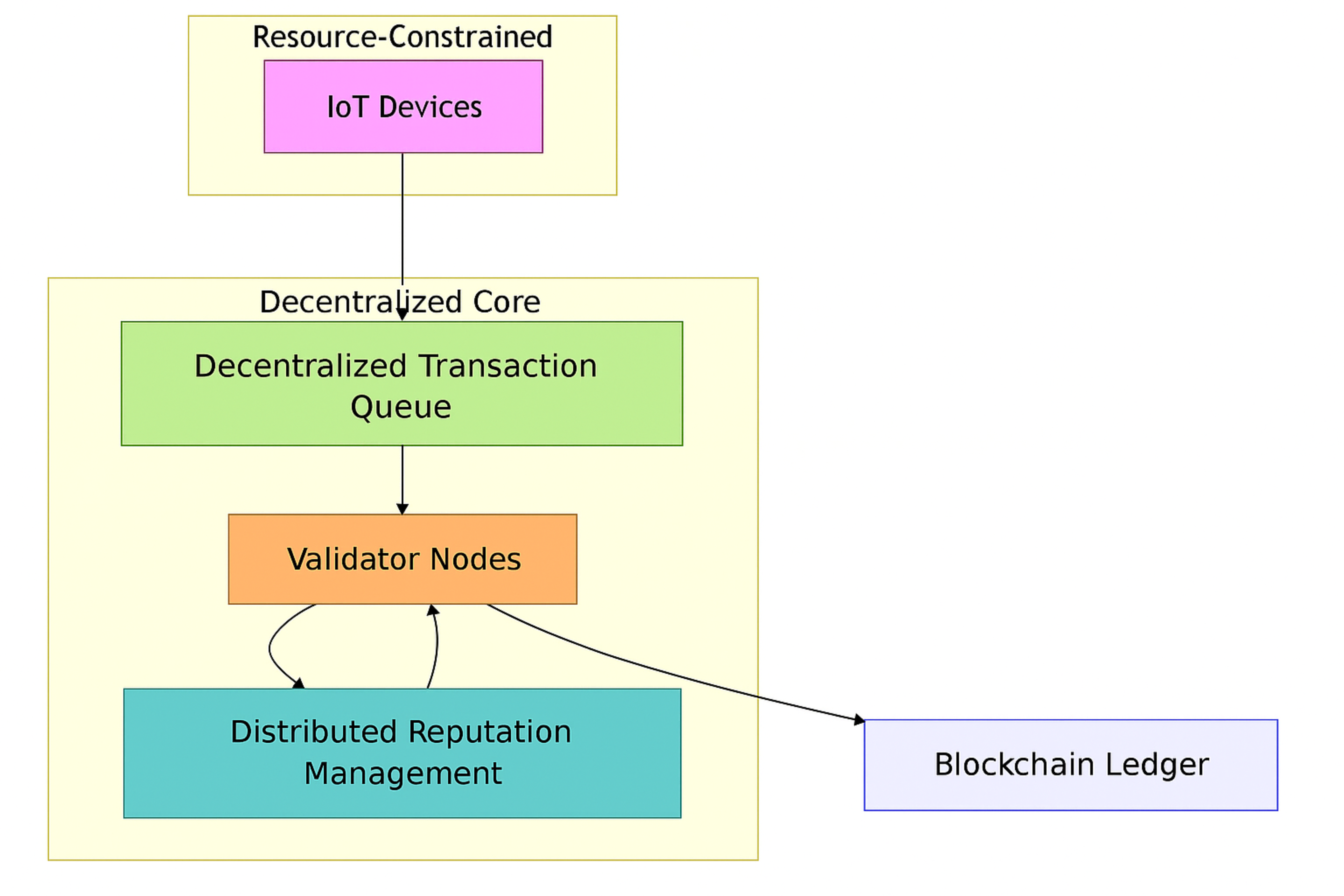
This paper proposes a hybrid consensus framework specifically designed for real-time Internet of Things (IoT) blockchain networks, where low latency, limited device capacity, and high scalability are critical requirements. Conventional approaches such as Proof of Work (PoW) and PBFT are unsuitable for IoT environments due to their computational overhead, energy consumption, and poor adaptability to heterogeneous devices. Our model integrates Proof of Validation (PoV) with Proof of Reputation (PoR) to select validators in a manner that balances efficiency, security, and decentralization. Transaction processing is modeled through M/M/1 queueing theory to enable priority handling of time-sensitive requests, while validator reputation dynamics are represented using Markov chains to capture state transitions under varying performance conditions. Practical IoT scenarios, including healthcare monitoring and smart transportation, are considered to highlight the relevance of the design. Simulation results demonstrate an average throughput of 1,995.8 transactions per block, latency of 0.0514 seconds, and energy consumption of 8.46 Wh per block. When compared with HB-IoT, HMM-Shard, and Microchain, the proposed framework achieves up to 22% lower latency, 15–30% higher throughput, and 35% better energy efficiency. These findings confirm the potential of the framework to support scalable, secure, and energy-aware blockchain infrastructures for real-time IoT applications.
Ali Ahmed Al-awamy, Nagi Al-shaibany, Eman Ahmed Alawamy (2025). A Real-Time Hybrid Consensus Framework for IoT Blockchain Networks Using Validator Reputation, Markov Modeling, and Priority Queueing. Sana'a University Journal of Applied Sciences and Technology, 1277-1290. DOI: https://doi.org/10.59628/jast.v3i6.1751
Ali Ahmed Al-awamy, Nagi Al-shaibany, Eman Ahmed Alawamy . “A Real-Time Hybrid Consensus Framework for IoT Blockchain Networks Using Validator Reputation, Markov Modeling, and Priority Queueing.” Sana'a University Journal of Applied Sciences and Technology, 2025, pp. 1277-1290. https://doi.org/10.59628/jast.v3i6.1751. Accessed 30 Oct. 2026.
Ali Ahmed Al-awamy, Nagi Al-shaibany, Eman Ahmed Alawamy . 2025. “A Real-Time Hybrid Consensus Framework for IoT Blockchain Networks Using Validator Reputation, Markov Modeling, and Priority Queueing.” Sana'a University Journal of Applied Sciences and Technology : 1277-1290. DOI: https://doi.org/10.59628/jast.v3i6.1751
Ali Ahmed Al-awamy, Nagi Al-shaibany, Eman Ahmed Alawamy (2025) ‘A Real-Time Hybrid Consensus Framework for IoT Blockchain Networks Using Validator Reputation, Markov Modeling, and Priority Queueing’, Sana'a University Journal of Applied Sciences and Technology, pp. 1277-1290. doi: 10.59628/jast.v3i6.1751
@article{jast2025_art1751,
    author  = {Ali Ahmed Al-awamy, Nagi Al-shaibany, Eman Ahmed Alawamy },
    title   = {A Real-Time Hybrid Consensus Framework for IoT Blockchain Networks Using Validator Reputation, Markov Modeling, and Priority Queueing},
    journal = {Sana'a University Journal of Applied Sciences and Technology},    year    = {2025},    month   = {December},    pages   = {1277-1290},    doi     = {10.59628/jast.v3i6.1751},
    url     = {https://doi.org/10.59628/jast.v3i6.1751},}
A Real-Time Hybrid Consensus Framework for IoT Blockchain Networks Using Validator Reputation, Markov Modeling, and Priority Queueing
Frequent set-item mining is a widely used technique in the field of data mining. The algorithm utilized in Association Rules constitutes the primary source of contention; this approach is memory-intensive and time-intensive. The extraction process for concealed patterns of frequent item sets, on the other hand, becomes more time-consuming as the volume of data grows. Therefore, the necessary algorithm for mining the patterns of frequently occurring concealed item sets must be memory-efficient and fast-running. By analyzing various algorithms for locating frequent item sets, this paper aims to contribute to the development of a more efficient algorithm in this domain. The paper will evaluate the efficiency of different algorithms by considering their memory usage and runtime. Additionally, it will explore potential improvements to existing algorithms to enhance their performance in mining frequently occurring concealed item sets.
Abdulkader Mohammed Abdulla Al-Badani, Abdualmajed A. G. Al-Khulaidi (2023). Analysis Of Mining Algorithms for Patterns of Frequent Item sets and Hidden. Sana'a University Journal of Applied Sciences and Technology. DOI: https://doi.org/10.59628/jast.v1i4.663
Abdulkader Mohammed Abdulla Al-Badani, Abdualmajed A. G. Al-Khulaidi . “Analysis Of Mining Algorithms for Patterns of Frequent Item sets and Hidden.” Sana'a University Journal of Applied Sciences and Technology, 2023, https://doi.org/10.59628/jast.v1i4.663. Accessed 30 Oct. 2026.
Abdulkader Mohammed Abdulla Al-Badani, Abdualmajed A. G. Al-Khulaidi . 2023. “Analysis Of Mining Algorithms for Patterns of Frequent Item sets and Hidden.” Sana'a University Journal of Applied Sciences and Technology DOI: https://doi.org/10.59628/jast.v1i4.663
Abdulkader Mohammed Abdulla Al-Badani, Abdualmajed A. G. Al-Khulaidi (2023) ‘Analysis Of Mining Algorithms for Patterns of Frequent Item sets and Hidden’, Sana'a University Journal of Applied Sciences and Technology. doi: 10.59628/jast.v1i4.663
@article{jast2023_art663,
    author  = {Abdulkader Mohammed Abdulla  Al-Badani, Abdualmajed A. G. Al-Khulaidi  },
    title   = {Analysis Of Mining Algorithms for Patterns  of Frequent Item sets and Hidden},
    journal = {Sana'a University Journal of Applied Sciences and Technology},    year    = {2023},    month   = {December},    doi     = {10.59628/jast.v1i4.663},
    url     = {https://doi.org/10.59628/jast.v1i4.663},}
Analysis Of Mining Algorithms for Patterns of Frequent Item sets and Hidden
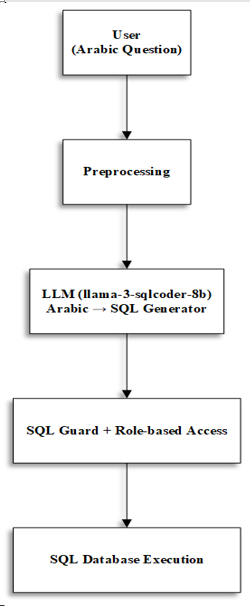
Recent advancements in Natural Language Processing (NLP) and Text-to-SQL systems have enabled easier interaction with relational databases. However, most solutions focus on English, leaving Arabic underrepresented. This study addresses that gap by fine-tuning the Llama-3-SQLCoder model to convert Arabic text into correct and executable SQL, enabling non-technical users to work with databases without learning SQL syntax. We enhanced the model using Low-Rank Adaptation (LoRA) and Unsloth, training it on Arabic questions paired with SQL queries from the Northwind database. To support low-resource environments, the model was converted to the GGUF format, reducing computational requirements while preserving performance. Evaluation results showed an execution accuracy of 90.24% and a validity rate of 97.56%, outperforming the zero-shot baseline (44% and 80%). The model also achieved an Exact Match score of 32% and an F1 score of 0.83, compared to 12% and 0.61 for the baseline. These findings demonstrate that LoRA and Unsloth are effective for adapting SQL-specialized models to Arabic. Despite these improvements, the system still struggles with complex nested queries and dialectal variations, indicating areas for future work. Overall, this study contributes to narrowing the gap between Arabic and other languages in Text-to-SQL research and improves database accessibility for non-technical users.
Mohammed Taj, Mohammed Zayed, Abdulwahid Alhetar, Mohammed Rajeh, Mohammed Abbas Al-Sharafi, Basem Abdulrhman Munassar (2026). Enabling Arabic Database Querying via Parameter-Efficient Fine-Tuning of Large Language Models. Sana'a University Journal of Applied Sciences and Technology, 1507-1519. DOI: https://doi.org/10.59628/jast.v4i1.2248
Mohammed Taj, Mohammed Zayed, Abdulwahid Alhetar, Mohammed Rajeh, Mohammed Abbas Al-Sharafi, Basem Abdulrhman Munassar . “Enabling Arabic Database Querying via Parameter-Efficient Fine-Tuning of Large Language Models.” Sana'a University Journal of Applied Sciences and Technology, 2026, pp. 1507-1519. https://doi.org/10.59628/jast.v4i1.2248. Accessed 30 Oct. 2026.
Mohammed Taj, Mohammed Zayed, Abdulwahid Alhetar, Mohammed Rajeh, Mohammed Abbas Al-Sharafi, Basem Abdulrhman Munassar . 2026. “Enabling Arabic Database Querying via Parameter-Efficient Fine-Tuning of Large Language Models.” Sana'a University Journal of Applied Sciences and Technology : 1507-1519. DOI: https://doi.org/10.59628/jast.v4i1.2248
Mohammed Taj, Mohammed Zayed, Abdulwahid Alhetar, Mohammed Rajeh, Mohammed Abbas Al-Sharafi, Basem Abdulrhman Munassar (2026) ‘Enabling Arabic Database Querying via Parameter-Efficient Fine-Tuning of Large Language Models’, Sana'a University Journal of Applied Sciences and Technology, pp. 1507-1519. doi: 10.59628/jast.v4i1.2248
@article{jast2026_art2248,
    author  = {Mohammed Taj, Mohammed Zayed, Abdulwahid Alhetar, Mohammed  Rajeh, Mohammed Abbas Al-Sharafi, Basem Abdulrhman Munassar },
    title   = {Enabling Arabic Database Querying via Parameter-Efficient Fine-Tuning of Large Language Models},
    journal = {Sana'a University Journal of Applied Sciences and Technology},    year    = {2026},    month   = {January},    pages   = {1507-1519},    doi     = {10.59628/jast.v4i1.2248},
    url     = {https://doi.org/10.59628/jast.v4i1.2248},}
Enabling Arabic Database Querying via Parameter-Efficient Fine-Tuning of Large Language Models

Artificial intelligence (AI) significantly enhances our daily lives, driving many service and financial institutions to seek optimal utilization of it. This paper addresses the problem, which is the inability of some institutions, such as banks, to satisfy customers using outdated methods and solely focusing on acquiring new customers instead of prioritizing customer retention that would be more effective and profitable to them. The main object of this paper is to enhance the quality of service in banks by proposing an intelligent model that leverages customer data to improve services and foster customer loyalty. This paper was motivated by the limited research on customer churn in Yemen and the scarcity of simple intelligent models globally. The methodology employed in this paper includes an in-depth analysis of existing literature on customer churn. Finally, this paper provides a comprehensive and concise conclusion based on the findings.
Sultan Yahya AL-SULTAN, Ibrahim Ahmed Al-Baltah (2024). Enhancement Customer Loyalty Via Data Mining Techniques in Yemeni Banks: Review Study. Sana'a University Journal of Applied Sciences and Technology, 348-354. DOI: https://doi.org/10.59628/jast.v2i4.1059
Sultan Yahya AL-SULTAN, Ibrahim Ahmed Al-Baltah . “Enhancement Customer Loyalty Via Data Mining Techniques in Yemeni Banks: Review Study.” Sana'a University Journal of Applied Sciences and Technology, 2024, pp. 348-354. https://doi.org/10.59628/jast.v2i4.1059. Accessed 30 Oct. 2026.
Sultan Yahya AL-SULTAN, Ibrahim Ahmed Al-Baltah . 2024. “Enhancement Customer Loyalty Via Data Mining Techniques in Yemeni Banks: Review Study.” Sana'a University Journal of Applied Sciences and Technology : 348-354. DOI: https://doi.org/10.59628/jast.v2i4.1059
Sultan Yahya AL-SULTAN, Ibrahim Ahmed Al-Baltah (2024) ‘Enhancement Customer Loyalty Via Data Mining Techniques in Yemeni Banks: Review Study’, Sana'a University Journal of Applied Sciences and Technology, pp. 348-354. doi: 10.59628/jast.v2i4.1059
@article{jast2024_art1059,
    author  = {Sultan Yahya AL-SULTAN, Ibrahim Ahmed Al-Baltah },
    title   = {Enhancement Customer Loyalty Via Data Mining Techniques in Yemeni Banks: Review Study},
    journal = {Sana'a University Journal of Applied Sciences and Technology},    year    = {2024},    month   = {September},    pages   = {348-354},    doi     = {10.59628/jast.v2i4.1059},
    url     = {https://doi.org/10.59628/jast.v2i4.1059},}
Enhancement Customer Loyalty Via Data Mining Techniques in Yemeni Banks: Review Study
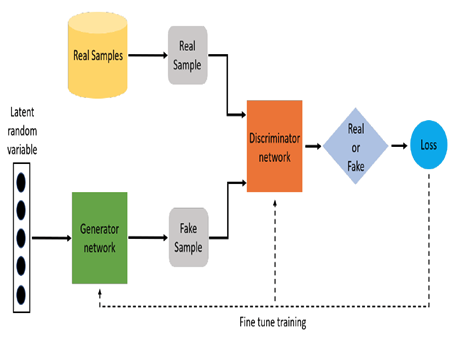
Generative adversarial networks (GANs) represent a ground-breaking advancement in artificial intelligence, revolutionizing data generation and content creation. This systematic review critically analyses literature from 2019-2024, sourced from major databases like IEEE Xplore and Scopus, to go beyond descriptive surveys and provide a synthesized, critical evaluation. We identify a pivotal gap in the existing literature: a frequent disconnect between reporting technical advancements and examining their profound ethical and societal implications. Our analysis yields several integrated insights. First, while GAN applications predominantly excel in visual content generation with architectures like StyleGAN and BigGAN achieving remarkable progress in photorealistic image and video synthesis their efficacy is highly application-specific, revealing significant trade-offs in stability and diversity in domains such as medical imaging and real-time video processing. Second, persistent core challenges like training instability and mode collapse continue to drive architectural innovations; however, we critically examine how solutions like Wasserstein loss or minibatch discrimination demonstrate varying effectiveness and limitations across different tasks and datasets. Third, and most critically, we argue that ethical concerns, particularly regarding deepfakes and data bias, are not peripheral issues but are intrinsically linked to architectural choices and the quality of training data. The key contribution of this review is its novel, integrated framework for evaluating GANs, which concurrently assesses architectural efficacy, application-specific maturity, and associated ethical risks. This holistic and critical synthesis provides researchers with a nuanced reference and outlines clear, responsible directions for future GAN development, emphasizing the need for models that are not only more powerful but also more robust, fair, and accountable.
Samah Ahmed Mohammed AlSarori, Ammar T. Zahary (2026). Generative Adversarial Networks for Visual Content: A Comprehensive Review of Image and Video Synthesis, Challenges, and Ethical Implications. Sana'a University Journal of Applied Sciences and Technology, 1552-1579. DOI: https://doi.org/10.59628/jast.v4i1.2100
Samah Ahmed Mohammed AlSarori, Ammar T. Zahary . “Generative Adversarial Networks for Visual Content: A Comprehensive Review of Image and Video Synthesis, Challenges, and Ethical Implications.” Sana'a University Journal of Applied Sciences and Technology, 2026, pp. 1552-1579. https://doi.org/10.59628/jast.v4i1.2100. Accessed 30 Oct. 2026.
Samah Ahmed Mohammed AlSarori, Ammar T. Zahary . 2026. “Generative Adversarial Networks for Visual Content: A Comprehensive Review of Image and Video Synthesis, Challenges, and Ethical Implications.” Sana'a University Journal of Applied Sciences and Technology : 1552-1579. DOI: https://doi.org/10.59628/jast.v4i1.2100
Samah Ahmed Mohammed AlSarori, Ammar T. Zahary (2026) ‘Generative Adversarial Networks for Visual Content: A Comprehensive Review of Image and Video Synthesis, Challenges, and Ethical Implications’, Sana'a University Journal of Applied Sciences and Technology, pp. 1552-1579. doi: 10.59628/jast.v4i1.2100
@article{jast2026_art2100,
    author  = {Samah Ahmed Mohammed AlSarori, Ammar T. Zahary },
    title   = {Generative Adversarial Networks for Visual Content: A Comprehensive Review of Image and Video Synthesis, Challenges, and Ethical Implications},
    journal = {Sana'a University Journal of Applied Sciences and Technology},    year    = {2026},    month   = {January},    pages   = {1552-1579},    doi     = {10.59628/jast.v4i1.2100},
    url     = {https://doi.org/10.59628/jast.v4i1.2100},}
Generative Adversarial Networks for Visual Content: A Comprehensive Review of Image and Video Synthesis, Challenges, and Ethical Implications
Recently, most companies have been conducting their business through the cloud network, so increasing the speed of data access via the Internet has become very important. Therefore, the importance of cache algorithms lies in increasing the speed of data access. As we know, there are cache substitution algorithms that work well with the cache when applied to the processor cache, but they hardly work when applied to caching for web purposes. The reason for this discrepancy is that it is not intended to increase the complexity of this type of storage. Considering the challenges of cache usage in terms of the large discrepancy in file size and the heterogeneous model of user access to data in a web environment, especially with pages with dynamic content, there is a real need to develop 'web cache' algorithms. In this paper, a hybrid algorithm for web caching using semantic similarity is developed. The GDFS algorithm was developed using NGD (Normalized Google Distance) to determine the semantic similarity between cache objects, which resulted in better performance in comparison to other algorithms. The results showed that the web cache hybrid algorithm using semantic similarity increased the hit rate compared to the basic algorithms by up to 80.10%. The proposed hybrid algorithm was able to overcome the problem of the low byte hit rate in the GDFS algorithm. The improvement in the byte hit rate reached 65%. This indicates an increase in the byte hit rate. The results showed that the web cache hybrid algorithm using semantic similarity reduced the page load time using distance measured from Google compared to the page load time using other algorithms that do not use semantic similarity and do not use cache. The results showed that the web cache hybrid algorithm using semantic similarity reduced the page load time from 4.17 seconds using GDFS-Line to 2.16 seconds using GDFS-NGD.
Abdualmajed Ahmed G. Al-Khulaidi, Mohammed Abdulbaqi Al-Sayani (2023). Web Caching Hybrid Algorithm by Semantic Similarity. Sana'a University Journal of Applied Sciences and Technology. DOI: https://doi.org/10.59628/jast.v1i2.328
Abdualmajed Ahmed G. Al-Khulaidi, Mohammed Abdulbaqi Al-Sayani . “Web Caching Hybrid Algorithm by Semantic Similarity.” Sana'a University Journal of Applied Sciences and Technology, 2023, https://doi.org/10.59628/jast.v1i2.328. Accessed 30 Oct. 2026.
Abdualmajed Ahmed G. Al-Khulaidi, Mohammed Abdulbaqi Al-Sayani . 2023. “Web Caching Hybrid Algorithm by Semantic Similarity.” Sana'a University Journal of Applied Sciences and Technology DOI: https://doi.org/10.59628/jast.v1i2.328
Abdualmajed Ahmed G. Al-Khulaidi, Mohammed Abdulbaqi Al-Sayani (2023) ‘Web Caching Hybrid Algorithm by Semantic Similarity’, Sana'a University Journal of Applied Sciences and Technology. doi: 10.59628/jast.v1i2.328
@article{jast2023_art328,
    author  = {Abdualmajed Ahmed G. Al-Khulaidi, Mohammed Abdulbaqi Al-Sayani },
    title   = {Web Caching Hybrid Algorithm by Semantic Similarity},
    journal = {Sana'a University Journal of Applied Sciences and Technology},    year    = {2023},    month   = {April},    doi     = {10.59628/jast.v1i2.328},
    url     = {https://doi.org/10.59628/jast.v1i2.328},}
Web Caching Hybrid Algorithm by Semantic Similarity
Nothing has been published in this category yet.

Sana'a University Journal
of Applied Sciences and Technology
A peer-reviewed, open-access journal publishing high-quality research in applied sciences, engineering, and technology since 2023.
