Software Engineering

Because of the enhanced efficiency and value that come with implementing ERP systems and e-government, these systems have taken center stage in government organizations throughout both developed and developing nations. To provide more efficient government and better services to citizens, public administrations and agencies have invested in Enterprise Resource Planning (ERP) systems as their core technological infrastructure for e-government. Despite recognizing the importance of management information systems in electronic government, most Arab countries in the Middle East and other underdeveloped countries are still dealing with issues with adopting these technologies. This study introduced a Systematic Literature Review (SLR) to identify the Critical Success Factors influencing the adoption of GRP systems, the benefits of GRP systems, and their challenges. Studies from 2015 to 2024 were selected from databases such as Scopus and IEEE Explore. This study proposed a conceptual model based on technological, organizational, and environmental factors. The study also analyzes the importance of the CSFs. It also summarized the most significant challenges and difficulties in adopting GRP systems, as well as future trends, thereby creating numerous opportunities to develop various solutions.
Hana’a A. Johar , Adnan Al-Mutawkkil, Ammar T. Zahary, Suad M. Othman (2026). A Systematic Literature Review of Factors Influencing the Adoption of GRP System. Sana'a University Journal of Applied Sciences and Technology, 1622-1639. DOI: https://doi.org/10.59628/jast.v4i1.2341
Hana’a A. Johar , Adnan Al-Mutawkkil, Ammar T. Zahary, Suad M. Othman . “A Systematic Literature Review of Factors Influencing the Adoption of GRP System.” Sana'a University Journal of Applied Sciences and Technology, 2026, pp. 1622-1639. https://doi.org/10.59628/jast.v4i1.2341. Accessed 31 Oct. 2026.
Hana’a A. Johar , Adnan Al-Mutawkkil, Ammar T. Zahary, Suad M. Othman . 2026. “A Systematic Literature Review of Factors Influencing the Adoption of GRP System.” Sana'a University Journal of Applied Sciences and Technology : 1622-1639. DOI: https://doi.org/10.59628/jast.v4i1.2341
Hana’a A. Johar , Adnan Al-Mutawkkil, Ammar T. Zahary, Suad M. Othman (2026) ‘A Systematic Literature Review of Factors Influencing the Adoption of GRP System’, Sana'a University Journal of Applied Sciences and Technology, pp. 1622-1639. doi: 10.59628/jast.v4i1.2341
@article{jast2026_art2341,
    author  = {Hana’a A. Johar , Adnan Al-Mutawkkil, Ammar T. Zahary, Suad M. Othman },
    title   = {A Systematic Literature Review of Factors Influencing the Adoption of GRP System},
    journal = {Sana'a University Journal of Applied Sciences and Technology},    year    = {2026},    month   = {January},    pages   = {1622-1639},    doi     = {10.59628/jast.v4i1.2341},
    url     = {https://doi.org/10.59628/jast.v4i1.2341},}
A Systematic Literature Review of Factors Influencing the Adoption of GRP System
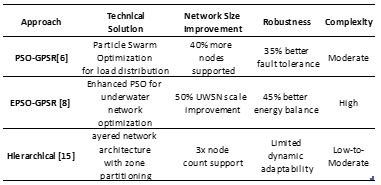
Objective: The aim of this survey is to provide a comprehensive review and evaluation of recent advancements in the Greedy Perimeter Stateless Routing (GPSR) protocol, with specific emphasis on special considerations for the individual challenges faced in Wireless Sensor Networks (WSNs), including energy constraints, scalabilitychallenges, reliability, and security.
Methodology: Systematic review of literature was conducted using leading academic databases (e.g., IEEE Xplore, ACM Digital Library, Scopus) during 2015-2025. Studies were selected based on pre-specified inclusion criteria with focus on GPSR variants for WSNs aiming at energy efficiency, scalability, reliability, security, or compatibility with emerging technologies.
Key Results: Many GPSR adaptations are enumerated and categorized by survey. Noteworthy trends include utilization of optimization algorithms (e.g., PSO, ACO) and machine learning/AI (e.g., fuzzy logic, deep learning) for improvement in energy efficiency, fault tolerance, and security. Comparative study recognizes trade offs with other adaptation techniques. Significant challenges such as localization accuracy, computational overhead, and issues of practical deployment are expounded upon.
Conclusions: While significant progress has been made in the adaptation of GPSR to WSNs, particularly by AI- based approaches, much remains to be done from the practical implementation and verification aspects beyond simulations. This survey synthesizes current knowledge, identifies research gaps, and suggests future directions based on lightweight security, robust localization, and real-world performance evaluation of current adaptations
Yosef A. Abdulmoghni , Sharaf A. Alhomdy, Yahya Al-Ashmoery (2025). Adapting GPSR Routing Protocol in Wireless Sensor Networks: Survey. Sana'a University Journal of Applied Sciences and Technology, 1347-1357. DOI: https://doi.org/10.59628/jast.v3i6.1687
Yosef A. Abdulmoghni , Sharaf A. Alhomdy, Yahya Al-Ashmoery . “Adapting GPSR Routing Protocol in Wireless Sensor Networks: Survey.” Sana'a University Journal of Applied Sciences and Technology, 2025, pp. 1347-1357. https://doi.org/10.59628/jast.v3i6.1687. Accessed 31 Oct. 2026.
Yosef A. Abdulmoghni , Sharaf A. Alhomdy, Yahya Al-Ashmoery . 2025. “Adapting GPSR Routing Protocol in Wireless Sensor Networks: Survey.” Sana'a University Journal of Applied Sciences and Technology : 1347-1357. DOI: https://doi.org/10.59628/jast.v3i6.1687
Yosef A. Abdulmoghni , Sharaf A. Alhomdy, Yahya Al-Ashmoery (2025) ‘Adapting GPSR Routing Protocol in Wireless Sensor Networks: Survey’, Sana'a University Journal of Applied Sciences and Technology, pp. 1347-1357. doi: 10.59628/jast.v3i6.1687
@article{jast2025_art1687,
    author  = {Yosef A. Abdulmoghni , Sharaf  A. Alhomdy, Yahya Al-Ashmoery },
    title   = {Adapting GPSR Routing Protocol in Wireless Sensor Networks: Survey},
    journal = {Sana'a University Journal of Applied Sciences and Technology},    year    = {2025},    month   = {December},    pages   = {1347-1357},    doi     = {10.59628/jast.v3i6.1687},
    url     = {https://doi.org/10.59628/jast.v3i6.1687},}
Adapting GPSR Routing Protocol in Wireless Sensor Networks: Survey
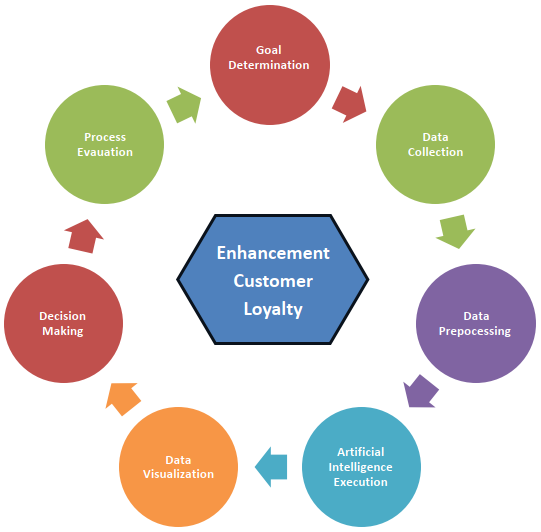
Artificial intelligence (AI) significantly enhances our daily lives, driving many service and financial institutions to seek optimal utilization of it. This paper addresses the problem, which is the inability of some institutions, such as banks, to satisfy customers using outdated methods and solely focusing on acquiring new customers instead of prioritizing customer retention that would be more effective and profitable to them. The main object of this paper is to enhance the quality of service in banks by proposing an intelligent model that leverages customer data to improve services and foster customer loyalty. This paper was motivated by the limited research on customer churn in Yemen and the scarcity of simple intelligent models globally. The methodology employed in this paper includes an in-depth analysis of existing literature on customer churn. Finally, this paper provides a comprehensive and concise conclusion based on the findings.
Sultan Yahya AL-SULTAN, Ibrahim Ahmed Al-Baltah (2024). Enhancement Customer Loyalty Via Data Mining Techniques in Yemeni Banks: Review Study. Sana'a University Journal of Applied Sciences and Technology, 348-354. DOI: https://doi.org/10.59628/jast.v2i4.1059
Sultan Yahya AL-SULTAN, Ibrahim Ahmed Al-Baltah . “Enhancement Customer Loyalty Via Data Mining Techniques in Yemeni Banks: Review Study.” Sana'a University Journal of Applied Sciences and Technology, 2024, pp. 348-354. https://doi.org/10.59628/jast.v2i4.1059. Accessed 31 Oct. 2026.
Sultan Yahya AL-SULTAN, Ibrahim Ahmed Al-Baltah . 2024. “Enhancement Customer Loyalty Via Data Mining Techniques in Yemeni Banks: Review Study.” Sana'a University Journal of Applied Sciences and Technology : 348-354. DOI: https://doi.org/10.59628/jast.v2i4.1059
Sultan Yahya AL-SULTAN, Ibrahim Ahmed Al-Baltah (2024) ‘Enhancement Customer Loyalty Via Data Mining Techniques in Yemeni Banks: Review Study’, Sana'a University Journal of Applied Sciences and Technology, pp. 348-354. doi: 10.59628/jast.v2i4.1059
@article{jast2024_art1059,
    author  = {Sultan Yahya AL-SULTAN, Ibrahim Ahmed Al-Baltah },
    title   = {Enhancement Customer Loyalty Via Data Mining Techniques in Yemeni Banks: Review Study},
    journal = {Sana'a University Journal of Applied Sciences and Technology},    year    = {2024},    month   = {September},    pages   = {348-354},    doi     = {10.59628/jast.v2i4.1059},
    url     = {https://doi.org/10.59628/jast.v2i4.1059},}
Enhancement Customer Loyalty Via Data Mining Techniques in Yemeni Banks: Review Study

A GIS-based Soil Conservation Service Curve Number (SCS-CN) approach was used to estimate surface-runoff potential in Yemen’s arid Abyan Delta (∼1,237 km2). Sentinel-2 (10 m) imagery was classified into major land-cover types and combined with hydrologic soil groups (HYSOGs) to assign CN values under Antecedent Moisture Condition II. The composite CN map (67–100; mean = 91.8) indicates limited infiltration across large areas of bare or impervious surfaces on clayey soils. Using the standard SCS-CN equations, event runoff was simulated for representative storm depths of 74, 124, and 174 mm. The model produced direct-runoff depths of ∼52, 100, and 150 mm, corresponding to runoff coefficients of ∼71%, 81%, and 86%, and basin-wide volumes of 0.65, 1.24, and 1.85 × 10⁸ m3, respectively. Spatial attribution shows that high-CN zones (notably barren HSG-C/D units and built-up/roads) generate most of the runoff despite covering a smaller fraction of the delta. The results identify priority areas for spate-irrigation, retention, and recharge interventions, and provide a reproducible baseline for flood-risk reduction and water-harvesting planning in data-scarce drylands. The workflow can be readily updated with improved soils, land-use, or climate inputs to support adaptive management.
Sady Alsady, Marwan Al-Badani, Zamzam Mubarak (2025). Estimating Surface Runoff Potential in the Abyan Delta, Yemen Using GIS-Based SCS-Curve Number Method. Sana'a University Journal of Applied Sciences and Technology, 1164-1170. DOI: https://doi.org/10.59628/jast.v3i5.1987
Sady Alsady, Marwan Al-Badani, Zamzam Mubarak . “Estimating Surface Runoff Potential in the Abyan Delta, Yemen Using GIS-Based SCS-Curve Number Method.” Sana'a University Journal of Applied Sciences and Technology, 2025, pp. 1164-1170. https://doi.org/10.59628/jast.v3i5.1987. Accessed 31 Oct. 2026.
Sady Alsady, Marwan Al-Badani, Zamzam Mubarak . 2025. “Estimating Surface Runoff Potential in the Abyan Delta, Yemen Using GIS-Based SCS-Curve Number Method.” Sana'a University Journal of Applied Sciences and Technology : 1164-1170. DOI: https://doi.org/10.59628/jast.v3i5.1987
Sady Alsady, Marwan Al-Badani, Zamzam Mubarak (2025) ‘Estimating Surface Runoff Potential in the Abyan Delta, Yemen Using GIS-Based SCS-Curve Number Method’, Sana'a University Journal of Applied Sciences and Technology, pp. 1164-1170. doi: 10.59628/jast.v3i5.1987
@article{jast2025_art1987,
    author  = {Sady Alsady, Marwan Al-Badani, Zamzam Mubarak },
    title   = {Estimating Surface Runoff Potential in the Abyan Delta, Yemen Using GIS-Based SCS-Curve Number Method},
    journal = {Sana'a University Journal of Applied Sciences and Technology},    year    = {2025},    month   = {October},    pages   = {1164-1170},    doi     = {10.59628/jast.v3i5.1987},
    url     = {https://doi.org/10.59628/jast.v3i5.1987},}
Estimating Surface Runoff Potential in the Abyan Delta, Yemen Using GIS-Based SCS-Curve Number Method
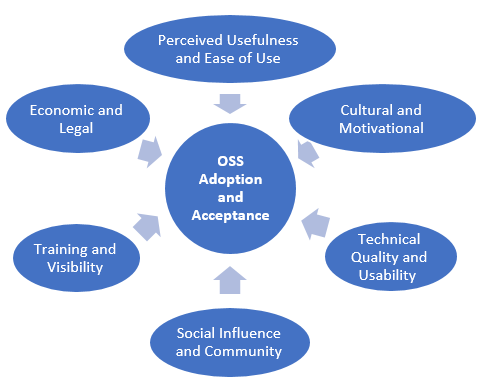
Free and open-source software (FOSS) is software in which anyone is freely licensed to use, copy, study, and change the software in any way. The source code is publicly shared, encouraging people to improve the software design voluntarily. This is in contrast to proprietary software, where the software is subject to a restrictive copyright license and the source code is usually hidden from users. Many countries are witnessing a significant transition towards adopting open-source software within their government structures, coupled with efforts to develop strategies and policies that support this trend. This change is attributed to several reasons, most notably savings in the total cost of ownership, freedom to copy and distribute software, compliance with legal controls, high reliability, a variety of available programs, and rapid performance, in addition to the multiple educational and administrative benefits. Despite this remarkable expansion, it remains necessary to understand the potential of this software for individuals and entities while identifying the factors influencing its adoption. Accordingly, this study aims to explore the acceptance of open-source software and analyze the technical, administrative, and personal factors that promote its use, especially in environments undergoing a transition towards sustainable digital systems. The study collected several papers published between 2007 and 2023, approximately 85 different research studies combining theoretical and experimental aspects. After that, 61 papers were selected from among them and analyzed. The results revealed six main categories that influence the acceptance and adoption of open-source software. The study recommends developing a comprehensive model that integrates all behavioral, social, cultural, and technical dimensions to identify the factors influencing the acceptance and adoption of open-source software. The study also emphasizes the need for future empirical research in the Yemeni context, especially in public and educational sectors, to validate the integrated framework, and provide evidence-based policy recommendations for effective OSS adoption.
Sumaia A. Al-Edresi, Adnan Y. Al-Mutawakkil (2026). Factors Influencing the Acceptance and Adoption of Open-Source Software: A Concept-Centric Systematic Literature Review. Sana'a University Journal of Applied Sciences and Technology, 2139- 2165. DOI: https://doi.org/10.59628/jast.v4i5.2201
Sumaia A. Al-Edresi, Adnan Y. Al-Mutawakkil . “Factors Influencing the Acceptance and Adoption of Open-Source Software: A Concept-Centric Systematic Literature Review.” Sana'a University Journal of Applied Sciences and Technology, 2026, pp. 2139- 2165. https://doi.org/10.59628/jast.v4i5.2201. Accessed 31 Oct. 2026.
Sumaia A. Al-Edresi, Adnan Y. Al-Mutawakkil . 2026. “Factors Influencing the Acceptance and Adoption of Open-Source Software: A Concept-Centric Systematic Literature Review.” Sana'a University Journal of Applied Sciences and Technology : 2139- 2165. DOI: https://doi.org/10.59628/jast.v4i5.2201
Sumaia A. Al-Edresi, Adnan Y. Al-Mutawakkil (2026) ‘Factors Influencing the Acceptance and Adoption of Open-Source Software: A Concept-Centric Systematic Literature Review’, Sana'a University Journal of Applied Sciences and Technology, pp. 2139- 2165. doi: 10.59628/jast.v4i5.2201
@article{jast2026_art2201,
    author  = {Sumaia A. Al-Edresi, Adnan Y. Al-Mutawakkil },
    title   = {Factors Influencing the Acceptance and Adoption of Open-Source Software: A Concept-Centric Systematic Literature Review},
    journal = {Sana'a University Journal of Applied Sciences and Technology},    year    = {2026},    month   = {May},    pages   = {2139- 2165},    doi     = {10.59628/jast.v4i5.2201},
    url     = {https://doi.org/10.59628/jast.v4i5.2201},}
Factors Influencing the Acceptance and Adoption of Open-Source Software: A Concept-Centric Systematic Literature Review
Nothing has been published in this category yet.

Sana'a University Journal
of Applied Sciences and Technology
A peer-reviewed, open-access journal publishing high-quality research in applied sciences, engineering, and technology since 2023.
