
A GIS-based Soil Conservation Service Curve Number (SCS-CN) approach was used to estimate surface-runoff potential in Yemen’s arid Abyan Delta (∼1,237 km2). Sentinel-2 (10 m) imagery was classified into major land-cover types and combined with hydrologic soil groups (HYSOGs) to assign CN values under Antecedent Moisture Condition II. The composite CN map (67–100; mean = 91.8) indicates limited infiltration across large areas of bare or impervious surfaces on clayey soils. Using the standard SCS-CN equations, event runoff was simulated for representative storm depths of 74, 124, and 174 mm. The model produced direct-runoff depths of ∼52, 100, and 150 mm, corresponding to runoff coefficients of ∼71%, 81%, and 86%, and basin-wide volumes of 0.65, 1.24, and 1.85 × 10⁸ m3, respectively. Spatial attribution shows that high-CN zones (notably barren HSG-C/D units and built-up/roads) generate most of the runoff despite covering a smaller fraction of the delta. The results identify priority areas for spate-irrigation, retention, and recharge interventions, and provide a reproducible baseline for flood-risk reduction and water-harvesting planning in data-scarce drylands. The workflow can be readily updated with improved soils, land-use, or climate inputs to support adaptive management.
Sady Alsady, Marwan Al-Badani, Zamzam Mubarak (2025). Estimating Surface Runoff Potential in the Abyan Delta, Yemen Using GIS-Based SCS-Curve Number Method. Sana'a University Journal of Applied Sciences and Technology, 1164-1170. DOI: https://doi.org/10.59628/jast.v3i5.1987
Sady Alsady, Marwan Al-Badani, Zamzam Mubarak . “Estimating Surface Runoff Potential in the Abyan Delta, Yemen Using GIS-Based SCS-Curve Number Method.” Sana'a University Journal of Applied Sciences and Technology, 2025, pp. 1164-1170. https://doi.org/10.59628/jast.v3i5.1987. Accessed 31 Oct. 2026.
Sady Alsady, Marwan Al-Badani, Zamzam Mubarak . 2025. “Estimating Surface Runoff Potential in the Abyan Delta, Yemen Using GIS-Based SCS-Curve Number Method.” Sana'a University Journal of Applied Sciences and Technology : 1164-1170. DOI: https://doi.org/10.59628/jast.v3i5.1987
Sady Alsady, Marwan Al-Badani, Zamzam Mubarak (2025) ‘Estimating Surface Runoff Potential in the Abyan Delta, Yemen Using GIS-Based SCS-Curve Number Method’, Sana'a University Journal of Applied Sciences and Technology, pp. 1164-1170. doi: 10.59628/jast.v3i5.1987
@article{jast2025_art1987,
    author  = {Sady Alsady, Marwan Al-Badani, Zamzam Mubarak },
    title   = {Estimating Surface Runoff Potential in the Abyan Delta, Yemen Using GIS-Based SCS-Curve Number Method},
    journal = {Sana'a University Journal of Applied Sciences and Technology},    year    = {2025},    month   = {October},    pages   = {1164-1170},    doi     = {10.59628/jast.v3i5.1987},
    url     = {https://doi.org/10.59628/jast.v3i5.1987},}
Estimating Surface Runoff Potential in the Abyan Delta, Yemen Using GIS-Based SCS-Curve Number Method
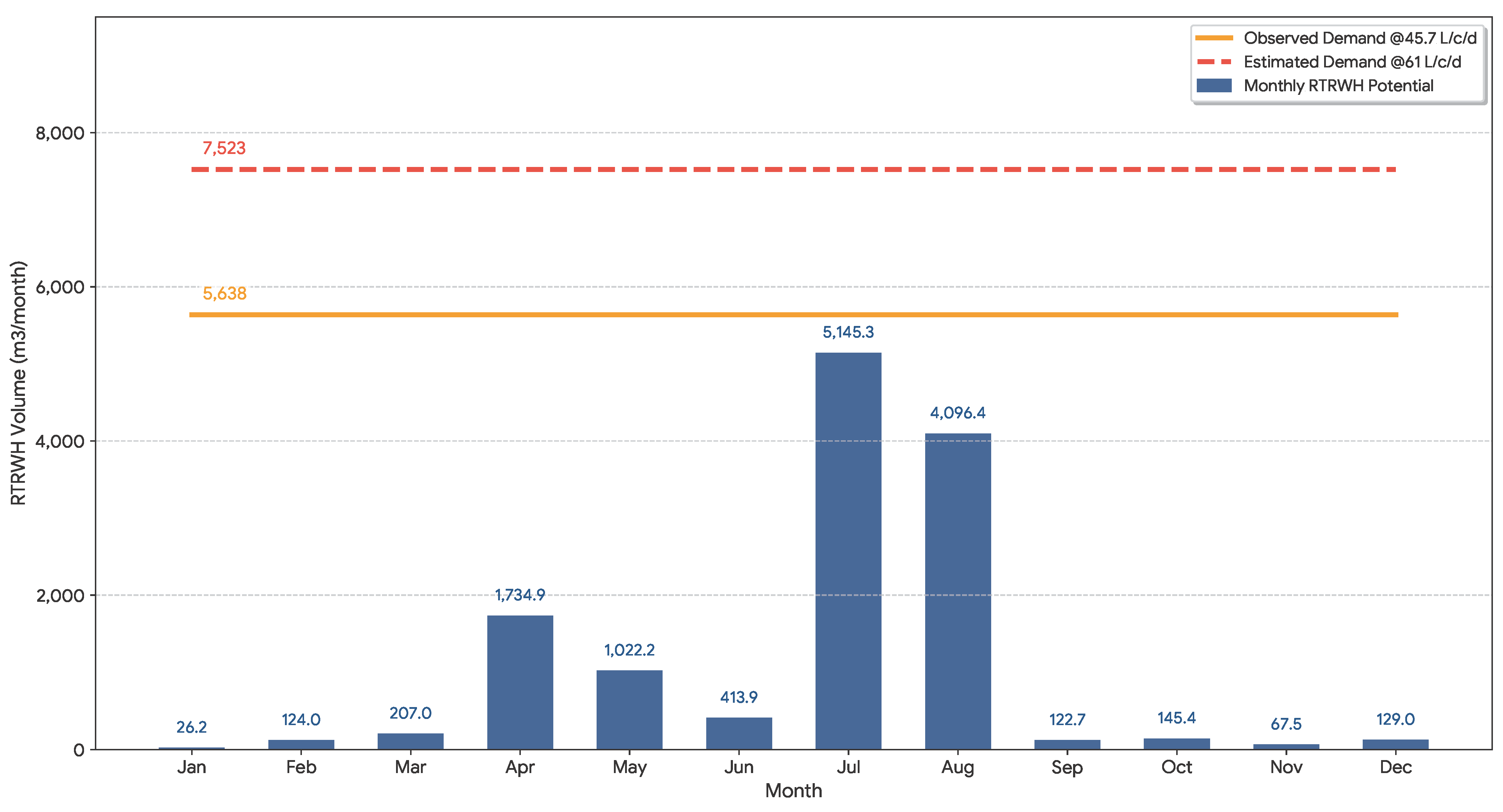
Sana’a City faces severe water scarcity driven by limited rainfall, rapid urban growth, and groundwater overexploitation. This study assessed the potential contribution of rooftop rainwater harvesting (RTRWH) to domestic water supply in Al-Wahdah District, Sana’a City. The methodology integrated household survey data, GIS-based rooftop digitization, roof-material information, and monthly rainfall records for 2013–2022, with an average annual rainfall of 335.4 mm. Of 374 valid surveyed buildings, 277 residential buildings were analyzed after excluding 97 non-residential or unsuitable records. Domestic demand was estimated using observed (47.5 L/c/d) household consumption and the SWSLC benchmark of 61 L/c/d. Current RTRWH use was negligible, contributing less than 1% of consumption. Under a theoretical full rooftop utilization scenario, excluding storage constraints and first-flush losses, RTRWH could provide about 13,234 m3/year, equivalent to 19.6% of observed demand and 14.7% of estimated demand. Results show that RTRWH is a valuable supplementary source, but practical use requires storage and water-quality consideration.
Adel Maaodhah, Marwan Al-Badani, Sharafaddin Salleh (2026). Household-Level Assessment of Urban Rooftop Rainwater Harvesting Potential and Its Contribution to Domestic Water Supply in Al-Wahdah District, Sana’a City, Yemen. Sana'a University Journal of Applied Sciences and Technology, 2344-2351. DOI: https://doi.org/10.59628/jast.v4i8.3287
Adel Maaodhah, Marwan Al-Badani, Sharafaddin Salleh . “Household-Level Assessment of Urban Rooftop Rainwater Harvesting Potential and Its Contribution to Domestic Water Supply in Al-Wahdah District, Sana’a City, Yemen.” Sana'a University Journal of Applied Sciences and Technology, 2026, pp. 2344-2351. https://doi.org/10.59628/jast.v4i8.3287. Accessed 31 Oct. 2026.
Adel Maaodhah, Marwan Al-Badani, Sharafaddin Salleh . 2026. “Household-Level Assessment of Urban Rooftop Rainwater Harvesting Potential and Its Contribution to Domestic Water Supply in Al-Wahdah District, Sana’a City, Yemen.” Sana'a University Journal of Applied Sciences and Technology : 2344-2351. DOI: https://doi.org/10.59628/jast.v4i8.3287
Adel Maaodhah, Marwan Al-Badani, Sharafaddin Salleh (2026) ‘Household-Level Assessment of Urban Rooftop Rainwater Harvesting Potential and Its Contribution to Domestic Water Supply in Al-Wahdah District, Sana’a City, Yemen’, Sana'a University Journal of Applied Sciences and Technology, pp. 2344-2351. doi: 10.59628/jast.v4i8.3287
@article{jast2026_art3287,
    author  = {Adel Maaodhah, Marwan Al-Badani, Sharafaddin Salleh },
    title   = {Household-Level Assessment of Urban Rooftop Rainwater Harvesting Potential and Its Contribution to Domestic Water Supply in Al-Wahdah District, Sana’a City, Yemen},
    journal = {Sana'a University Journal of Applied Sciences and Technology},    year    = {2026},    month   = {August},    pages   = {2344-2351},    doi     = {10.59628/jast.v4i8.3287},
    url     = {https://doi.org/10.59628/jast.v4i8.3287},}
Household-Level Assessment of Urban Rooftop Rainwater Harvesting Potential and Its Contribution to Domestic Water Supply in Al-Wahdah District, Sana’a City, Yemen
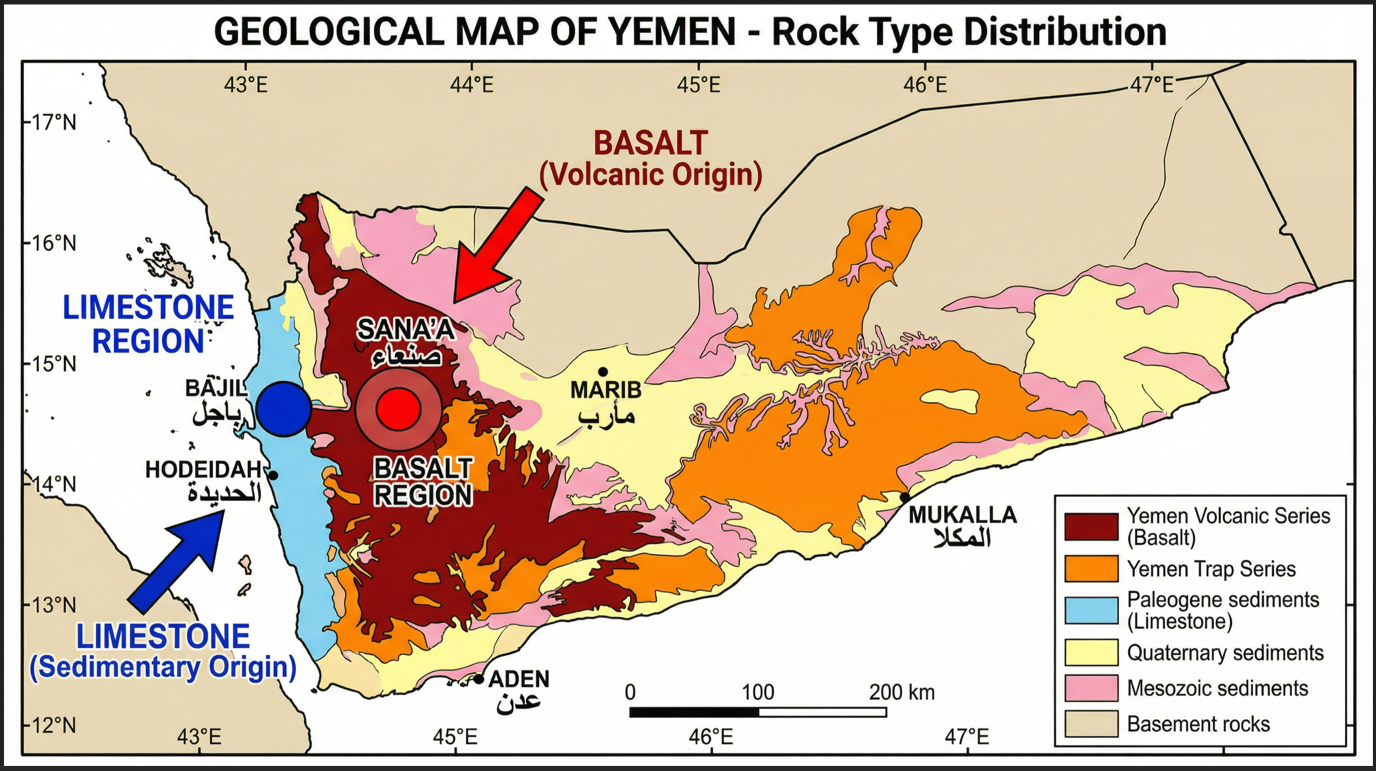
Mineral filler selection significantly influences the mechanical performance and economic efficiency of Hot Mix Asphalt (HMA). This study evaluates two locally available Yemeni fillers, Bajil limestone and Sana’a basalt, to identify a technically and economically optimal alternative for pavement construction. Marshall mix design and standardized laboratory tests were conducted to assess stability, flow, volumetric properties, optimum asphalt content (OAC), and moisture susceptibility. Results indicate that the limestone mixture achieved an OAC of (3.8%), compared to (4.8%) for the basalt mixture, representing a 21% reduction in asphalt binder demand and substantial cost savings. Although basalt provided slightly higher Marshall stability, both mixtures satisfied specification requirements. The limestone mix demonstrated superior moisture resistance, achieving a tensile strength ratio of (90.7%) compared to (82.6%) for basalt. Overall, Bajil limestone provides adequate mechanical performance, improved durability, and enhanced economic efficiency, making it a practical and sustainable alternative filler for asphalt pavement applications in Yemen.
Salman Al-Nuwairah, Abdlsalam AL-Thawr, Ali Rajeh (2026). Influence of Filler Type on Hot Mix Asphalt Properties: Performance Assessment of Bajil Limestone and Sana’a Basalt. Sana'a University Journal of Applied Sciences and Technology, 1881-1889. DOI: https://doi.org/10.59628/jast.v4i3.2725
Salman Al-Nuwairah, Abdlsalam AL-Thawr, Ali Rajeh . “Influence of Filler Type on Hot Mix Asphalt Properties: Performance Assessment of Bajil Limestone and Sana’a Basalt.” Sana'a University Journal of Applied Sciences and Technology, 2026, pp. 1881-1889. https://doi.org/10.59628/jast.v4i3.2725. Accessed 31 Oct. 2026.
Salman Al-Nuwairah, Abdlsalam AL-Thawr, Ali Rajeh . 2026. “Influence of Filler Type on Hot Mix Asphalt Properties: Performance Assessment of Bajil Limestone and Sana’a Basalt.” Sana'a University Journal of Applied Sciences and Technology : 1881-1889. DOI: https://doi.org/10.59628/jast.v4i3.2725
Salman Al-Nuwairah, Abdlsalam AL-Thawr, Ali Rajeh (2026) ‘Influence of Filler Type on Hot Mix Asphalt Properties: Performance Assessment of Bajil Limestone and Sana’a Basalt’, Sana'a University Journal of Applied Sciences and Technology, pp. 1881-1889. doi: 10.59628/jast.v4i3.2725
@article{jast2026_art2725,
    author  = {Salman Al-Nuwairah, Abdlsalam  AL-Thawr, Ali Rajeh },
    title   = {Influence of Filler Type on Hot Mix Asphalt Properties: Performance Assessment of Bajil Limestone and Sana’a Basalt},
    journal = {Sana'a University Journal of Applied Sciences and Technology},    year    = {2026},    month   = {March},    pages   = {1881-1889},    doi     = {10.59628/jast.v4i3.2725},
    url     = {https://doi.org/10.59628/jast.v4i3.2725},}
Influence of Filler Type on Hot Mix Asphalt Properties: Performance Assessment of Bajil Limestone and Sana’a Basalt

In Yemen, telecom projects frequently experience schedule delays, which in turn impede the successful execution of strategic initiatives and the effective deployment of new public services. This study aims to investigate the internal factors causing schedule delays in Yemen-Mobile’s transceiver sites projects. A re-structured questionnaire was distributed to employees involved in the implementation of transceiver sits projects in Yemen Mobile. Of the 191 questionnaires distributed, 154 valid responses were collected and used for analysis. The study identified ten major factors that have a significant detrimental influence on project schedules and caused delay. Procurement phase - related issues emerged as the most influential. These factors included a lack of technical equipment, supplier-related delays, lengthy purchasing procedures and unqualified technical equipment suppliers. Furthermore, Delays in the implementation phase also include delays in fiber optic network connection, security-related material and equipment delays to the project site and implementation start barriers. In addition to, the lack of comprehensive procurement planning, ineffective the strategy of addressing challenges of sites acquisition and lack of monitoring and control plans were identified as a critical planning issue. The study provided practical recommendations for improving procurement management, boosting the efficiency of the implementation phase, and addressing planning issues.
Mohammed Ahmed M. Aqlan, Wael Alaghbari, Farouk A. Al-Fahaidy (2026). KEY INTERNAL FACTORS CAUSING SCHEDULE DELAYS IN YEMEN-MOBILE TELECOM TRANSCEIVER SITES PROJECTS. Sana'a University Journal of Applied Sciences and Technology, 1481-1495. DOI: https://doi.org/10.59628/jast.v4i1.2292
Mohammed Ahmed M. Aqlan, Wael Alaghbari, Farouk A. Al-Fahaidy . “KEY INTERNAL FACTORS CAUSING SCHEDULE DELAYS IN YEMEN-MOBILE TELECOM TRANSCEIVER SITES PROJECTS.” Sana'a University Journal of Applied Sciences and Technology, 2026, pp. 1481-1495. https://doi.org/10.59628/jast.v4i1.2292. Accessed 31 Oct. 2026.
Mohammed Ahmed M. Aqlan, Wael Alaghbari, Farouk A. Al-Fahaidy . 2026. “KEY INTERNAL FACTORS CAUSING SCHEDULE DELAYS IN YEMEN-MOBILE TELECOM TRANSCEIVER SITES PROJECTS.” Sana'a University Journal of Applied Sciences and Technology : 1481-1495. DOI: https://doi.org/10.59628/jast.v4i1.2292
Mohammed Ahmed M. Aqlan, Wael Alaghbari, Farouk A. Al-Fahaidy (2026) ‘KEY INTERNAL FACTORS CAUSING SCHEDULE DELAYS IN YEMEN-MOBILE TELECOM TRANSCEIVER SITES PROJECTS’, Sana'a University Journal of Applied Sciences and Technology, pp. 1481-1495. doi: 10.59628/jast.v4i1.2292
@article{jast2026_art2292,
    author  = {Mohammed Ahmed M. Aqlan, Wael Alaghbari, Farouk A. Al-Fahaidy },
    title   = {KEY INTERNAL FACTORS CAUSING SCHEDULE DELAYS IN YEMEN-MOBILE TELECOM TRANSCEIVER SITES PROJECTS},
    journal = {Sana'a University Journal of Applied Sciences and Technology},    year    = {2026},    month   = {January},    pages   = {1481-1495},    doi     = {10.59628/jast.v4i1.2292},
    url     = {https://doi.org/10.59628/jast.v4i1.2292},}
KEY INTERNAL FACTORS CAUSING SCHEDULE DELAYS IN YEMEN-MOBILE TELECOM TRANSCEIVER SITES PROJECTS
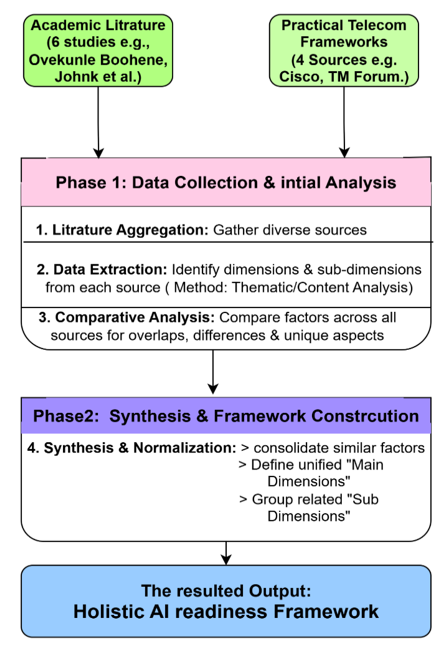
Telecommunications operators are under increasing pressure to use Artificial Intelligence (AI) to keep up with the recent technologies and stay ahead in the service provision advancement. However, within organizations that are not adequately prepared for AI adoption, many of these initiatives fail to gain traction. The study explores how existing academic research and practical frameworks can conceptualize organizational AI readiness in project-based telecom contexts. It synthesizes six peer-reviewed academic studies on AI readiness and digital transformation and four telecom-relevant AI readiness and maturity frameworks from industry bodies. Using a hybrid Technology–Organization–Environment (TOE) and People Process–Technology-in-use–Data (PPTD) lens, the 80 readiness indicators derived from the academic and practical resources were coded. Then, analyzed them through reflexive thematic analysis and identified nine interrelated AI readiness themes: strategic AI vision and business alignment; leadership, culture and change climate; human capital and AI skills; data assets, governance and protection; technology and infrastructure backbone; AI solutions, lifecycle and experimentation; organizational processes, governance and project operations; value realization and performance impact; and external ecosystem, regulation and partnerships. These themes are integrated into a conceptual diagnostic framework tailored to project management in telecom organizations and motivated by the challenges of communication service providers in contexts such as Yemen. The resulted framework addresses the gap of fragmented academic and practical perspectives. This offers telecom project management offices (PMOs) a conceptualizing mechanism to reflect on AI readiness, identify potential gaps and prioritizing interventions. In the same time, it provides a basis for future empirical validation and cross-sector comparison.
Mohammed Abdullah Thabit Al-maazi, Ibrahim Alameri, Farouk A. Al-Fahaidy (2026). Organizational AI Readiness for Telecom Project Management: A Conceptual Review and Diagnostic Framework. Sana'a University Journal of Applied Sciences and Technology, 2010-2024. DOI: https://doi.org/10.59628/jast.v4i4.2682
Mohammed Abdullah Thabit Al-maazi, Ibrahim Alameri, Farouk A. Al-Fahaidy . “Organizational AI Readiness for Telecom Project Management: A Conceptual Review and Diagnostic Framework.” Sana'a University Journal of Applied Sciences and Technology, 2026, pp. 2010-2024. https://doi.org/10.59628/jast.v4i4.2682. Accessed 31 Oct. 2026.
Mohammed Abdullah Thabit Al-maazi, Ibrahim Alameri, Farouk A. Al-Fahaidy . 2026. “Organizational AI Readiness for Telecom Project Management: A Conceptual Review and Diagnostic Framework.” Sana'a University Journal of Applied Sciences and Technology : 2010-2024. DOI: https://doi.org/10.59628/jast.v4i4.2682
Mohammed Abdullah Thabit Al-maazi, Ibrahim Alameri, Farouk A. Al-Fahaidy (2026) ‘Organizational AI Readiness for Telecom Project Management: A Conceptual Review and Diagnostic Framework’, Sana'a University Journal of Applied Sciences and Technology, pp. 2010-2024. doi: 10.59628/jast.v4i4.2682
@article{jast2026_art2682,
    author  = {Mohammed Abdullah Thabit Al-maazi, Ibrahim Alameri, Farouk A. Al-Fahaidy },
    title   = {Organizational AI Readiness for Telecom Project Management: A Conceptual Review and Diagnostic Framework},
    journal = {Sana'a University Journal of Applied Sciences and Technology},    year    = {2026},    month   = {April},    pages   = {2010-2024},    doi     = {10.59628/jast.v4i4.2682},
    url     = {https://doi.org/10.59628/jast.v4i4.2682},}
Organizational AI Readiness for Telecom Project Management: A Conceptual Review and Diagnostic Framework
Explore commentaries, corrections, critiques and other scholarly links.
This document provides a detailed methodological and scientific response to the commentary on our published study of factors influencing the success of occupational health and safety (OHS) management in NGO-related construction projects in Sana’a, Yemen. The response clarifies the study’s empirical scope, sampling rationale, interpretation of questionnaire-based evidence, psychometric results, institutional context, and use of ISO 45001:2018 as an analytical framework. It also acknowledges the distinction between perceived management priorities and objective safety performance indicators and explains how the study’s recommendations were derived from the evidence collected. The authors have revised the presentation of the response to maintain a respectful academic tone and to distinguish clearly between textual clarification, methodological justification, and points that may warrant further discussion.
Ibtisam M. H. Al-Ma’anisi, Fadhl A. S. Al-Nozaily, Tariq A. Barakat (2026). Reply to Comment on The Identifying the Key Factors Affecting the Success of Occupational Health and Safety Management during the Implementation of Construction Projects for NGOs in Sana’a, Yemen. Sana'a University Journal of Applied Sciences and Technology, 2733-2740. DOI: https://doi.org/10.59628/jast.v4i10.4021
Ibtisam M. H. Al-Ma’anisi, Fadhl A. S. Al-Nozaily, Tariq A. Barakat . “Reply to Comment on The Identifying the Key Factors Affecting the Success of Occupational Health and Safety Management during the Implementation of Construction Projects for NGOs in Sana’a, Yemen.” Sana'a University Journal of Applied Sciences and Technology, 2026, pp. 2733-2740. https://doi.org/10.59628/jast.v4i10.4021. Accessed 31 Oct. 2026.
Ibtisam M. H. Al-Ma’anisi, Fadhl A. S. Al-Nozaily, Tariq A. Barakat . 2026. “Reply to Comment on The Identifying the Key Factors Affecting the Success of Occupational Health and Safety Management during the Implementation of Construction Projects for NGOs in Sana’a, Yemen.” Sana'a University Journal of Applied Sciences and Technology : 2733-2740. DOI: https://doi.org/10.59628/jast.v4i10.4021
Ibtisam M. H. Al-Ma’anisi, Fadhl A. S. Al-Nozaily, Tariq A. Barakat (2026) ‘Reply to Comment on The Identifying the Key Factors Affecting the Success of Occupational Health and Safety Management during the Implementation of Construction Projects for NGOs in Sana’a, Yemen’, Sana'a University Journal of Applied Sciences and Technology, pp. 2733-2740. doi: 10.59628/jast.v4i10.4021
@article{jast2026_art4021,
    author  = {Ibtisam M. H. Al-Ma’anisi, Fadhl A. S. Al-Nozaily, Tariq A. Barakat },
    title   = {Reply to Comment on The Identifying the Key Factors Affecting the Success of Occupational Health and Safety Management during the Implementation of Construction Projects for NGOs in Sana’a, Yemen},
    journal = {Sana'a University Journal of Applied Sciences and Technology},    year    = {2026},    month   = {October},    pages   = {2733-2740},    doi     = {10.59628/jast.v4i10.4021},
    url     = {https://doi.org/10.59628/jast.v4i10.4021},}
Reply to Comment on The Identifying the Key Factors Affecting the Success of Occupational Health and Safety Management during the Implementation of Construction Projects for NGOs in Sana’a, Yemen
Disputes in construction projects pose a major challenge worldwide, particularly in fragile environments such as Yemen, where they often disrupt key infrastructure development. This study examines the root causes of disputes in foreign-led construction projects in Yemen, using a mixed-methods approach that integrates quantitative and qualitative data. A structured questionnaire was distributed to 212 professionals (199 valid responses), and semi-structured interviews were conducted with five senior Yemeni experts. Nineteen dispute-related variables were analyzed in five dimensions: technical, contractual, administrative, operational, and behavioral. Statistical analyses using SPSS (t-tests and ANOVA) confirmed that all the dimensions were significant and interrelated. The results identified unclear contract clauses, delayed payments, weak coordination, and cultural gaps as the primary dispute triggers. The triangulated findings validate the reliability of the results. The study concludes that disputes arise from multiple interlinked factors and recommends stronger contract governance, effective communication, and proactive project management to minimize disputes in Yemen’s construction sector.
Akram Fadhel Murshed AL-Matari, Abdulmalek Hazza Al-Jolahy, Fadhl Ali Al-Nozaily (2026). Root Causes of Disputes in Construction Projects Implemented by Foreign Companies in Yemen. Sana'a University Journal of Applied Sciences and Technology, 1741-1750. DOI: https://doi.org/10.59628/jast.v4i2.2227
Akram Fadhel Murshed AL-Matari, Abdulmalek Hazza Al-Jolahy, Fadhl Ali Al-Nozaily . “Root Causes of Disputes in Construction Projects Implemented by Foreign Companies in Yemen.” Sana'a University Journal of Applied Sciences and Technology, 2026, pp. 1741-1750. https://doi.org/10.59628/jast.v4i2.2227. Accessed 31 Oct. 2026.
Akram Fadhel Murshed AL-Matari, Abdulmalek Hazza Al-Jolahy, Fadhl Ali Al-Nozaily . 2026. “Root Causes of Disputes in Construction Projects Implemented by Foreign Companies in Yemen.” Sana'a University Journal of Applied Sciences and Technology : 1741-1750. DOI: https://doi.org/10.59628/jast.v4i2.2227
Akram Fadhel Murshed AL-Matari, Abdulmalek Hazza Al-Jolahy, Fadhl Ali Al-Nozaily (2026) ‘Root Causes of Disputes in Construction Projects Implemented by Foreign Companies in Yemen’, Sana'a University Journal of Applied Sciences and Technology, pp. 1741-1750. doi: 10.59628/jast.v4i2.2227
@article{jast2026_art2227,
    author  = {Akram Fadhel Murshed AL-Matari, Abdulmalek Hazza Al-Jolahy, Fadhl Ali Al-Nozaily },
    title   = {Root Causes of Disputes in Construction Projects Implemented by Foreign Companies in Yemen},
    journal = {Sana'a University Journal of Applied Sciences and Technology},    year    = {2026},    month   = {February},    pages   = {1741-1750},    doi     = {10.59628/jast.v4i2.2227},
    url     = {https://doi.org/10.59628/jast.v4i2.2227},}
Root Causes of Disputes in Construction Projects Implemented by Foreign Companies in Yemen
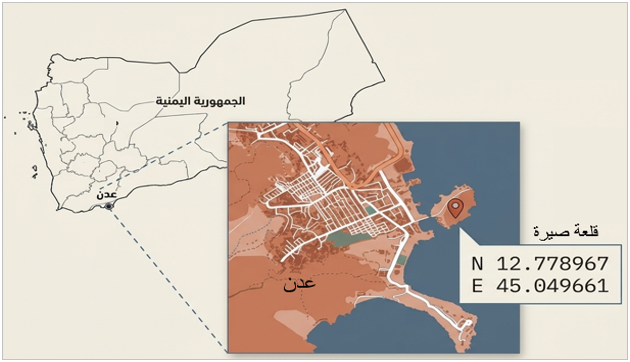
Qadhad is one of the most prominent traditional construction materials in Yemeni architecture, it has been used for centuries in lining cisterns, roofs, and hydraulic structures due to its high resistance to water and moisture, as well as its remarkable long-term durability. This study aims to characterize and analyze the properties of traditional Qadhad used in the historic Sira Castle in Aden City, thereby providing a scientific basis for its reproduction with comparable performance in contemporary conservation and construction as a waterproofing material. Physical tests (apparent density, open porosity, water absorption, and capillary absorption), hydraulic tests (permeability and hydraulic indices), and mineralogical analyses (XRD, XRF, SEM-EDS) were conducted in accordance with international standards. The results indicated that the apparent density of the Sira Castle Qadhad reached 1740 kg/m³, while the open porosity was 19.6%. The water absorption was 11.27%, and the permeability coefficient was approximately 6.55×10⁻⁹ m/s, demonstrating an exceptional ability to resist water infiltration and an excellent balance between density and durability. The mineral analyses (XRD and XRF) revealed the mineralogical and chemical composition of the Qadhad, while SEM-EDS micrographs showed its dense microstructure formed by calcium and aluminum hydrate gels that fill the pores, granting the material outstanding waterproofing performance that has endured for centuries in coastal environments.
Sarhan Al-Gawi, M.A. Al-Gorafi, Abdulwahab M. Al-Nono (2026). Unveiling the Secrets of Ancient Waterproofing: A Multi-Analytical Characterization of Traditional Qadhad Mortar from Sira Castle, Yemen. Sana'a University Journal of Applied Sciences and Technology, 2103-2121. DOI: https://doi.org/10.59628/jast.v4i5.2910
Sarhan Al-Gawi, M.A. Al-Gorafi, Abdulwahab M. Al-Nono . “Unveiling the Secrets of Ancient Waterproofing: A Multi-Analytical Characterization of Traditional Qadhad Mortar from Sira Castle, Yemen.” Sana'a University Journal of Applied Sciences and Technology, 2026, pp. 2103-2121. https://doi.org/10.59628/jast.v4i5.2910. Accessed 31 Oct. 2026.
Sarhan Al-Gawi, M.A. Al-Gorafi, Abdulwahab M. Al-Nono . 2026. “Unveiling the Secrets of Ancient Waterproofing: A Multi-Analytical Characterization of Traditional Qadhad Mortar from Sira Castle, Yemen.” Sana'a University Journal of Applied Sciences and Technology : 2103-2121. DOI: https://doi.org/10.59628/jast.v4i5.2910
Sarhan Al-Gawi, M.A. Al-Gorafi, Abdulwahab M. Al-Nono (2026) ‘Unveiling the Secrets of Ancient Waterproofing: A Multi-Analytical Characterization of Traditional Qadhad Mortar from Sira Castle, Yemen’, Sana'a University Journal of Applied Sciences and Technology, pp. 2103-2121. doi: 10.59628/jast.v4i5.2910
@article{jast2026_art2910,
    author  = {Sarhan Al-Gawi, M.A. Al-Gorafi, Abdulwahab M. Al-Nono },
    title   = {Unveiling the Secrets of Ancient Waterproofing: A Multi-Analytical Characterization of Traditional Qadhad Mortar from Sira Castle, Yemen},
    journal = {Sana'a University Journal of Applied Sciences and Technology},    year    = {2026},    month   = {May},    pages   = {2103-2121},    doi     = {10.59628/jast.v4i5.2910},
    url     = {https://doi.org/10.59628/jast.v4i5.2910},}
Unveiling the Secrets of Ancient Waterproofing: A Multi-Analytical Characterization of Traditional Qadhad Mortar from Sira Castle, Yemen
Nothing has been published in this category yet.

Sana'a University Journal
of Applied Sciences and Technology
A peer-reviewed, open-access journal publishing high-quality research in applied sciences, engineering, and technology since 2023.
