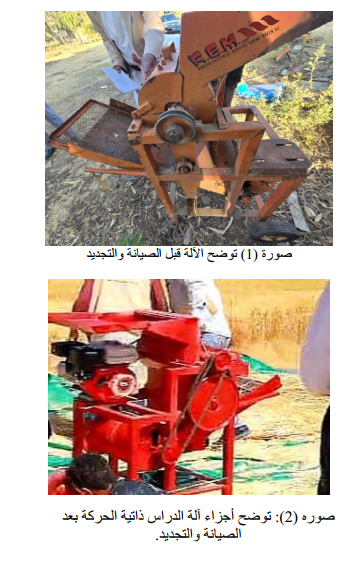
Threshing and winnowing are essential post-harvest operations in cereal production, particularly for smallholdings, where traditional manual methods demand extensive labor, time, and cost, while also increasing grain losses during transport. To address these limitations, a self propelled threshing and winnowing machine suitable for small-scale farms was developed. This study evaluated the effects of four drum rotational speeds (800, 1000, 1200, and 1400 rpm) and four feed rates (20, 25, 30, and 35 kg) on wheat productivity, operating time, threshing efficiency, energy consumption, operating cost, and cleaning efficiency. The results indicated that wheat productivity increased with higher drum speed and feed rate, reaching a maximum at 1400 rpm and 35 kg. Operating time decreased with increasing drum speed and increased with higher feed rates, with the shortest time (39.1 min) observed at 1400 rpm and 20 kg. Conversely, threshing efficiency decreased as drum speed increased but improved with higher feed rates, achieving a maximum value of 89.2% at 800 rpm and 35 kg. Total grain losses, energy consumption, and operating costs increased with both drum speed and feed rate, while cleaning efficiency declined. The lowest grain loss (5.38%), minimum energy consumption (41.4 kWh), lowest operating cost, and highest cleaning efficiency (92.2%) were recorded at 800 rpm and a feed rate of 20 kg. Overall, although higher speeds and feed rates enhance productivity, they adversely affect efficiency, losses, and costs. Therefore, optimal operating conditions depend on balancing productivity and performance, with the best overall performance achieved at 800 rpm and 20 kg feed rate.