To create fresh transition metal complexes of chloroquine and ketoprofen, we combined Ni(II), Co(II), Cu(II), and Zn(II). Metal analysis, IR, UV-vis, and X-ray diffraction (XRD) spectrum analyzes of the complexes were utilized to characterize them. The octahedral geometry was proposed for all compounds on the basis of the UV-vis and magnetic susceptibility data. The practical size of the ligands and complexes with crystallinity structure was in the nano range according to the XRD data. The antibacterial and antifungal activities of the ligands and their metal complexes have been examined.
Yasmin M.S. Jamil, Fathi M. Al-Azab, Nedhal A. A. Al-Selwi, Anwar M. AL-Ryami, Mosaad R. Mlahia (2024). Spectroscopic and biological studies of mixed ligand complexes of transition metal (II) ions with chloroquine and ketoprofen. Sana'a University Journal of Applied Sciences and Technology, 53 - 64. DOI: https://doi.org/10.59628/jast.v2i1.801
Yasmin M.S. Jamil, Fathi M. Al-Azab, Nedhal A. A. Al-Selwi, Anwar M. AL-Ryami, Mosaad R. Mlahia . “Spectroscopic and biological studies of mixed ligand complexes of transition metal (II) ions with chloroquine and ketoprofen.” Sana'a University Journal of Applied Sciences and Technology, 2024, pp. 53 - 64. https://doi.org/10.59628/jast.v2i1.801. Accessed 31 Oct. 2026.
Yasmin M.S. Jamil, Fathi M. Al-Azab, Nedhal A. A. Al-Selwi, Anwar M. AL-Ryami, Mosaad R. Mlahia . 2024. “Spectroscopic and biological studies of mixed ligand complexes of transition metal (II) ions with chloroquine and ketoprofen.” Sana'a University Journal of Applied Sciences and Technology : 53 - 64. DOI: https://doi.org/10.59628/jast.v2i1.801
Yasmin M.S. Jamil, Fathi M. Al-Azab, Nedhal A. A. Al-Selwi, Anwar M. AL-Ryami, Mosaad R. Mlahia (2024) ‘Spectroscopic and biological studies of mixed ligand complexes of transition metal (II) ions with chloroquine and ketoprofen’, Sana'a University Journal of Applied Sciences and Technology, pp. 53 - 64. doi: 10.59628/jast.v2i1.801
@article{jast2024_art801,
    author  = {Yasmin M.S. Jamil, Fathi M. Al-Azab, Nedhal A. A. Al-Selwi, Anwar M. AL-Ryami, Mosaad R. Mlahia },
    title   = {Spectroscopic and biological studies of mixed ligand complexes of transition metal (II) ions with chloroquine and ketoprofen},
    journal = {Sana'a University Journal of Applied Sciences and Technology},    year    = {2024},    month   = {February},    pages   = {53 - 64},    doi     = {10.59628/jast.v2i1.801},
    url     = {https://doi.org/10.59628/jast.v2i1.801},}
Spectroscopic and biological studies of mixed ligand complexes of transition metal (II) ions with chloroquine and ketoprofen
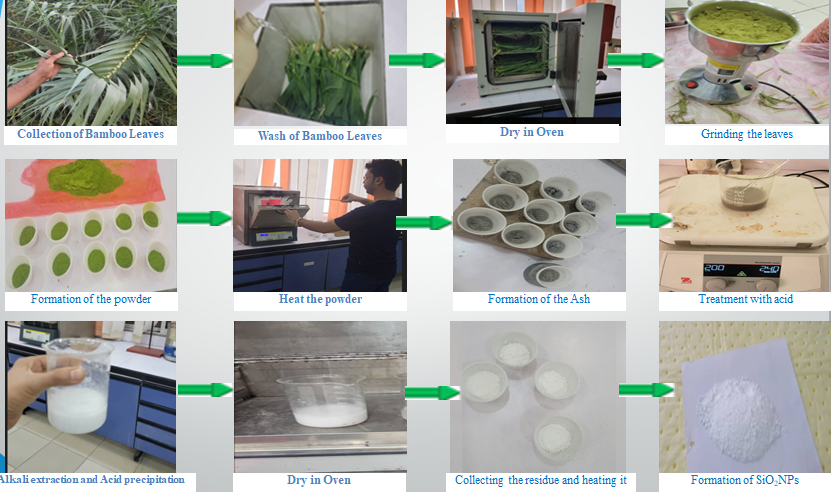
This study illustrates the low-cost, eco-friendly synthesis of silica nanoparticles using local bamboo leaves collected in August 2024 from the Aqqan Valley in the Al-Masimir District of Lahij Governorate, Yemen. Nanosilica powder synthesis by precipitation method is generated subsequent to thermal treatment of BLA at 750°C followed by characterization using advanced characterization techniques. The absorption peaks close to λmax = 240 nm in the UV spectrum showed silica nanoparticles, which were observed using UV-Vis spectroscopy. The presence of a siloxane group (Si-O-Si) in the experimental FT-IR spectral data indicated the high purity of the nanosilica particles. The prepared silica showed a high purity of 97.82% using XRF. The particle size determined by transmission electron microscopy (TEM) was found to be between 10.79 nm and 22.73 nm with minor agglomerations. Analysis of the nanosilica by X-ray diffraction (XRD) confirmed an amorphous structure with a
peak intensity at 2θ=23°.
Fursan Thabet A. Saleh, Sadeq H. Azzam, Amani A. Al-Gaadbi, Bushra M. Alattab, Saad A. Al-Arnoot, Hussein M.A. Al-Maydama, Maher Ali Almaqtari (2025). Synthesis and characteristics of Silica nanoparticles (SiO2NPs) from Bamboo Leaves Ash by precipitation method. Sana'a University Journal of Applied Sciences and Technology, 949-953. DOI: https://doi.org/10.59628/jast.v3i4.1792
Fursan Thabet A. Saleh, Sadeq H. Azzam, Amani A. Al-Gaadbi, Bushra M. Alattab, Saad A. Al-Arnoot, Hussein M.A. Al-Maydama, Maher Ali Almaqtari . “Synthesis and characteristics of Silica nanoparticles (SiO2NPs) from Bamboo Leaves Ash by precipitation method.” Sana'a University Journal of Applied Sciences and Technology, 2025, pp. 949-953. https://doi.org/10.59628/jast.v3i4.1792. Accessed 31 Oct. 2026.
Fursan Thabet A. Saleh, Sadeq H. Azzam, Amani A. Al-Gaadbi, Bushra M. Alattab, Saad A. Al-Arnoot, Hussein M.A. Al-Maydama, Maher Ali Almaqtari . 2025. “Synthesis and characteristics of Silica nanoparticles (SiO2NPs) from Bamboo Leaves Ash by precipitation method.” Sana'a University Journal of Applied Sciences and Technology : 949-953. DOI: https://doi.org/10.59628/jast.v3i4.1792
Fursan Thabet A. Saleh, Sadeq H. Azzam, Amani A. Al-Gaadbi, Bushra M. Alattab, Saad A. Al-Arnoot, Hussein M.A. Al-Maydama, Maher Ali Almaqtari (2025) ‘Synthesis and characteristics of Silica nanoparticles (SiO2NPs) from Bamboo Leaves Ash by precipitation method’, Sana'a University Journal of Applied Sciences and Technology, pp. 949-953. doi: 10.59628/jast.v3i4.1792
@article{jast2025_art1792,
    author  = {Fursan Thabet A.  Saleh, Sadeq H. Azzam, Amani A. Al-Gaadbi, Bushra M. Alattab, Saad A. Al-Arnoot, Hussein M.A. Al-Maydama, Maher Ali  Almaqtari },
    title   = {Synthesis and characteristics of Silica nanoparticles (SiO2NPs) from Bamboo Leaves Ash by precipitation method},
    journal = {Sana'a University Journal of Applied Sciences and Technology},    year    = {2025},    month   = {August},    pages   = {949-953},    doi     = {10.59628/jast.v3i4.1792},
    url     = {https://doi.org/10.59628/jast.v3i4.1792},}
Synthesis and characteristics of Silica nanoparticles (SiO2NPs) from Bamboo Leaves Ash by precipitation method

Mixed ligand complexes of fluconazole (FCZ), like the main ligand and glycine (Gly) as the secondary ligand, were synthesized and characterized using elemental analysis, spectroscopy, infrared and electronic spectra, magnetic susceptibility, and molar conductivity. The results showed that 1:1:1 [M:L1:L2] octahedral complexes were formed, with FCZ coordinating through its C=N group and glycine coordinating through its carboxylic oxygen and amino nitrogen. Molar conductivity indicated the complexes were not electrolytic in nature. The antifungal activity of FCZ, glycine, and their metal complexes with Cu, Ni, and Cd was tested against Aspergillus niger, Peni- cillium italicum, and Candida albicans. Cadmium complex [Cd(FCZ)(Gly (H2O)2Cl].2H2O showed significantly enhanced activity with outperforming the standard antifungal agent Nystatin against A. niger and P. italicum. These findings highlight the potential of such complexes as effective antifungal agents.
Yasmin Jamil, Majeda M. Al-Baseer, Basem Al-Akhali, Ahmed N. Alhakimi (2025). Synthesis and characterization of mixed ligand complexes of Fluconazole drug and glycine with some transition metals: antifungal study. Sana'a University Journal of Applied Sciences and Technology, 718-729. DOI: https://doi.org/10.59628/jast.v3i2.1534
Yasmin Jamil, Majeda M. Al-Baseer, Basem Al-Akhali, Ahmed N. Alhakimi . “Synthesis and characterization of mixed ligand complexes of Fluconazole drug and glycine with some transition metals: antifungal study.” Sana'a University Journal of Applied Sciences and Technology, 2025, pp. 718-729. https://doi.org/10.59628/jast.v3i2.1534. Accessed 31 Oct. 2026.
Yasmin Jamil, Majeda M. Al-Baseer, Basem Al-Akhali, Ahmed N. Alhakimi . 2025. “Synthesis and characterization of mixed ligand complexes of Fluconazole drug and glycine with some transition metals: antifungal study.” Sana'a University Journal of Applied Sciences and Technology : 718-729. DOI: https://doi.org/10.59628/jast.v3i2.1534
Yasmin Jamil, Majeda M. Al-Baseer, Basem Al-Akhali, Ahmed N. Alhakimi (2025) ‘Synthesis and characterization of mixed ligand complexes of Fluconazole drug and glycine with some transition metals: antifungal study’, Sana'a University Journal of Applied Sciences and Technology, pp. 718-729. doi: 10.59628/jast.v3i2.1534
@article{jast2025_art1534,
    author  = {Yasmin Jamil, Majeda M. Al-Baseer, Basem Al-Akhali, Ahmed N. Alhakimi },
    title   = {Synthesis and characterization of mixed ligand complexes of Fluconazole drug and glycine with some transition metals: antifungal study},
    journal = {Sana'a University Journal of Applied Sciences and Technology},    year    = {2025},    month   = {April},    pages   = {718-729},    doi     = {10.59628/jast.v3i2.1534},
    url     = {https://doi.org/10.59628/jast.v3i2.1534},}
Synthesis and characterization of mixed ligand complexes of Fluconazole drug and glycine with some transition metals: antifungal study

4-(N, N-dimethylaminobenzylidene) 1-phenylsemicarbazide Schiff base (SB) was synthesized from 1-phenylsemicarbazide and 4-(N,N-dimethylaminobenzaldehyde). Numerous analytical approaches, such as ele-mental analysis, 1HNMR, 13CNMR, electronic spectra, and FT-IR spectroscopy were utilized to analyze the newly synthesized Schiff base. The Ti (IV) Schiff base complex was produced, and its electrolytic nature, stability, and octahedral structural properties were determined by elemental, IR, UV-Vis spectral, conductivity, and thermal studies (TGA-DTA). From XRD results, the practical size of Schiff base and its complex were in the nano range with crystallinity structure. To evaluate the antibacterial activity, the free ligand and its complex were assessed in vitro against Pseudomonas aeruginosa, Escherichia coli, and Staphylococcus aureus. These results show that the metal complex has stronger antibacterial action than the Schiff base ligand.
Fathi M. Al-Azab, Yasmin M. S Jamil, Nedhal A. A. Al-Selwi, Ahmed N. Alhakimi, Dheya A. Hameed, Gamil M. S. Qasem, Abuzar Ebead Albadri Albadri (2024). Titanium Complex with New Schiff Base 4-(N, N-dimethylaminobenzylidene)-1- phenylsemicarbazide: Synthesis, Thermal, XRD, and Antibacterial properties. Sana'a University Journal of Applied Sciences and Technology, 391-402. DOI: https://doi.org/10.59628/jast.v2i4.1145
Fathi M. Al-Azab, Yasmin M. S Jamil, Nedhal A. A. Al-Selwi, Ahmed N. Alhakimi, Dheya A. Hameed, Gamil M. S. Qasem, Abuzar Ebead Albadri Albadri . “Titanium Complex with New Schiff Base 4-(N, N-dimethylaminobenzylidene)-1- phenylsemicarbazide: Synthesis, Thermal, XRD, and Antibacterial properties.” Sana'a University Journal of Applied Sciences and Technology, 2024, pp. 391-402. https://doi.org/10.59628/jast.v2i4.1145. Accessed 31 Oct. 2026.
Fathi M. Al-Azab, Yasmin M. S Jamil, Nedhal A. A. Al-Selwi, Ahmed N. Alhakimi, Dheya A. Hameed, Gamil M. S. Qasem, Abuzar Ebead Albadri Albadri . 2024. “Titanium Complex with New Schiff Base 4-(N, N-dimethylaminobenzylidene)-1- phenylsemicarbazide: Synthesis, Thermal, XRD, and Antibacterial properties.” Sana'a University Journal of Applied Sciences and Technology : 391-402. DOI: https://doi.org/10.59628/jast.v2i4.1145
Fathi M. Al-Azab, Yasmin M. S Jamil, Nedhal A. A. Al-Selwi, Ahmed N. Alhakimi, Dheya A. Hameed, Gamil M. S. Qasem, Abuzar Ebead Albadri Albadri (2024) ‘Titanium Complex with New Schiff Base 4-(N, N-dimethylaminobenzylidene)-1- phenylsemicarbazide: Synthesis, Thermal, XRD, and Antibacterial properties’, Sana'a University Journal of Applied Sciences and Technology, pp. 391-402. doi: 10.59628/jast.v2i4.1145
@article{jast2024_art1145,
    author  = {Fathi M. Al-Azab, Yasmin M. S Jamil, Nedhal A. A. Al-Selwi, Ahmed N. Alhakimi, Dheya A. Hameed, Gamil M. S.  Qasem, Abuzar Ebead Albadri Albadri },
    title   = {Titanium Complex with New Schiff Base 4-(N, N-dimethylaminobenzylidene)-1- phenylsemicarbazide: Synthesis, Thermal, XRD, and Antibacterial properties},
    journal = {Sana'a University Journal of Applied Sciences and Technology},    year    = {2024},    month   = {September},    pages   = {391-402},    doi     = {10.59628/jast.v2i4.1145},
    url     = {https://doi.org/10.59628/jast.v2i4.1145},}
Titanium Complex with New Schiff Base 4-(N, N-dimethylaminobenzylidene)-1- phenylsemicarbazide: Synthesis, Thermal, XRD, and Antibacterial properties
Nothing has been published in this category yet.

Sana'a University Journal
of Applied Sciences and Technology
A peer-reviewed, open-access journal publishing high-quality research in applied sciences, engineering, and technology since 2023.
