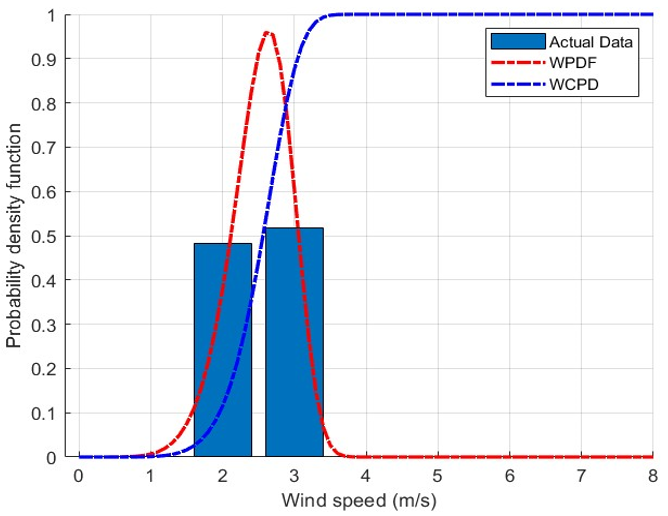
In the field of electricity generation, one promising area is wind energy, since it is accessible and renewable worldwide. This study evaluated the wind power potential (WPP) at the selected locations (Sana’a and Amran). This study makes use of wind speed data that was recorded at a height of 10 meters over five years (2010–2014). The mean and maximum values of the recorded wind speeds are shown in this study. Analysis was done on the monthly, seasonal, and annual changes in wind speed. Weibull distribution function (WDF) has been used to examine the wind properties and power potential of the suggested locations. Using the real data that was recorded over the five years, the annual mean wind speeds (MWS) in Sana’a were determined to be 2.513, 2.6, 2.445, 2.462 and 2.6 m/s respectively and in Amran, they were determined to be 2.899, 2.656, 2.88, 2.945, 3.05 m/s respectively. The mean power and energy densities over the five years were found to be 8.207 W/m2 and 71.889 kWh/m2; 11.803 W/m2 and 103.396 kWh/m2 for Sana’a and Amran respectively. The power density (PD) determined using the WDF and the power density PD determined using actual wind data were almost identical. Based on the findings, the MWS at the two sites chosen for the study is less than 4.0 m/s, which is far slower than the cut-in wind speed of many wind turbines from modern models. So, we recommend that some studies should be conducted to evaluate the potential for wind energy at some sites in Sana’a and Amran governorates outside the cities especially in or near mountainous site.
Waleed S A Hasan, Ali Saif M Hassan, Mohammed A Shukri (2025). Assessing Wind Power Potential at Sana’a and Amran in Yemen. Sana'a University Journal of Applied Sciences and Technology, 634-644. DOI: https://doi.org/10.59628/jast.v3i1.1535
Waleed S A Hasan, Ali Saif M Hassan, Mohammed A Shukri . “Assessing Wind Power Potential at Sana’a and Amran in Yemen.” Sana'a University Journal of Applied Sciences and Technology, 2025, pp. 634-644. https://doi.org/10.59628/jast.v3i1.1535. Accessed 30 Oct. 2026.
Waleed S A Hasan, Ali Saif M Hassan, Mohammed A Shukri . 2025. “Assessing Wind Power Potential at Sana’a and Amran in Yemen.” Sana'a University Journal of Applied Sciences and Technology : 634-644. DOI: https://doi.org/10.59628/jast.v3i1.1535
Waleed S A Hasan, Ali Saif M Hassan, Mohammed A Shukri (2025) ‘Assessing Wind Power Potential at Sana’a and Amran in Yemen’, Sana'a University Journal of Applied Sciences and Technology, pp. 634-644. doi: 10.59628/jast.v3i1.1535
@article{jast2025_art1535,
    author  = {Waleed S A Hasan, Ali Saif M Hassan, Mohammed A Shukri },
    title   = {Assessing Wind Power Potential at Sana’a and Amran in Yemen},
    journal = {Sana'a University Journal of Applied Sciences and Technology},    year    = {2025},    month   = {February},    pages   = {634-644},    doi     = {10.59628/jast.v3i1.1535},
    url     = {https://doi.org/10.59628/jast.v3i1.1535},}
Assessing Wind Power Potential at Sana’a and Amran in Yemen
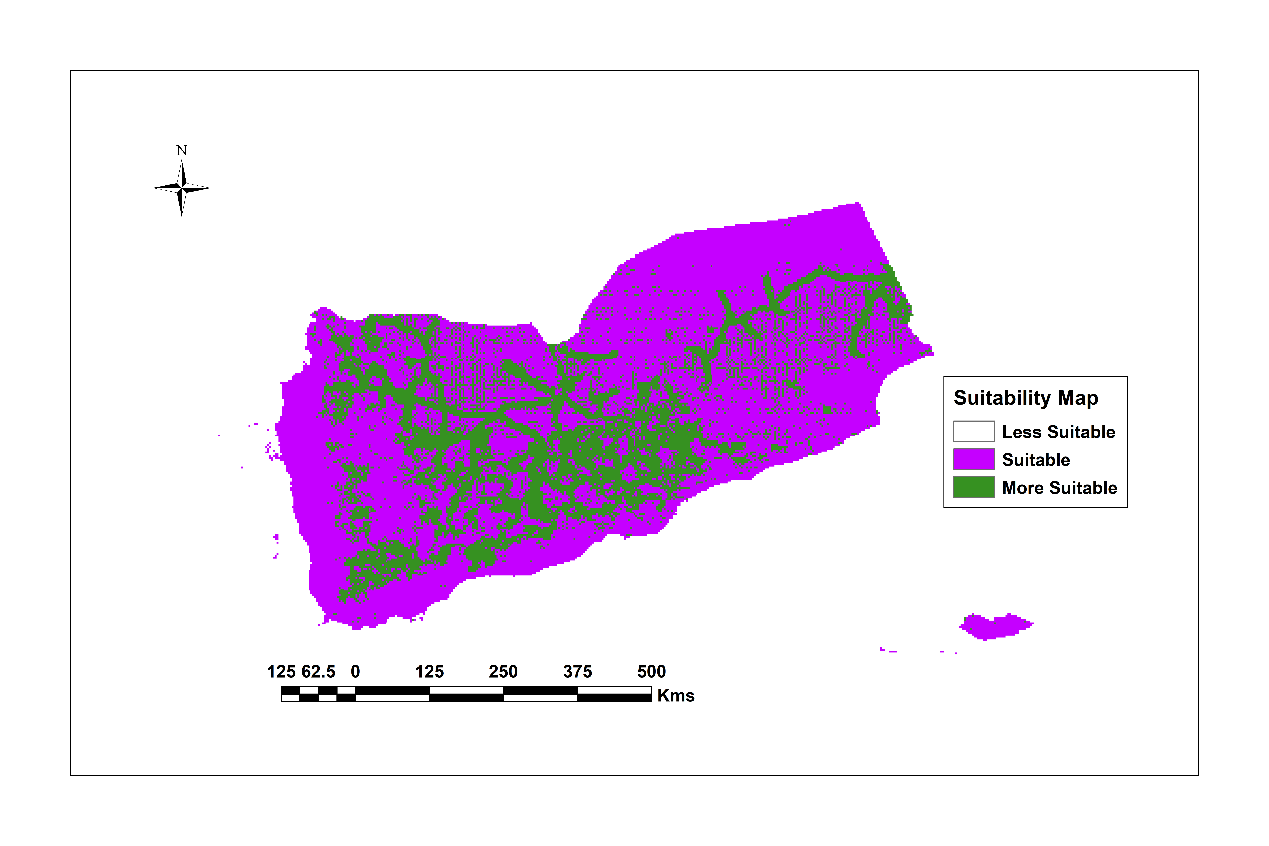
The study presents a comprehensive evaluation of optimal locations for solar energy facilities in Yemen by com-
bining Geographic Information System (GIS) technology with Multi-Criteria Decision-Making (MCDM) methodolo-
gies. It identifies twelve crucial criteria, assigning weights through the Analytical Hierarchy Process (AHP) and
subsequently validating them using the Best-Worst Method (BWM). A weighted overlay analysis conducted in
GIS resulted in a national suitability map, indicating that the eastern, southern, and northern regions of Yemen are
particularly well-suited for solar energy development. The findings reveal that 30.84% of the country is classified
as highly suitable, while 69.16% is moderately suitable, and merely 0.0022% is deemed less suitable for solar
installations. The sensitivity analysis highlights the significant influence of weighting the criteria, as even slight modifications to factors such as Global Horizontal Irradiance (GHI) and slope can lead to substantial changes in suitability assessments. Overall, the integration of AHP, BWM, and GIS is shown to create a robust framework for solar site selection, providing practical guidance for policymakers and energy planners in Yemen.
A. N. Algawbery, M. A. Shukri, M. K. AL-Moutawakel (2025). Suitability Analysis of Solar Energy Plant Sites in Yemen Using AHP, BWM, and GIS Methods. Sana'a University Journal of Applied Sciences and Technology, 999-1007. DOI: https://doi.org/10.59628/jast.v3i4.2068
A. N. Algawbery, M. A. Shukri, M. K. AL-Moutawakel . “Suitability Analysis of Solar Energy Plant Sites in Yemen Using AHP, BWM, and GIS Methods.” Sana'a University Journal of Applied Sciences and Technology, 2025, pp. 999-1007. https://doi.org/10.59628/jast.v3i4.2068. Accessed 30 Oct. 2026.
A. N. Algawbery, M. A. Shukri, M. K. AL-Moutawakel . 2025. “Suitability Analysis of Solar Energy Plant Sites in Yemen Using AHP, BWM, and GIS Methods.” Sana'a University Journal of Applied Sciences and Technology : 999-1007. DOI: https://doi.org/10.59628/jast.v3i4.2068
A. N. Algawbery, M. A. Shukri, M. K. AL-Moutawakel (2025) ‘Suitability Analysis of Solar Energy Plant Sites in Yemen Using AHP, BWM, and GIS Methods’, Sana'a University Journal of Applied Sciences and Technology, pp. 999-1007. doi: 10.59628/jast.v3i4.2068
@article{jast2025_art2068,
    author  = {A. N. Algawbery, M. A. Shukri, M. K. AL-Moutawakel },
    title   = {Suitability Analysis of Solar Energy Plant Sites in Yemen Using AHP, BWM, and GIS Methods},
    journal = {Sana'a University Journal of Applied Sciences and Technology},    year    = {2025},    month   = {August},    pages   = {999-1007},    doi     = {10.59628/jast.v3i4.2068},
    url     = {https://doi.org/10.59628/jast.v3i4.2068},}
Suitability Analysis of Solar Energy Plant Sites in Yemen Using AHP, BWM, and GIS Methods
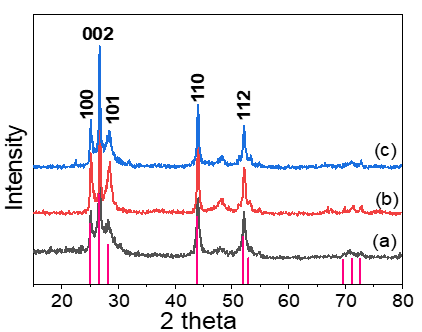
Cadmium sulfide cd1s1−x nanoparticles were synthesized using a simple and cost-effective hydrothermal method by varying the Cd:S molar ratio to investigate its effect on the photocatalytic degradation of Rhodamine B (Rh-B) in aqueous solution under simulated solar irradiation serves as a model organic pollutant. Structural and morphological characterization using XRD, SEM, and UV–Vis spectroscopy confirmed the particularity of cd1s1−x particle with good crystallinity and visible light absorption properties. The photocatalytic efficiency of the cd1s1−x nanoparticles exhibited a strong dependence on the sulfur ion concentration, indicating the critical role of precursor ratio in tuning photocatalyst performance. Among the samples, the one prepared with x= 0.3026 exhibited the highest degradation efficiency, achieving nearly complete removal of Rh-B within 73 minutes. The enhanced photocatalytic performance is attributed to the optimized particle size, which improves crystallinity and surface area, facilitating more efficient charge separation, light absorption, and separation of photogenerated charge carriers. This study highlights the crucial role of precursor composition in tailoring the structural and functional properties of cd1s1−x nanoparticles, providing a straightforward and scalable approach for developing efficient visible-light-responsive photocatalysts for environmental remediation applications.
H. Arhab, Shakib M. A. Alsowidy, Mohammed S.Qusailah, A. M. Abdulkarem (2026). Visible-Light Photocatalytic Enhancement in Hydrothermally Synthesized Cd₁S₁₋ₓ Nanoparticles: Structural and Optical Characterization. Sana'a University Journal of Applied Sciences and Technology, 1814-1824. DOI: https://doi.org/10.59628/jast.v4i3.2464
H. Arhab, Shakib M. A. Alsowidy, Mohammed S.Qusailah, A. M. Abdulkarem . “Visible-Light Photocatalytic Enhancement in Hydrothermally Synthesized Cd₁S₁₋ₓ Nanoparticles: Structural and Optical Characterization.” Sana'a University Journal of Applied Sciences and Technology, 2026, pp. 1814-1824. https://doi.org/10.59628/jast.v4i3.2464. Accessed 30 Oct. 2026.
H. Arhab, Shakib M. A. Alsowidy, Mohammed S.Qusailah, A. M. Abdulkarem . 2026. “Visible-Light Photocatalytic Enhancement in Hydrothermally Synthesized Cd₁S₁₋ₓ Nanoparticles: Structural and Optical Characterization.” Sana'a University Journal of Applied Sciences and Technology : 1814-1824. DOI: https://doi.org/10.59628/jast.v4i3.2464
H. Arhab, Shakib M. A. Alsowidy, Mohammed S.Qusailah, A. M. Abdulkarem (2026) ‘Visible-Light Photocatalytic Enhancement in Hydrothermally Synthesized Cd₁S₁₋ₓ Nanoparticles: Structural and Optical Characterization’, Sana'a University Journal of Applied Sciences and Technology, pp. 1814-1824. doi: 10.59628/jast.v4i3.2464
@article{jast2026_art2464,
    author  = {H.  Arhab, Shakib M. A. Alsowidy, Mohammed S.Qusailah, A. M. Abdulkarem },
    title   = {Visible-Light Photocatalytic Enhancement in Hydrothermally Synthesized Cd₁S₁₋ₓ Nanoparticles: Structural and Optical Characterization},
    journal = {Sana'a University Journal of Applied Sciences and Technology},    year    = {2026},    month   = {March},    pages   = {1814-1824},    doi     = {10.59628/jast.v4i3.2464},
    url     = {https://doi.org/10.59628/jast.v4i3.2464},}
Visible-Light Photocatalytic Enhancement in Hydrothermally Synthesized Cd₁S₁₋ₓ Nanoparticles: Structural and Optical Characterization
Nothing has been published in this category yet.

Sana'a University Journal
of Applied Sciences and Technology
A peer-reviewed, open-access journal publishing high-quality research in applied sciences, engineering, and technology since 2023.
