
SEAF-FL-MLP: Audited Federated Edge-AI Anomaly Detection with Client Heterogeneity and Shortcut-Sensitivity Analysis
الملخص
Smart agriculture and industrial Internet-of-Things
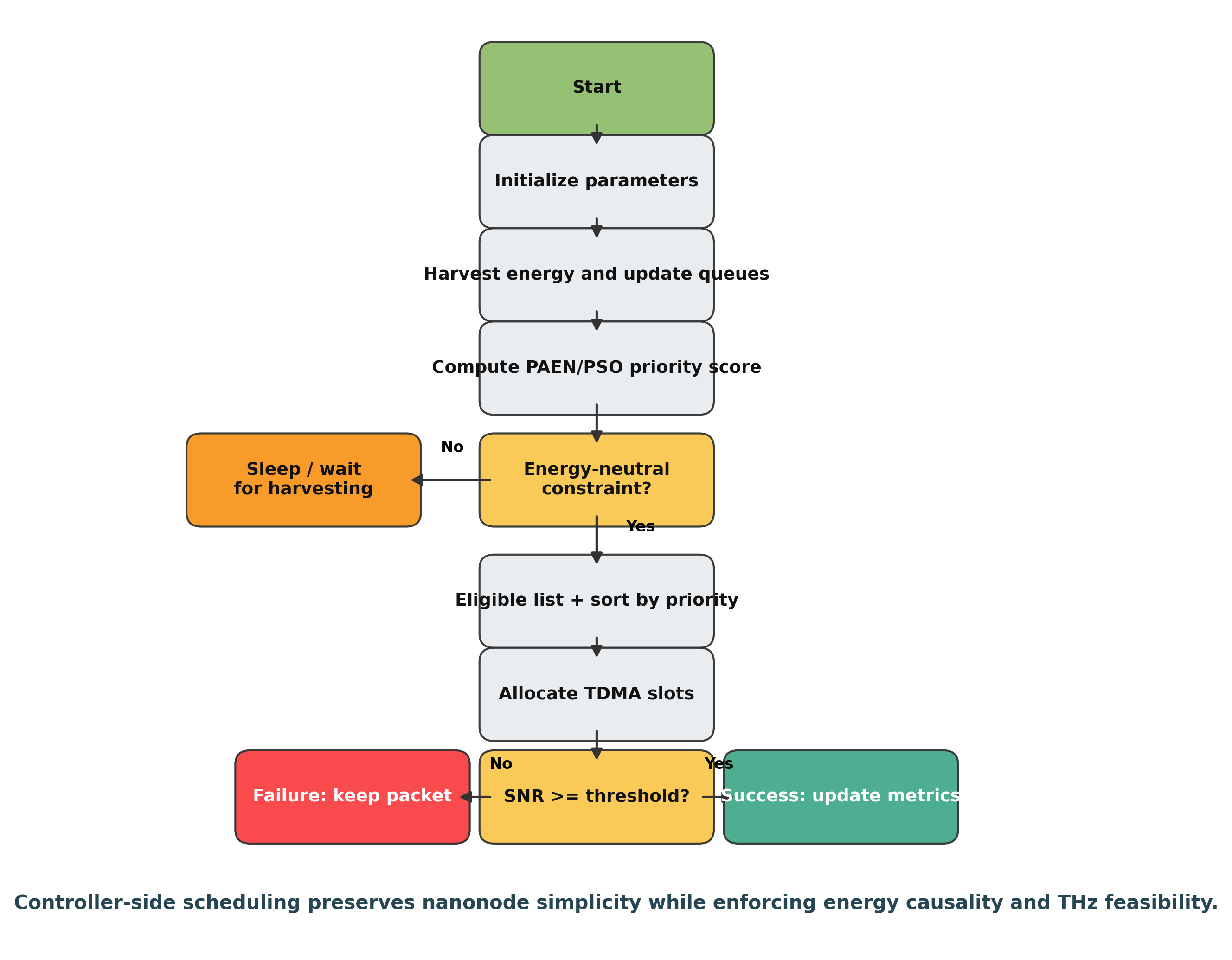
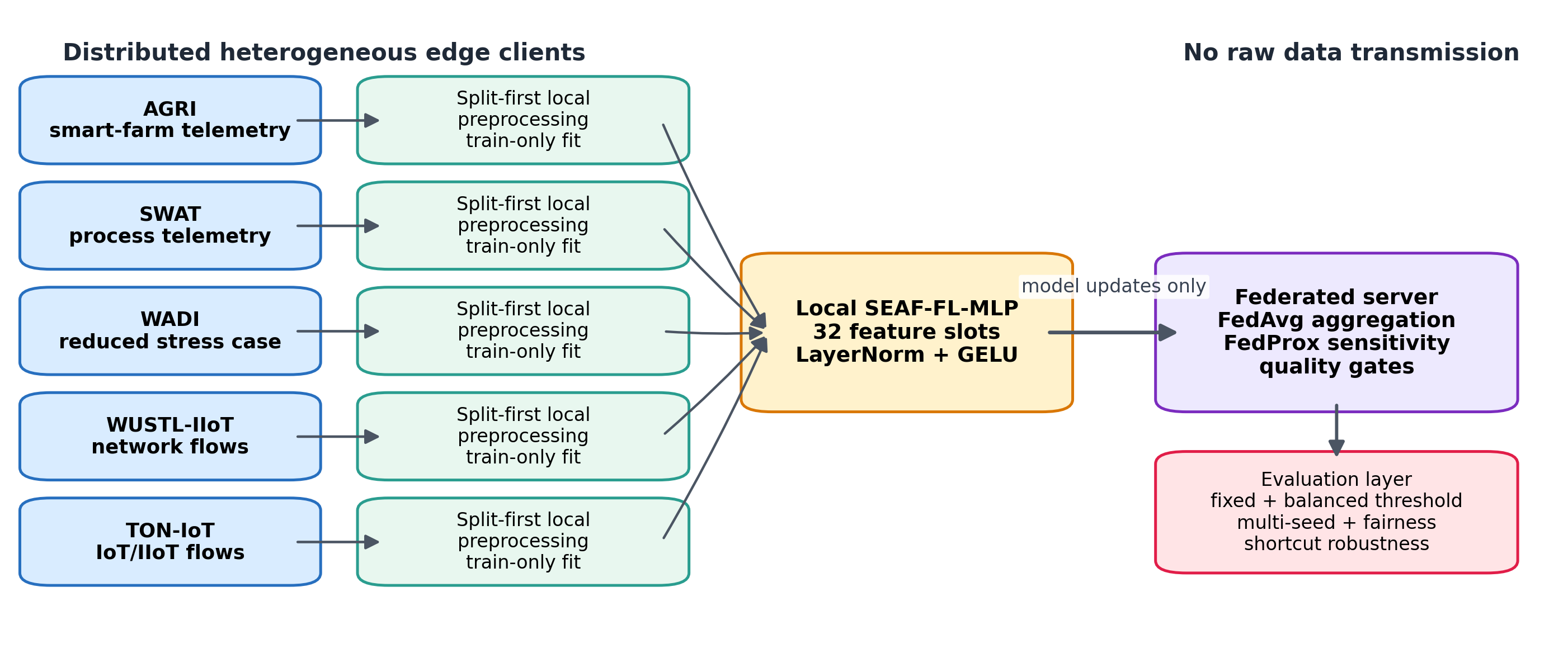
(IoT) systems increasingly rely on distributed sensors, edge gate-ways, and networked control services, making privacy-preserving and communication-efficient anomaly detection essential. Centralized learning can expose operational telemetry, increase communication overhead, and degrade under heterogeneous non-independent and identically distributed (non-IID) client conditions. This paper presents SEAF-FL-MLP, a leakage safe federated edge-AI framework for binary anomaly detection across five heterogeneous IoT clients: AGRI, SWAT, WADI, WUSTL-IIoT, and TON-IoT. The framework integrates split-first preprocessing, train-only imputation/encoding/scaling/feature selection, client- specific processing, a compact multilayer perceptron (MLP), FedAvg aggregation, validation-only threshold selection, and test-only final evaluation. In the audited V9 output, the balanced validation-selected threshold achieved Accuracy=96.32%, Precision=96.67%, Recall = 93.74%, F1-score = 95.18%, ROC-AUC = 98.86%, and PR-AUC = 98.03% on the global held-out test set, with a model size of 0.0372 MB and an estimated total communication cost of 4.4682 MB across 12 federated rounds and five clients. Client-wise analysis revealed substantial heterogeneity: WUSTL-IIoT, TON-IoT, and SWAT achieved strong F1-scores, whereas AGRI and WADI remained challenging stress cases. WUSTL shortcut-reduced sensitivity showed that the WUSTL client remained strong after removing high-risk shortcut-sensitive features, although the global pipeline was partially sensitive to replacing WUSTL with the shortcut-reduced version. FedProx did not materially improve performance under the tested configuration, and the ablation results did not support claiming mutual-information feature selection as a performance-improving component in this run. The results position SEAF-FL-MLP as a compact, communication-efficient, and reproducible federated edge-AI baseline while emphasizing the necessity of transparent client-level, fairness, and shortcut-robustness analysis.