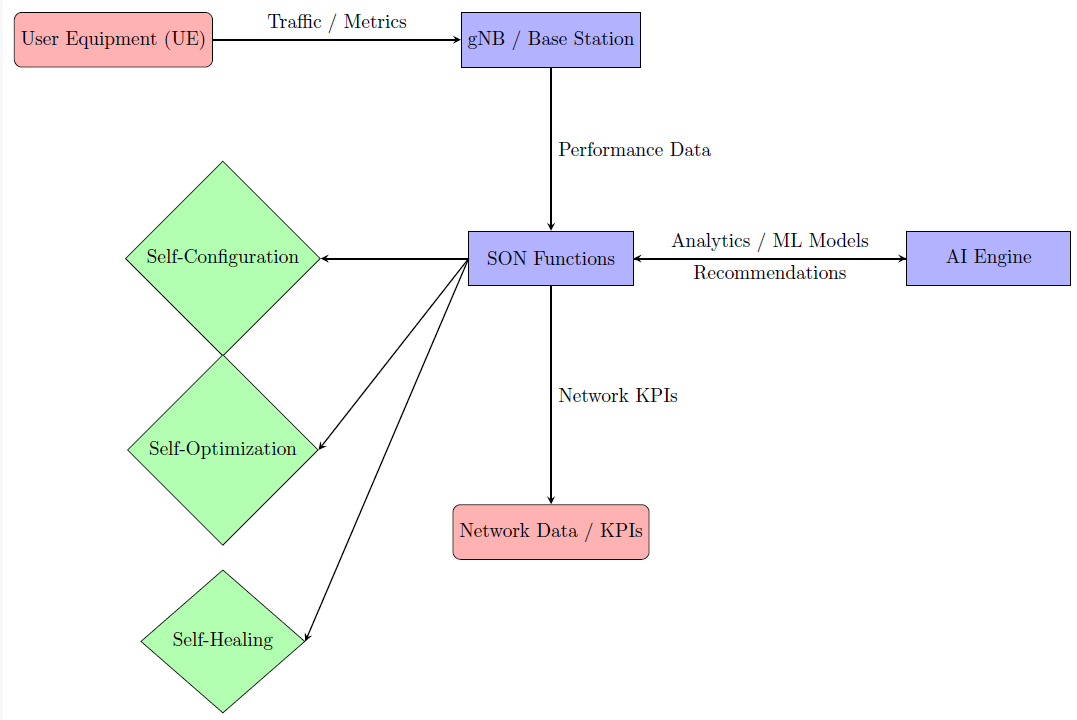
This paper investigates the application of Artificial Intelligence (AI) in Self-Organizing Networks (SON) for 5G networks, focusing on coverage enhancement and reduction of Operational Expenditures (OPEX). A conceptual AI-Self Organizing Networks (SON) framework integrated with O RAN architecture is proposed, and an illustrative Python-based simulation is conducted to demonstrate potential trends in coverage probability, energy consumption, and estimated OPEX savings. The simulation results indicate that AI-SON can achieve near-optimal coverage (coverage probability 0.9985) while reducing energy usage and maintenance costs, with an estimated OPEX reduction of 2030% compared to baseline strategies. The study clarifies that the simulation is illustrative and not experimentally validated, providing a foundation for future rigorous evaluations.
Mohamed Hankal (المؤلف) (2026). AI-Driven Self-Organizing Networks (SON) for 5G OPEX Reduction: A Comprehensive Survey and Conceptual Framework. مجلة جامعة صنعاء للعلوم التطبيقية والتكنولوجيا, 1496-1506. DOI: https://doi.org/10.59628/jast.v4i1.2291
Mohamed Hankal (المؤلف). “AI-Driven Self-Organizing Networks (SON) for 5G OPEX Reduction: A Comprehensive Survey and Conceptual Framework.” مجلة جامعة صنعاء للعلوم التطبيقية والتكنولوجيا, 2026, pp. 1496-1506. https://doi.org/10.59628/jast.v4i1.2291. Accessed 30 أكتوبر. 2026.
Mohamed Hankal (المؤلف). 2026. “AI-Driven Self-Organizing Networks (SON) for 5G OPEX Reduction: A Comprehensive Survey and Conceptual Framework.” مجلة جامعة صنعاء للعلوم التطبيقية والتكنولوجيا : 1496-1506. DOI: https://doi.org/10.59628/jast.v4i1.2291
Mohamed Hankal (المؤلف) (2026) ‘AI-Driven Self-Organizing Networks (SON) for 5G OPEX Reduction: A Comprehensive Survey and Conceptual Framework’, مجلة جامعة صنعاء للعلوم التطبيقية والتكنولوجيا, pp. 1496-1506. doi: 10.59628/jast.v4i1.2291
@article{jast2026_art2291,
    author  = {Mohamed Hankal (المؤلف)},
    title   = {AI-Driven Self-Organizing Networks (SON) for 5G OPEX Reduction: A Comprehensive Survey and Conceptual Framework},
    journal = {مجلة جامعة صنعاء للعلوم التطبيقية والتكنولوجيا},    year    = {2026},    month   = {يناير},    pages   = {1496-1506},    doi     = {10.59628/jast.v4i1.2291},
    url     = {https://doi.org/10.59628/jast.v4i1.2291},}
AI-Driven Self-Organizing Networks (SON) for 5G OPEX Reduction: A Comprehensive Survey and Conceptual Framework
The emergence of data in recent years, characterized by the "6Vs" (Volume, Velocity, Variety, Veracity, Value, and Variability), has started the era of big data. While this data holds great potential for uncovering valuable insights and knowledge, its size presents significant challenges for analysis. This paper explores two critical big data reduction techniques: feature selection and sampling. Feature selection focuses on identifying and eliminating irrelevant or redundant features, reducing data dimensionality. Sampling, on the other hand, selects a representative subset of data points for analysis. We compare and contrast these techniques, highlighting their strengths and weaknesses. The paper explores when each approach is most suitable and suggest the potential benefits of combining them for even more efficient big data analysis.
Mohammed Zayed، Fadl Mutaher Ba-Alwi (المؤلف) (2025). Big Data Formation, Reduction, and Its Impact on Sampling: A survey. مجلة جامعة صنعاء للعلوم التطبيقية والتكنولوجيا, 597-603. DOI: https://doi.org/10.59628/jast.v3i1.1516
Mohammed Zayed، Fadl Mutaher Ba-Alwi (المؤلف). “Big Data Formation, Reduction, and Its Impact on Sampling: A survey.” مجلة جامعة صنعاء للعلوم التطبيقية والتكنولوجيا, 2025, pp. 597-603. https://doi.org/10.59628/jast.v3i1.1516. Accessed 30 أكتوبر. 2026.
Mohammed Zayed، Fadl Mutaher Ba-Alwi (المؤلف). 2025. “Big Data Formation, Reduction, and Its Impact on Sampling: A survey.” مجلة جامعة صنعاء للعلوم التطبيقية والتكنولوجيا : 597-603. DOI: https://doi.org/10.59628/jast.v3i1.1516
Mohammed Zayed، Fadl Mutaher Ba-Alwi (المؤلف) (2025) ‘Big Data Formation, Reduction, and Its Impact on Sampling: A survey’, مجلة جامعة صنعاء للعلوم التطبيقية والتكنولوجيا, pp. 597-603. doi: 10.59628/jast.v3i1.1516
@article{jast2025_art1516,
    author  = {Mohammed Zayed، Fadl  Mutaher Ba-Alwi (المؤلف)},
    title   = {Big Data Formation, Reduction, and Its Impact on Sampling: A survey},
    journal = {مجلة جامعة صنعاء للعلوم التطبيقية والتكنولوجيا},    year    = {2025},    month   = {فبراير},    pages   = {597-603},    doi     = {10.59628/jast.v3i1.1516},
    url     = {https://doi.org/10.59628/jast.v3i1.1516},}
Big Data Formation, Reduction, and Its Impact on Sampling: A survey

The widespread adoption of face masks during the COVID-19 pandemic created new requirements for facial recognition technology, driving focused innovation in Masked Face Recognition (MFR) systems. This survey synthesizes and analyzes key research developments from 2020 to 2024, examining more than twenty pivotal studies in the field. The review provides a structured comparison of contemporary deep learning methodologies, with particular attention to Convolutional Neural Network (CNN) implementations including ResNet, VGG, and MobileNet architectures. It further evaluates the characteristics and performance outcomes associated with principal publicly available datasets employed in MFR model development. The analysis highlights important considerations for advancing MFR systems, particularly regarding data quality and model generalization. Current research directions emphasize improving the alignment between training data characteristics and real-world application environments. Among available resources, the MaskedFace-Net dataset demonstrates particularly strong performance in benchmark evaluations, with reported recognition rates exceeding 99%, attributed to its specialized design and substantial scale. For practical implementation, the findings support utilizing established CNN-based frameworks, with opportunities for enhancement through complementary approaches such as integration with traditional classifiers. Looking forward, this survey identifies promising pathways for continued progress in MFR technology, centered on evolutionary advancements within proven architectural paradigms, sophisticated data utilization strategies, and optimizations for deployment efficiency. This comprehensive review offers valuable guidance for researchers and engineers working to create effective and adaptable masked face recognition solutions.
Haron M . Ahmed Omer، Fadl Ba-Alwi (المؤلف) (2026). Deep Learning Approaches for Masked Face Recognition: A Survey of Research During (2020-2024). مجلة جامعة صنعاء للعلوم التطبيقية والتكنولوجيا, 2130-2138. DOI: https://doi.org/10.59628/jast.v4i5.2643
Haron M . Ahmed Omer، Fadl Ba-Alwi (المؤلف). “Deep Learning Approaches for Masked Face Recognition: A Survey of Research During (2020-2024).” مجلة جامعة صنعاء للعلوم التطبيقية والتكنولوجيا, 2026, pp. 2130-2138. https://doi.org/10.59628/jast.v4i5.2643. Accessed 30 أكتوبر. 2026.
Haron M . Ahmed Omer، Fadl Ba-Alwi (المؤلف). 2026. “Deep Learning Approaches for Masked Face Recognition: A Survey of Research During (2020-2024).” مجلة جامعة صنعاء للعلوم التطبيقية والتكنولوجيا : 2130-2138. DOI: https://doi.org/10.59628/jast.v4i5.2643
Haron M . Ahmed Omer، Fadl Ba-Alwi (المؤلف) (2026) ‘Deep Learning Approaches for Masked Face Recognition: A Survey of Research During (2020-2024)’, مجلة جامعة صنعاء للعلوم التطبيقية والتكنولوجيا, pp. 2130-2138. doi: 10.59628/jast.v4i5.2643
@article{jast2026_art2643,
    author  = {Haron M . Ahmed Omer، Fadl Ba-Alwi (المؤلف)},
    title   = {Deep Learning Approaches for Masked Face Recognition: A Survey of Research During (2020-2024)},
    journal = {مجلة جامعة صنعاء للعلوم التطبيقية والتكنولوجيا},    year    = {2026},    month   = {مايو},    pages   = {2130-2138},    doi     = {10.59628/jast.v4i5.2643},
    url     = {https://doi.org/10.59628/jast.v4i5.2643},}
Deep Learning Approaches for Masked Face Recognition: A Survey of Research During (2020-2024)
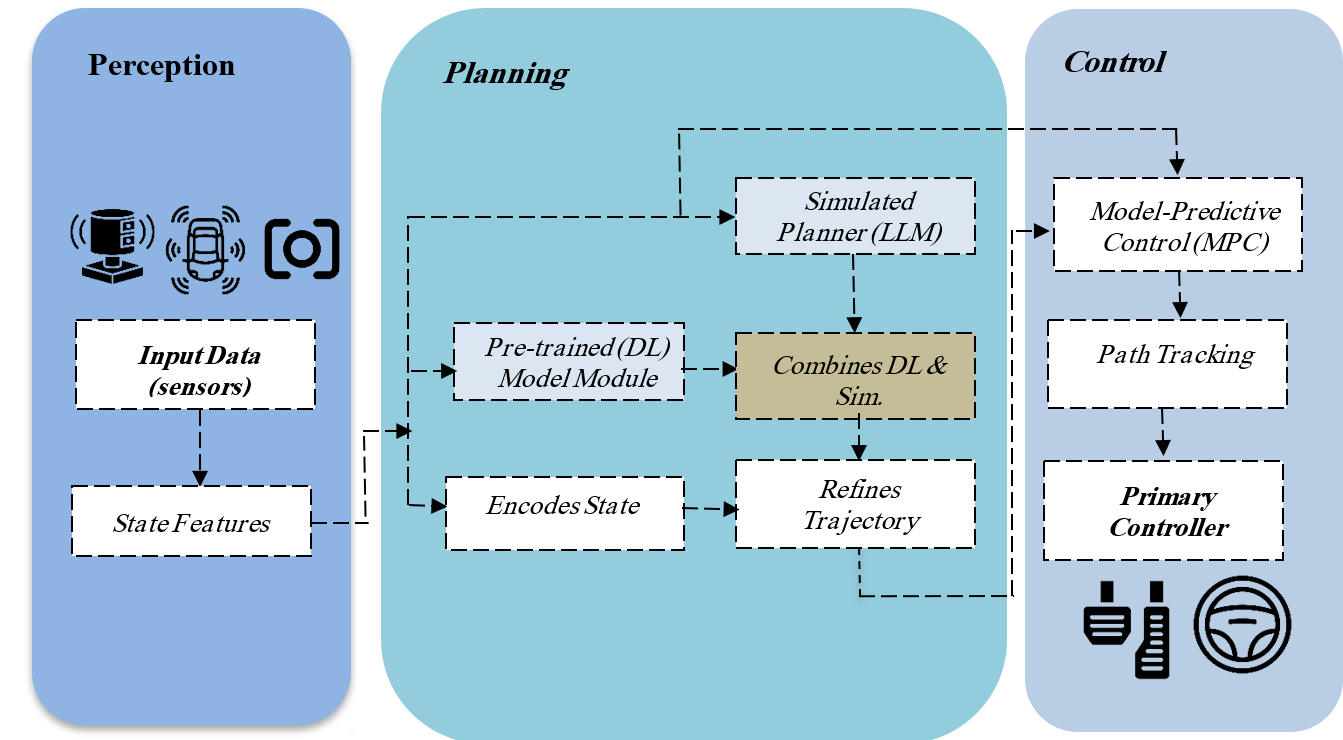
Autonomous vehicle (AV) trajectory planning in dense urban environments requires models that generalize to rare or previously unseen scenario types. Deep neural networks (DNNs) trained on large datasets perform poorly in such data-scarce conditions, while large language models (LLMs) generalize well but lack the numerical precision required for low-level vehicle control. This paper presents a hybrid trajectory planning framework that fuses a finetuned LLM with a multi-branch DNN at the trajectory level and applies a Model Predictive Control (MPC) controller as a final optimization stage. Gemini 1.5 Flash, fine-tuned on 479 labeled scenario-trajectory pairs, generates 15- aypoint trajectory proposals from structured textual scene descriptions. A modular DNN processes the same scene as a numerical input vector and produces a parallel trajectory proposal. The two proposals are fused by a learned trajectory refinement network, and the output is passed to an MPC controller that enforces vehicle dynamics constraints while minimizing a multi-objective cost function. Training relies on a three-step distortion- based augmentation technique, curve distortion, scale distortion, and Gaussian smoothing, that generates semi-realistic trajectory variants from a base dataset of over 70,000 labeled rows, reducing the data volume required for effective DNN training. Evaluation across 200 runs in the CARLA simulator on unseen urban scenarios shows that the MPC-enhanced hybrid model achieves an Average Displacement Error (ADE) of 0.66 m and a Final Displacement Error (FDE) of 1.94 m, corresponding to improvements of 37.7% and 34.3% over the DNN-only baseline. The collision rate (CR) decreases from 3.71% to 2.90%, a 21.8% reduction. These results establish that trajectory-level fusion of LLM semantic reasoning with DNN-based feature extraction delivers measurable accuracy and safety gains in data-efficient autonomous driving conditions. The ADE/FDE improvements are statistically significant (p < 0.001). The collision-rate reduction is a consistent trend across ablations, but it is not statistically significant at n = 200 runs (see Section 4.4).
Yusuf Al-jamaly، Khaleel AL-Hattab، Adel Rawea (المؤلف) (2026). LLM-DNN Fusion for Data-Efficient Trajectory Generation in Autonomous Driving: A Hybrid Approach with MPC Optimization. مجلة جامعة صنعاء للعلوم التطبيقية والتكنولوجيا, 2679-2691. DOI: https://doi.org/10.59628/jast.v4i10.3391
Yusuf Al-jamaly، Khaleel AL-Hattab، Adel Rawea (المؤلف). “LLM-DNN Fusion for Data-Efficient Trajectory Generation in Autonomous Driving: A Hybrid Approach with MPC Optimization.” مجلة جامعة صنعاء للعلوم التطبيقية والتكنولوجيا, 2026, pp. 2679-2691. https://doi.org/10.59628/jast.v4i10.3391. Accessed 30 أكتوبر. 2026.
Yusuf Al-jamaly، Khaleel AL-Hattab، Adel Rawea (المؤلف). 2026. “LLM-DNN Fusion for Data-Efficient Trajectory Generation in Autonomous Driving: A Hybrid Approach with MPC Optimization.” مجلة جامعة صنعاء للعلوم التطبيقية والتكنولوجيا : 2679-2691. DOI: https://doi.org/10.59628/jast.v4i10.3391
Yusuf Al-jamaly، Khaleel AL-Hattab، Adel Rawea (المؤلف) (2026) ‘LLM-DNN Fusion for Data-Efficient Trajectory Generation in Autonomous Driving: A Hybrid Approach with MPC Optimization’, مجلة جامعة صنعاء للعلوم التطبيقية والتكنولوجيا, pp. 2679-2691. doi: 10.59628/jast.v4i10.3391
@article{jast2026_art3391,
    author  = {Yusuf Al-jamaly، Khaleel AL-Hattab، Adel Rawea (المؤلف)},
    title   = {LLM-DNN Fusion for Data-Efficient Trajectory Generation in Autonomous Driving: A Hybrid Approach with MPC Optimization},
    journal = {مجلة جامعة صنعاء للعلوم التطبيقية والتكنولوجيا},    year    = {2026},    month   = {أكتوبر},    pages   = {2679-2691},    doi     = {10.59628/jast.v4i10.3391},
    url     = {https://doi.org/10.59628/jast.v4i10.3391},}
LLM-DNN Fusion for Data-Efficient Trajectory Generation in Autonomous Driving: A Hybrid Approach with MPC Optimization

The rapid evolution of 5G networks introduces unprecedented high-speed communication and massive connectivity, but it also intensifies security challenges. Ensuring confidentiality, integrity, and availability of data requires robust encryption mechanisms. This study evaluates the performance and overhead of Advanced Encryption Standard (AES), Rivest–Shamir–Adleman (RSA), and Elliptic Curve Cryptography (ECC) in 5G networks using simulation-based analysis. Metrics considered include latency (ms), throughput (%), encryption/decryption time per MB, and computational cost on UE-class hardware, providing quantitative comparison across typical 5G scenarios (high mobility eMBB, URLLC, and mMTCIoT devices).
Key findings: AES achieves low latency and high throughput for bulk data; ECC provides secure, lightweight key exchange; RSA is suitable only for session key establishment due to higher computational overhead. Overall, hybrid AES+ECC provides the best tradeoff between security and performance in realistic 5G environments.
Mohamed Hankal (المؤلف) (2026). Performance of Encryption schemes in 5G Networks. مجلة جامعة صنعاء للعلوم التطبيقية والتكنولوجيا, 1959-1966. DOI: https://doi.org/10.59628/jast.v4i4.2317
Mohamed Hankal (المؤلف). “Performance of Encryption schemes in 5G Networks.” مجلة جامعة صنعاء للعلوم التطبيقية والتكنولوجيا, 2026, pp. 1959-1966. https://doi.org/10.59628/jast.v4i4.2317. Accessed 30 أكتوبر. 2026.
Mohamed Hankal (المؤلف). 2026. “Performance of Encryption schemes in 5G Networks.” مجلة جامعة صنعاء للعلوم التطبيقية والتكنولوجيا : 1959-1966. DOI: https://doi.org/10.59628/jast.v4i4.2317
Mohamed Hankal (المؤلف) (2026) ‘Performance of Encryption schemes in 5G Networks’, مجلة جامعة صنعاء للعلوم التطبيقية والتكنولوجيا, pp. 1959-1966. doi: 10.59628/jast.v4i4.2317
@article{jast2026_art2317,
    author  = {Mohamed Hankal (المؤلف)},
    title   = {Performance of Encryption schemes in 5G Networks},
    journal = {مجلة جامعة صنعاء للعلوم التطبيقية والتكنولوجيا},    year    = {2026},    month   = {أبريل},    pages   = {1959-1966},    doi     = {10.59628/jast.v4i4.2317},
    url     = {https://doi.org/10.59628/jast.v4i4.2317},}
Performance of Encryption schemes in 5G Networks
لم يتم نشر أي شيء من هذه الفئة بعد.

مجلة جامعة صنعاء
للعلوم التطبيقية والتكنولوجيا
مجلة علمية محكمة ومتاحة للجميع، تنشر أبحاثاً عالية الجودة في مجالات العلوم التطبيقية والهندسة والحاسوب منذ عام 2023.
