فيزياء علم المواد

The microstructural characteristics of solder alloys critically determine their mechanical performance and reliability in high precision electronic applications. These characteristics including phase distribution, grain size, and intermetallic compound (IMC) formation govern the alloy’s response to thermal and mechanical stresses. Precise control of IMCs such as Cu6Sn5 and Ag3Sn, along with uniform fine grains, enhances toughness, creep resistance, and reduces fracture susceptibility. In this study, the effect of low copper additions (0.2–1 wt %) on the (96.5- x) Sn − 3.5Ag − xCu alloy was systematically investigated through a combination of XRD and SEM analyses. The results reveal a clear dependence of crystallite size, dislocation density, and IMC distribution on copper content and identify the optimal Cu concentration for stabilizing the β -Sn phase while improving mechanical properties. These findings provide a detailed understanding of microstructural evolution under low-Cu alloying, offering insights not addressed in previous studies.
Amtalsabowr A.AL-Thamari، A.H.Al-Hammadi، Ibrahim G.H. Loqman، Ahmed.M.A.Haider (المؤلف) (2026). The Effect of the Cu additions on the structure of the soldered (96.5- x)Sn - (3.5)Ag -(x)Cu alloy with x=0.2, 0.4, 0.6, 0.8 and 1 wt %. مجلة جامعة صنعاء للعلوم التطبيقية والتكنولوجيا, 2254-2264. DOI: https://doi.org/10.59628/jast.v4i6.2827
Amtalsabowr A.AL-Thamari، A.H.Al-Hammadi، Ibrahim G.H. Loqman، Ahmed.M.A.Haider (المؤلف). “The Effect of the Cu additions on the structure of the soldered (96.5- x)Sn - (3.5)Ag -(x)Cu alloy with x=0.2, 0.4, 0.6, 0.8 and 1 wt %.” مجلة جامعة صنعاء للعلوم التطبيقية والتكنولوجيا, 2026, pp. 2254-2264. https://doi.org/10.59628/jast.v4i6.2827. Accessed 31 أكتوبر. 2026.
Amtalsabowr A.AL-Thamari، A.H.Al-Hammadi، Ibrahim G.H. Loqman، Ahmed.M.A.Haider (المؤلف). 2026. “The Effect of the Cu additions on the structure of the soldered (96.5- x)Sn - (3.5)Ag -(x)Cu alloy with x=0.2, 0.4, 0.6, 0.8 and 1 wt %.” مجلة جامعة صنعاء للعلوم التطبيقية والتكنولوجيا : 2254-2264. DOI: https://doi.org/10.59628/jast.v4i6.2827
Amtalsabowr A.AL-Thamari، A.H.Al-Hammadi، Ibrahim G.H. Loqman، Ahmed.M.A.Haider (المؤلف) (2026) ‘The Effect of the Cu additions on the structure of the soldered (96.5- x)Sn - (3.5)Ag -(x)Cu alloy with x=0.2, 0.4, 0.6, 0.8 and 1 wt %’, مجلة جامعة صنعاء للعلوم التطبيقية والتكنولوجيا, pp. 2254-2264. doi: 10.59628/jast.v4i6.2827
@article{jast2026_art2827,
    author  = {Amtalsabowr A.AL-Thamari، A.H.Al-Hammadi، Ibrahim G.H. Loqman، Ahmed.M.A.Haider (المؤلف)},
    title   = {The Effect of the Cu additions on the structure of the soldered (96.5- x)Sn - (3.5)Ag -(x)Cu alloy with x=0.2, 0.4, 0.6, 0.8 and 1 wt %},
    journal = {مجلة جامعة صنعاء للعلوم التطبيقية والتكنولوجيا},    year    = {2026},    month   = {يونيو},    pages   = {2254-2264},    doi     = {10.59628/jast.v4i6.2827},
    url     = {https://doi.org/10.59628/jast.v4i6.2827},}
The Effect of the Cu additions on the structure of the soldered (96.5- x)Sn - (3.5)Ag -(x)Cu alloy with x=0.2, 0.4, 0.6, 0.8 and 1 wt %

Green synthesis offers an environmentally benign approach for producing functional metal oxide nanomaterials. In this study, chamomile extract was employed as a natural reducing and stabilizing agent to synthesize ZnO and MgO nanoparticles under identical reaction conditions. The nanoparticles were prepared at 30 °C for 30 min under neutral pH, followed by heat treatment at 400 °C for five hours to remove residual moisture and promote crystallization. Structural and morphological characteristics were examined using X-ray diffraction (XRD), UV–visible spectroscopy and scanning electron microscopy (SEM). The UV–Vis spectra exhibited characteristic absorption peaks at 369 nm for ZnO and 265 nm for MgO. XRD analysis confirmed the formation of hexagonal wurtzite ZnO and face-centered cubic MgO phases, with calculated crystallite sizes of 8.35 nm and 11.58 nm, respectively. SEM images revealed predominantly spherical ZnO nanoparticles forming agglomerated secondary structures (55–70 nm) and spherical MgO nanoparticles with primary sizes ranging from 60–75 nm. The results demonstrate that chamomile extract serves as an effective biotemplate for controlling the nucleation and growth of ZnO and MgO nanoparticles, leading to well-defined structural and morphological features. This study highlights the potential of plant-mediated synthesis as a sustainable route for producing stable nanomaterials suitable for biomedical and environmental applications, reinforcing the role of green chemistry in advancing eco-friendly nanotechnology.
Ali Hashim Mohammed، Ali Maajal Ali، Mohaimen Baseem Awf، Rafaa Abd Alkareem Abdulwahid، Laith Saleh، Ghassan Adnan Naeem (المؤلف) (2026). Green Synthesis and Characterization of ZnO and MgO Nanoparticles Using Chamomile Extract. مجلة جامعة صنعاء للعلوم التطبيقية والتكنولوجيا, 1825-1830. DOI: https://doi.org/10.59628/jast.v4i3.2488
Ali Hashim Mohammed، Ali Maajal Ali، Mohaimen Baseem Awf، Rafaa Abd Alkareem Abdulwahid، Laith Saleh، Ghassan Adnan Naeem (المؤلف). “Green Synthesis and Characterization of ZnO and MgO Nanoparticles Using Chamomile Extract.” مجلة جامعة صنعاء للعلوم التطبيقية والتكنولوجيا, 2026, pp. 1825-1830. https://doi.org/10.59628/jast.v4i3.2488. Accessed 31 أكتوبر. 2026.
Ali Hashim Mohammed، Ali Maajal Ali، Mohaimen Baseem Awf، Rafaa Abd Alkareem Abdulwahid، Laith Saleh، Ghassan Adnan Naeem (المؤلف). 2026. “Green Synthesis and Characterization of ZnO and MgO Nanoparticles Using Chamomile Extract.” مجلة جامعة صنعاء للعلوم التطبيقية والتكنولوجيا : 1825-1830. DOI: https://doi.org/10.59628/jast.v4i3.2488
Ali Hashim Mohammed، Ali Maajal Ali، Mohaimen Baseem Awf، Rafaa Abd Alkareem Abdulwahid، Laith Saleh، Ghassan Adnan Naeem (المؤلف) (2026) ‘Green Synthesis and Characterization of ZnO and MgO Nanoparticles Using Chamomile Extract’, مجلة جامعة صنعاء للعلوم التطبيقية والتكنولوجيا, pp. 1825-1830. doi: 10.59628/jast.v4i3.2488
@article{jast2026_art2488,
    author  = {Ali Hashim Mohammed، Ali Maajal Ali، Mohaimen Baseem Awf، Rafaa Abd Alkareem Abdulwahid، Laith Saleh، Ghassan Adnan Naeem (المؤلف)},
    title   = {Green Synthesis and Characterization of ZnO and MgO Nanoparticles Using Chamomile Extract},
    journal = {مجلة جامعة صنعاء للعلوم التطبيقية والتكنولوجيا},    year    = {2026},    month   = {مارس},    pages   = {1825-1830},    doi     = {10.59628/jast.v4i3.2488},
    url     = {https://doi.org/10.59628/jast.v4i3.2488},}
Green Synthesis and Characterization of ZnO and MgO Nanoparticles Using Chamomile Extract
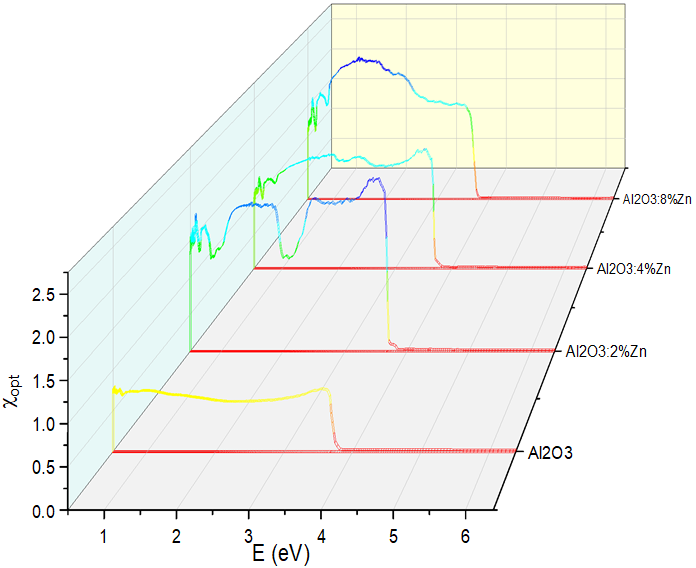
This study investigates the morphology and optical properties of prepared α-Al2O3:Zn nanoparticles by sol-gel method at room temperature. TEM image revealed hexagonal structure and the average particle size in the range (9.52-15.94 nm), and showed the particles distribution and area by histograms distribution. The Selected Area Electron Diffraction (SAED) illustrated the polycrystalline structure. XRD analysis confirmed hexagonal structure with a high crystalline and polycrystalline structure of α-Al2O3:Zn nanoparticles, the average crystallite size in the range (30.529- 24.057 nm). The optical study found that the energy gab of prepared α-Al2O3:Zn (0%, 2%, 4%, 8%) were (5.145, 4.86, 4.88, 4.95 eV), respectively. Furthermore, other optical parameters such as refractive index, extinction coefficient, and dielectric constant are studied.
Eman Mohammed Ali Nassar، A.H. AL-Hammadi، Yasser Hussein Issa Mohammed (المؤلف) (2025). Morphological and Optical Analysis of α − Al2O3 : Zn Nanoparticles. مجلة جامعة صنعاء للعلوم التطبيقية والتكنولوجيا, 1408-1418. DOI: https://doi.org/10.59628/jast.v3i6.1876
Eman Mohammed Ali Nassar، A.H. AL-Hammadi، Yasser Hussein Issa Mohammed (المؤلف). “Morphological and Optical Analysis of α − Al2O3 : Zn Nanoparticles.” مجلة جامعة صنعاء للعلوم التطبيقية والتكنولوجيا, 2025, pp. 1408-1418. https://doi.org/10.59628/jast.v3i6.1876. Accessed 31 أكتوبر. 2026.
Eman Mohammed Ali Nassar، A.H. AL-Hammadi، Yasser Hussein Issa Mohammed (المؤلف). 2025. “Morphological and Optical Analysis of α − Al2O3 : Zn Nanoparticles.” مجلة جامعة صنعاء للعلوم التطبيقية والتكنولوجيا : 1408-1418. DOI: https://doi.org/10.59628/jast.v3i6.1876
Eman Mohammed Ali Nassar، A.H. AL-Hammadi، Yasser Hussein Issa Mohammed (المؤلف) (2025) ‘Morphological and Optical Analysis of α − Al2O3 : Zn Nanoparticles’, مجلة جامعة صنعاء للعلوم التطبيقية والتكنولوجيا, pp. 1408-1418. doi: 10.59628/jast.v3i6.1876
@article{jast2025_art1876,
    author  = {Eman Mohammed Ali Nassar، A.H. AL-Hammadi، Yasser Hussein Issa Mohammed (المؤلف)},
    title   = {Morphological and Optical Analysis of α − Al2O3 : Zn Nanoparticles},
    journal = {مجلة جامعة صنعاء للعلوم التطبيقية والتكنولوجيا},    year    = {2025},    month   = {ديسمبر},    pages   = {1408-1418},    doi     = {10.59628/jast.v3i6.1876},
    url     = {https://doi.org/10.59628/jast.v3i6.1876},}
Morphological and Optical Analysis of α − Al2O3 : Zn Nanoparticles
Copper sulfide (CuS) nanoparticles have garnered significant interest due to their unique structural, optical, and biological properties, making them promising candidates for cancer therapy. This work systematically examines how strontium incorporation influences the structural properties, optical behavior, and anticancer activity of copper sulfide nanoparticles for potential lung cancer therapeutics. Using the co-precipitation approach, Sr-doped CuS nanoparticles with different Sr concentrations were produced. Characterization techniques, including XRD, TEM, and UV-VIS-NIR spectroscopy, were employed to analyze their physicochemical properties. The results indicate that Sr doping enhances crystallinity, modifies the bandgap, and influences optical conductivity. Cytotoxicity analysis using MTT assays on A549 lung cancer cells emonstrated that Sr-doped CuS nanoparticles exhibit enhanced anticancer activity compared to pure CuS. The 2.5% Sr-doped sample showed the most significant reduction in cell viability. These findings suggest that Sr-doped CuS nanoparticles are promising candidates for biomedical applications. However, further studies are needed to assess their photothermal and photodynamic effects under controlled light exposure.
Asma’a Ahmed AL-Adhreai، A.M. Abdulwahab، A. H. Al-Hammadi (المؤلف) (2025). Structural, Optical and Cytotoxic Analysis of Sr-Doped CuS Nanoparticles for Lung Cancer Applications. مجلة جامعة صنعاء للعلوم التطبيقية والتكنولوجيا, 990-998. DOI: https://doi.org/10.59628/jast.v3i4.1728
Asma’a Ahmed AL-Adhreai، A.M. Abdulwahab، A. H. Al-Hammadi (المؤلف). “Structural, Optical and Cytotoxic Analysis of Sr-Doped CuS Nanoparticles for Lung Cancer Applications.” مجلة جامعة صنعاء للعلوم التطبيقية والتكنولوجيا, 2025, pp. 990-998. https://doi.org/10.59628/jast.v3i4.1728. Accessed 31 أكتوبر. 2026.
Asma’a Ahmed AL-Adhreai، A.M. Abdulwahab، A. H. Al-Hammadi (المؤلف). 2025. “Structural, Optical and Cytotoxic Analysis of Sr-Doped CuS Nanoparticles for Lung Cancer Applications.” مجلة جامعة صنعاء للعلوم التطبيقية والتكنولوجيا : 990-998. DOI: https://doi.org/10.59628/jast.v3i4.1728
Asma’a Ahmed AL-Adhreai، A.M. Abdulwahab، A. H. Al-Hammadi (المؤلف) (2025) ‘Structural, Optical and Cytotoxic Analysis of Sr-Doped CuS Nanoparticles for Lung Cancer Applications’, مجلة جامعة صنعاء للعلوم التطبيقية والتكنولوجيا, pp. 990-998. doi: 10.59628/jast.v3i4.1728
@article{jast2025_art1728,
    author  = {Asma’a Ahmed AL-Adhreai، A.M. Abdulwahab، A. H. Al-Hammadi (المؤلف)},
    title   = {Structural, Optical and Cytotoxic Analysis of Sr-Doped CuS Nanoparticles for Lung Cancer Applications},
    journal = {مجلة جامعة صنعاء للعلوم التطبيقية والتكنولوجيا},    year    = {2025},    month   = {أغسطس},    pages   = {990-998},    doi     = {10.59628/jast.v3i4.1728},
    url     = {https://doi.org/10.59628/jast.v3i4.1728},}
Structural, Optical and Cytotoxic Analysis of Sr-Doped CuS Nanoparticles for Lung Cancer Applications

In the pursuit of developing high-performance, lead-free solder alloys with enhanced reliability and environmental compliance, this study investigates the structural effects of incorporating the alloy (x)Ag–(3.5+x)Cu into the near-eutectic (96.5–2x)Sn system. The objective is to evaluate the influence of varying Ag and Cu concentrations on phase formation and microstructural evolution. Five alloy compositions were synthesized with x values of 0.1, 0.2, 0.3, 0.4, and 0.5 using conventional melting and casting techniques. The samples were characterized using X-ray diffraction (XRD) to identify crystalline phases and scanning electron microscopy (SEM) to analyze microstructural features. X-ray diffraction (XRD) analysis confirmed that all alloy samples predominantly consist of a single-phase tetragonal β-Sn structure. The incremental addition of silver and copper to the tin matrix enhanced the particle size refinement of the near-eutectic Sn–Ag–Cu ternary alloy. The introduction of the (x)Ag–(3.5+x)Cu alloy into the (96.5–2x)Sn system at varying concentrations (x = 0.1, 0.2, 0.3, 0.4, 0.5) resulted in noticeable shifts in diffraction peak positions (2θ), indicating lattice distortion and compositional changes. The calculated lattice parameters closely matched the standard peaks listed in JCPDS PDF No. 04-0673, and no new phases were detected within the ternary systems. Scanning electron microscopy (SEM) revealed distinct grayscale variations corresponding to differences in chemical composition and electron density across the microstructure. Notably, even minimal additions of Ag (x = 0.1) significantly improved the microstructural uniformity, which is critical for understanding the structural integrity and potential reliability of Sn–Ag–Cu solder joints in electronic interconnects.
Hend. Q.A. Al-hubaishi، A.H. Al-Hammadi، Ibrahim G.H. Loqman، Ahmed. M.A. Haider، Abdulmalek Mansoor N. Hulif (المؤلف) (2026). Studying Structural analysis by (X-ray and SEM) of (96.5-2x)Sn-(x)Ag-(3.5+x)Cu alloy with x=0.1,0.2,0.3,0.4 and 0.5 wt%. مجلة جامعة صنعاء للعلوم التطبيقية والتكنولوجيا, 2198-2208. DOI: https://doi.org/10.59628/jast.v4i6.2754
Hend. Q.A. Al-hubaishi، A.H. Al-Hammadi، Ibrahim G.H. Loqman، Ahmed. M.A. Haider، Abdulmalek Mansoor N. Hulif (المؤلف). “Studying Structural analysis by (X-ray and SEM) of (96.5-2x)Sn-(x)Ag-(3.5+x)Cu alloy with x=0.1,0.2,0.3,0.4 and 0.5 wt%.” مجلة جامعة صنعاء للعلوم التطبيقية والتكنولوجيا, 2026, pp. 2198-2208. https://doi.org/10.59628/jast.v4i6.2754. Accessed 31 أكتوبر. 2026.
Hend. Q.A. Al-hubaishi، A.H. Al-Hammadi، Ibrahim G.H. Loqman، Ahmed. M.A. Haider، Abdulmalek Mansoor N. Hulif (المؤلف). 2026. “Studying Structural analysis by (X-ray and SEM) of (96.5-2x)Sn-(x)Ag-(3.5+x)Cu alloy with x=0.1,0.2,0.3,0.4 and 0.5 wt%.” مجلة جامعة صنعاء للعلوم التطبيقية والتكنولوجيا : 2198-2208. DOI: https://doi.org/10.59628/jast.v4i6.2754
Hend. Q.A. Al-hubaishi، A.H. Al-Hammadi، Ibrahim G.H. Loqman، Ahmed. M.A. Haider، Abdulmalek Mansoor N. Hulif (المؤلف) (2026) ‘Studying Structural analysis by (X-ray and SEM) of (96.5-2x)Sn-(x)Ag-(3.5+x)Cu alloy with x=0.1,0.2,0.3,0.4 and 0.5 wt%’, مجلة جامعة صنعاء للعلوم التطبيقية والتكنولوجيا, pp. 2198-2208. doi: 10.59628/jast.v4i6.2754
@article{jast2026_art2754,
    author  = {Hend. Q.A. Al-hubaishi، A.H. Al-Hammadi، Ibrahim G.H. Loqman، Ahmed. M.A. Haider، Abdulmalek Mansoor N. Hulif (المؤلف)},
    title   = {Studying Structural analysis by (X-ray and SEM) of (96.5-2x)Sn-(x)Ag-(3.5+x)Cu alloy with x=0.1,0.2,0.3,0.4 and 0.5 wt%},
    journal = {مجلة جامعة صنعاء للعلوم التطبيقية والتكنولوجيا},    year    = {2026},    month   = {يونيو},    pages   = {2198-2208},    doi     = {10.59628/jast.v4i6.2754},
    url     = {https://doi.org/10.59628/jast.v4i6.2754},}
Studying Structural analysis by (X-ray and SEM) of (96.5-2x)Sn-(x)Ag-(3.5+x)Cu alloy with x=0.1,0.2,0.3,0.4 and 0.5 wt%

Ferrite nanoparticles are interesting materials due to their rich and unique physical and chemical properties. They find applications in catalysis, bio-processing, medicine, magnetic recording, adsorption, devices, so nanoferrite materials had been synthesized to produce new alternate substance for reducing the rare or high cost of industrial materials. Therefore,Co0.5Mn0.5-xZnxFe2O4 nanoferrite compositions (x=0,0.1,0.2,0.3,0.4) were successfully synthesized via the citrate-nitrate sol-gel auto-combustion technique. A comprehensive investigation of structural and optical, properties was conducted using X-ray diffraction (XRD), Fourier transform infrared spectroscopy (FTIR), and UV–Vis diffuse reflectance spectroscopy (DRS). XRD analysis confirmed the formation of a single-phase cubic spinel structure with space group Fd-3m, without detectable secondary phases, indicating the successful incorporation of Zn2+ and Mn2+ ions into the cobalt ferrite lattice. The crystallite size was found to vary between 8.017 and 10.130 nm depending on Zn substitution. Rietveld refinement further verified the structural stability with a lattice parameter of a = 8.370 Å and satisfactory fit (x2 = 0.15). Microstructural parameters such as dislocation density, microstrain, and stacking fault probability were found to increase with decreasing crystallite size. The FTIR spectroscopy confirmed the formation of spinel ferrite and spectra exhibited characteristic metal–oxygen vibration bands at approximately 585 cm−1 and 415 cm−1, corresponding to tetrahedral and octahedral sites of the spinel structure. UV–Vis DRS analysis revealed strong absorption in the UV–visible region, with the optical band gap decreasing from 2.96 to 2.81 eV as the Zn concentration increased, demonstrating tunable electronic properties. The absorption coefficient, extinction coefficient, imaginary dielectric constant, and optical conductivity increased with Zn substitution, whereas the refractive index and real dielectric constant showed an opposite trend, with a maximum refractive index observed near 2.6 eV (475 nm). The enhanced optical conductivity around 3.6 eV was attributed to interband transitions and charge-transfer processes such as O2- → Fe3+ and Fe2+ ↔ Fe3+. These results demonstrate that Zn substitution effectively tailors the optical response of Co–Mn ferrites, highlighting their potential for optoelectronic and photonic applications.
Yousef A. Alsabah، Abdelrahman A. Elbadawi، Ibrahim Alsuqia، Olfat Humaid، A .A. Al-Muntaser (المؤلف) (2026). Tuning Structural and Optical Properties of Co0.5Mn0.5-xZnxFe2O4 Nanoferrites via Zn Substitution for Optoelectronic Applications. مجلة جامعة صنعاء للعلوم التطبيقية والتكنولوجيا, 2209-2218. DOI: https://doi.org/10.59628/jast.v4i5.2925
Yousef A. Alsabah، Abdelrahman A. Elbadawi، Ibrahim Alsuqia، Olfat Humaid، A .A. Al-Muntaser (المؤلف). “Tuning Structural and Optical Properties of Co0.5Mn0.5-xZnxFe2O4 Nanoferrites via Zn Substitution for Optoelectronic Applications.” مجلة جامعة صنعاء للعلوم التطبيقية والتكنولوجيا, 2026, pp. 2209-2218. https://doi.org/10.59628/jast.v4i5.2925. Accessed 31 أكتوبر. 2026.
Yousef A. Alsabah، Abdelrahman A. Elbadawi، Ibrahim Alsuqia، Olfat Humaid، A .A. Al-Muntaser (المؤلف). 2026. “Tuning Structural and Optical Properties of Co0.5Mn0.5-xZnxFe2O4 Nanoferrites via Zn Substitution for Optoelectronic Applications.” مجلة جامعة صنعاء للعلوم التطبيقية والتكنولوجيا : 2209-2218. DOI: https://doi.org/10.59628/jast.v4i5.2925
Yousef A. Alsabah، Abdelrahman A. Elbadawi، Ibrahim Alsuqia، Olfat Humaid، A .A. Al-Muntaser (المؤلف) (2026) ‘Tuning Structural and Optical Properties of Co0.5Mn0.5-xZnxFe2O4 Nanoferrites via Zn Substitution for Optoelectronic Applications’, مجلة جامعة صنعاء للعلوم التطبيقية والتكنولوجيا, pp. 2209-2218. doi: 10.59628/jast.v4i5.2925
@article{jast2026_art2925,
    author  = {Yousef A. Alsabah، Abdelrahman A. Elbadawi، Ibrahim Alsuqia، Olfat Humaid، A .A. Al-Muntaser (المؤلف)},
    title   = {Tuning Structural and Optical Properties of Co0.5Mn0.5-xZnxFe2O4 Nanoferrites via Zn Substitution for Optoelectronic Applications},
    journal = {مجلة جامعة صنعاء للعلوم التطبيقية والتكنولوجيا},    year    = {2026},    month   = {يونيو},    pages   = {2209-2218},    doi     = {10.59628/jast.v4i5.2925},
    url     = {https://doi.org/10.59628/jast.v4i5.2925},}
Tuning Structural and Optical Properties of Co0.5Mn0.5-xZnxFe2O4 Nanoferrites via Zn Substitution for Optoelectronic Applications

Cadmium sulfide cd1s1−x nanoparticles were synthesized using a simple and cost-effective hydrothermal method by varying the Cd:S molar ratio to investigate its effect on the photocatalytic degradation of Rhodamine B (Rh-B) in aqueous solution under simulated solar irradiation serves as a model organic pollutant. Structural and morphological characterization using XRD, SEM, and UV–Vis spectroscopy confirmed the particularity of cd1s1−x particle with good crystallinity and visible light absorption properties. The photocatalytic efficiency of the cd1s1−x nanoparticles exhibited a strong dependence on the sulfur ion concentration, indicating the critical role of precursor ratio in tuning photocatalyst performance. Among the samples, the one prepared with x= 0.3026 exhibited the highest degradation efficiency, achieving nearly complete removal of Rh-B within 73 minutes. The enhanced photocatalytic performance is attributed to the optimized particle size, which improves crystallinity and surface area, facilitating more efficient charge separation, light absorption, and separation of photogenerated charge carriers. This study highlights the crucial role of precursor composition in tailoring the structural and functional properties of cd1s1−x nanoparticles, providing a straightforward and scalable approach for developing efficient visible-light-responsive photocatalysts for environmental remediation applications.
H Arhab، Shakib M. A. Alsowidy، Mohammed S.Qusailah، A. M. Abdulkarem (المؤلف) (2026). Visible-Light Photocatalytic Enhancement in Hydrothermally Synthesized Cd₁S₁₋ₓ Nanoparticles: Structural and Optical Characterization. مجلة جامعة صنعاء للعلوم التطبيقية والتكنولوجيا, 1814-1824. DOI: https://doi.org/10.59628/jast.v4i3.2464
H Arhab، Shakib M. A. Alsowidy، Mohammed S.Qusailah، A. M. Abdulkarem (المؤلف). “Visible-Light Photocatalytic Enhancement in Hydrothermally Synthesized Cd₁S₁₋ₓ Nanoparticles: Structural and Optical Characterization.” مجلة جامعة صنعاء للعلوم التطبيقية والتكنولوجيا, 2026, pp. 1814-1824. https://doi.org/10.59628/jast.v4i3.2464. Accessed 31 أكتوبر. 2026.
H Arhab، Shakib M. A. Alsowidy، Mohammed S.Qusailah، A. M. Abdulkarem (المؤلف). 2026. “Visible-Light Photocatalytic Enhancement in Hydrothermally Synthesized Cd₁S₁₋ₓ Nanoparticles: Structural and Optical Characterization.” مجلة جامعة صنعاء للعلوم التطبيقية والتكنولوجيا : 1814-1824. DOI: https://doi.org/10.59628/jast.v4i3.2464
H Arhab، Shakib M. A. Alsowidy، Mohammed S.Qusailah، A. M. Abdulkarem (المؤلف) (2026) ‘Visible-Light Photocatalytic Enhancement in Hydrothermally Synthesized Cd₁S₁₋ₓ Nanoparticles: Structural and Optical Characterization’, مجلة جامعة صنعاء للعلوم التطبيقية والتكنولوجيا, pp. 1814-1824. doi: 10.59628/jast.v4i3.2464
@article{jast2026_art2464,
    author  = {H  Arhab، Shakib M. A. Alsowidy، Mohammed S.Qusailah، A. M. Abdulkarem (المؤلف)},
    title   = {Visible-Light Photocatalytic Enhancement in Hydrothermally Synthesized Cd₁S₁₋ₓ Nanoparticles: Structural and Optical Characterization},
    journal = {مجلة جامعة صنعاء للعلوم التطبيقية والتكنولوجيا},    year    = {2026},    month   = {مارس},    pages   = {1814-1824},    doi     = {10.59628/jast.v4i3.2464},
    url     = {https://doi.org/10.59628/jast.v4i3.2464},}
Visible-Light Photocatalytic Enhancement in Hydrothermally Synthesized Cd₁S₁₋ₓ Nanoparticles: Structural and Optical Characterization
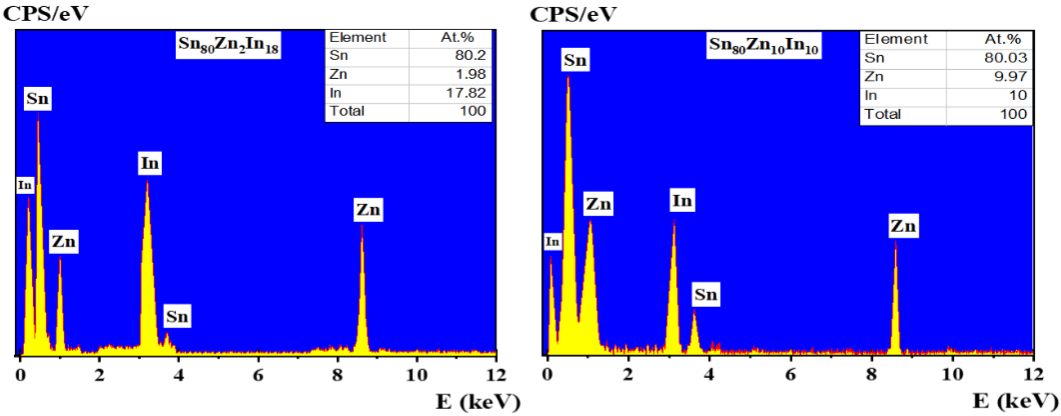
The primary objective of this study is to enhance the properties of Sn-In alloys by incorporating varying amounts of zinc (Zn) to develop alternative lead-free alloys suitable for electronic applications. The samples were synthesized using high-purity in (Sn), indium (In), and zinc (Zn). Zn was added at different weight percentages (2, 4, 6, 8, and 10 wt. %) to the Sn-In base alloy. Structural analysis was performed using X-ray diffraction (XRD) to identify the phase formation and crystalline characteristics. Scanning electron microscopy (SEM) was employed to examine the microstructure, and energy-dispersive X-ray spectroscopy (EDX) was used to determine the elemental composition and phase distribution within the samples. The XRD results indicated that the Sn-Zn-In alloys exhibited a single-phase tetragonal structure. Increasing the Zn concentrations in the Sn matrix refined the grain size of the ternary Sn-Zn-In alloy. Additionally, Zn incorporation into the Sn-In binary alloy altered the intensity of the diffraction peaks and induced shifts in the (2θ) position, particularly in the 80Sn-10Zn-10In alloy. The calculated lattice parameters closely matched the standard values reported in JCPDS PDF# 04-0673, and no new phases were detected in the ternary systems. The SEM analysis revealed the presence of three distinct regions within the alloy microstructure: a gray region rich in β-Sn, a dark region corresponding to the indium-rich phase, and a white region representing the zinc-rich phase. The EDX spectra confirmed that the elemental composition of the Sn-Zn-In alloys closely matched the nominal ratios, indicating successful alloying and homogeneous elemental distribution.
Salam A.Q. ALarnoot، A.H. Al-Hammadi، Ahmed. M.A. Haider (المؤلف) (2025). Zinc-Induced Effects on the Structural and Morphological Properties of Sn-Zn-In Triple Alloys: Insights from XRD, EDX, and SEM Analysis. مجلة جامعة صنعاء للعلوم التطبيقية والتكنولوجيا, 922-932. DOI: https://doi.org/10.59628/jast.v3i4.1649
Salam A.Q. ALarnoot، A.H. Al-Hammadi، Ahmed. M.A. Haider (المؤلف). “Zinc-Induced Effects on the Structural and Morphological Properties of Sn-Zn-In Triple Alloys: Insights from XRD, EDX, and SEM Analysis.” مجلة جامعة صنعاء للعلوم التطبيقية والتكنولوجيا, 2025, pp. 922-932. https://doi.org/10.59628/jast.v3i4.1649. Accessed 31 أكتوبر. 2026.
Salam A.Q. ALarnoot، A.H. Al-Hammadi، Ahmed. M.A. Haider (المؤلف). 2025. “Zinc-Induced Effects on the Structural and Morphological Properties of Sn-Zn-In Triple Alloys: Insights from XRD, EDX, and SEM Analysis.” مجلة جامعة صنعاء للعلوم التطبيقية والتكنولوجيا : 922-932. DOI: https://doi.org/10.59628/jast.v3i4.1649
Salam A.Q. ALarnoot، A.H. Al-Hammadi، Ahmed. M.A. Haider (المؤلف) (2025) ‘Zinc-Induced Effects on the Structural and Morphological Properties of Sn-Zn-In Triple Alloys: Insights from XRD, EDX, and SEM Analysis’, مجلة جامعة صنعاء للعلوم التطبيقية والتكنولوجيا, pp. 922-932. doi: 10.59628/jast.v3i4.1649
@article{jast2025_art1649,
    author  = {Salam A.Q. ALarnoot، A.H. Al-Hammadi، Ahmed. M.A. Haider (المؤلف)},
    title   = {Zinc-Induced Effects on the Structural and Morphological Properties of Sn-Zn-In Triple Alloys: Insights from XRD, EDX, and SEM Analysis},
    journal = {مجلة جامعة صنعاء للعلوم التطبيقية والتكنولوجيا},    year    = {2025},    month   = {أغسطس},    pages   = {922-932},    doi     = {10.59628/jast.v3i4.1649},
    url     = {https://doi.org/10.59628/jast.v3i4.1649},}
Zinc-Induced Effects on the Structural and Morphological Properties of Sn-Zn-In Triple Alloys: Insights from XRD, EDX, and SEM Analysis
لم يتم نشر أي شيء من هذه الفئة بعد.

مجلة جامعة صنعاء
للعلوم التطبيقية والتكنولوجيا
مجلة علمية محكمة ومتاحة للجميع، تنشر أبحاثاً عالية الجودة في مجالات العلوم التطبيقية والهندسة والحاسوب منذ عام 2023.
