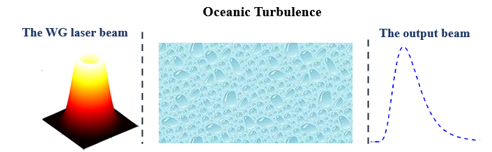
This study investigates the propagation behavior of a class of general circular light beams (CiBs), known as Whittaker–Gaussian beams (WGBs), as they traverse oceanic turbulence by employing the Rytov approximation and diffraction integral formalism. Based on the derived analytical expression, numerical simulations were per- formed to evaluate the impact of oceanic turbulence on the axial intensity distribution of these circular beams. The results indicate that the beam intensity profile is significantly influenced by variations in its initial parameters, namely, the beam waist and wavelength, as well as by key oceanic turbulence parameters, including the rate of mean-square temperature dissipation, balance between temperature and salinity fluctuations, and rate of turbulent kinetic energy dissipation per unit mass. These findings offer deeper insights that can support the development and optimization of optical systems used in underwater communication, remote sensing, and imaging applications.