نظرية المعلومات والترميز
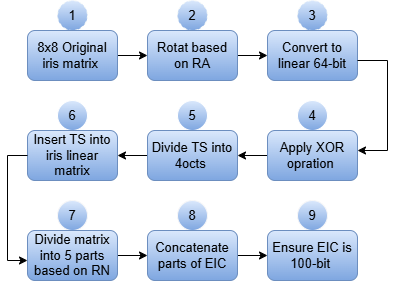
Biometric features are extensively utilized in real-time applications for unique human identification. Among these, iris recognition stands out as a highly reliable physiological biometric modality. However, traditional iris recognition systems are prone to security vulnerabilities due to their reliance on static encoding techniques. This paper proposes a dynamic iris authentication system that generates a unique One-Time Encoded Iris Code (EIC) per session by combining Gabor filters for texture enhancement and Haar wavelets for compact feature representation. The proposed (EIC) uses matrix rotation, XOR operations, random numbers, and timestamp embedding to ensure security. Formal evaluations, including FAR vs. FRR and Real-or-Random analysis, confirm the system’s resilience, with results showing 7% FAR and 11% FRR. Performance metrics indicate an average processing time of 0.067 seconds and memory usage of 2309.36 KB, demonstrating superior efficiency compared to existing schemes. This work contributes a scalable and secure solution for modern authentication needs. The proposed system offers a secure, scalable solution for applications requiring reliable user authentication, such as smart home environments and secure access systems.
Zahra M. Rajeh، A. Alhomdy A. Alhomdy، Fursan Thabit ، Khawla A. Maodah (المؤلف) (2025). A Dynamic Iris Authentication System with One-Time Encoding. مجلة جامعة صنعاء للعلوم التطبيقية والتكنولوجيا, 1266-1276. DOI: https://doi.org/10.59628/jast.v3i6.1978
Zahra M. Rajeh، A. Alhomdy A. Alhomdy، Fursan Thabit ، Khawla A. Maodah (المؤلف). “A Dynamic Iris Authentication System with One-Time Encoding.” مجلة جامعة صنعاء للعلوم التطبيقية والتكنولوجيا, 2025, pp. 1266-1276. https://doi.org/10.59628/jast.v3i6.1978. Accessed 30 أكتوبر. 2026.
Zahra M. Rajeh، A. Alhomdy A. Alhomdy، Fursan Thabit ، Khawla A. Maodah (المؤلف). 2025. “A Dynamic Iris Authentication System with One-Time Encoding.” مجلة جامعة صنعاء للعلوم التطبيقية والتكنولوجيا : 1266-1276. DOI: https://doi.org/10.59628/jast.v3i6.1978
Zahra M. Rajeh، A. Alhomdy A. Alhomdy، Fursan Thabit ، Khawla A. Maodah (المؤلف) (2025) ‘A Dynamic Iris Authentication System with One-Time Encoding’, مجلة جامعة صنعاء للعلوم التطبيقية والتكنولوجيا, pp. 1266-1276. doi: 10.59628/jast.v3i6.1978
@article{jast2025_art1978,
    author  = {Zahra M. Rajeh، A. Alhomdy A. Alhomdy، Fursan Thabit ، Khawla A. Maodah (المؤلف)},
    title   = {A Dynamic Iris Authentication System with One-Time Encoding},
    journal = {مجلة جامعة صنعاء للعلوم التطبيقية والتكنولوجيا},    year    = {2025},    month   = {ديسمبر},    pages   = {1266-1276},    doi     = {10.59628/jast.v3i6.1978},
    url     = {https://doi.org/10.59628/jast.v3i6.1978},}
A Dynamic Iris Authentication System with One-Time Encoding

As technological advancements accelerate globally, it is crucial for emerging markets like Yemen to keep up with these changes to make the most of modern technology. In particular, Augmented Reality (AR) technology offers significant potential to improve operations across sectors such as education, healthcare, trade, and tourism. Yemen, despite its developing position in the telecommunications and information technology sectors, is experiencing a recovery in computing services, driven largely by policies that promote local data centers to ensure information security. This proximity to data storage and processing facilities provides a unique opportunity to implement AR more efficiently and effectively. This paper proposes a framework for adopting AR technology using Edge Computing (EC) in Yemen. EC technology allows data to be processed and stored closer to end users, reducing the need to rely on remote data centers and ensuring unique interactive immersive experiences. The proposed framework was built using two established models: The Technology Acceptance Model (TAM) and The Unified Theory of Acceptance and Use of Technology (UTAUT2), informed by on the-ground insights from key technology and telecom entities in Yemen. The research results showed that Perceived Usefulness and Facilitating Conditions received the highest scores (5/5), indicating their critical role in the adoption of edge computing, while Ease of Use and Social Influence scored lower (3.5/5) due to existing technical and societal limitations.
Nabeel Alsohybe، Roaa Mousa Albanaa (المؤلف) (2025). A Framework for Adopting Enhanced Augmented Reality Technology through Edge Computing: A Case Study of Yemen. مجلة جامعة صنعاء للعلوم التطبيقية والتكنولوجيا, 770-776. DOI: https://doi.org/10.59628/jast.v3i2.1369
Nabeel Alsohybe، Roaa Mousa Albanaa (المؤلف). “A Framework for Adopting Enhanced Augmented Reality Technology through Edge Computing: A Case Study of Yemen.” مجلة جامعة صنعاء للعلوم التطبيقية والتكنولوجيا, 2025, pp. 770-776. https://doi.org/10.59628/jast.v3i2.1369. Accessed 30 أكتوبر. 2026.
Nabeel Alsohybe، Roaa Mousa Albanaa (المؤلف). 2025. “A Framework for Adopting Enhanced Augmented Reality Technology through Edge Computing: A Case Study of Yemen.” مجلة جامعة صنعاء للعلوم التطبيقية والتكنولوجيا : 770-776. DOI: https://doi.org/10.59628/jast.v3i2.1369
Nabeel Alsohybe، Roaa Mousa Albanaa (المؤلف) (2025) ‘A Framework for Adopting Enhanced Augmented Reality Technology through Edge Computing: A Case Study of Yemen’, مجلة جامعة صنعاء للعلوم التطبيقية والتكنولوجيا, pp. 770-776. doi: 10.59628/jast.v3i2.1369
@article{jast2025_art1369,
    author  = {Nabeel Alsohybe، Roaa Mousa Albanaa (المؤلف)},
    title   = {A Framework for Adopting Enhanced Augmented Reality Technology through Edge Computing: A Case Study of Yemen},
    journal = {مجلة جامعة صنعاء للعلوم التطبيقية والتكنولوجيا},    year    = {2025},    month   = {أبريل},    pages   = {770-776},    doi     = {10.59628/jast.v3i2.1369},
    url     = {https://doi.org/10.59628/jast.v3i2.1369},}
A Framework for Adopting Enhanced Augmented Reality Technology through Edge Computing: A Case Study of Yemen
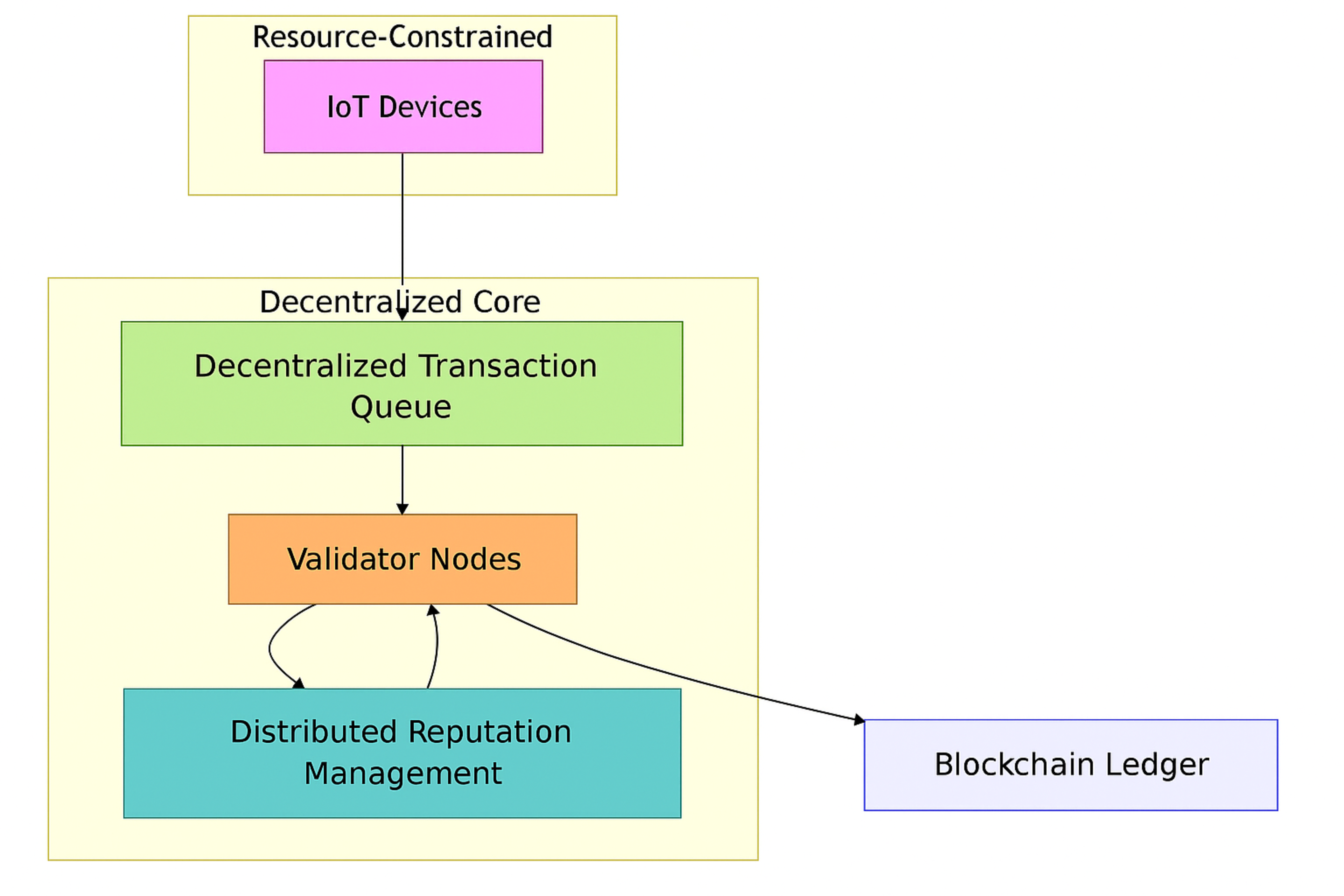
This paper proposes a hybrid consensus framework specifically designed for real-time Internet of Things (IoT) blockchain networks, where low latency, limited device capacity, and high scalability are critical requirements. Conventional approaches such as Proof of Work (PoW) and PBFT are unsuitable for IoT environments due to their computational overhead, energy consumption, and poor adaptability to heterogeneous devices. Our model integrates Proof of Validation (PoV) with Proof of Reputation (PoR) to select validators in a manner that balances efficiency, security, and decentralization. Transaction processing is modeled through M/M/1 queueing theory to enable priority handling of time-sensitive requests, while validator reputation dynamics are represented using Markov chains to capture state transitions under varying performance conditions. Practical IoT scenarios, including healthcare monitoring and smart transportation, are considered to highlight the relevance of the design. Simulation results demonstrate an average throughput of 1,995.8 transactions per block, latency of 0.0514 seconds, and energy consumption of 8.46 Wh per block. When compared with HB-IoT, HMM-Shard, and Microchain, the proposed framework achieves up to 22% lower latency, 15–30% higher throughput, and 35% better energy efficiency. These findings confirm the potential of the framework to support scalable, secure, and energy-aware blockchain infrastructures for real-time IoT applications.
Ali Ahmed Al-awamy، Nagi Al-shaibany، Eman Ahmed Alawamy (المؤلف) (2025). A Real-Time Hybrid Consensus Framework for IoT Blockchain Networks Using Validator Reputation, Markov Modeling, and Priority Queueing. مجلة جامعة صنعاء للعلوم التطبيقية والتكنولوجيا, 1277-1290. DOI: https://doi.org/10.59628/jast.v3i6.1751
Ali Ahmed Al-awamy، Nagi Al-shaibany، Eman Ahmed Alawamy (المؤلف). “A Real-Time Hybrid Consensus Framework for IoT Blockchain Networks Using Validator Reputation, Markov Modeling, and Priority Queueing.” مجلة جامعة صنعاء للعلوم التطبيقية والتكنولوجيا, 2025, pp. 1277-1290. https://doi.org/10.59628/jast.v3i6.1751. Accessed 30 أكتوبر. 2026.
Ali Ahmed Al-awamy، Nagi Al-shaibany، Eman Ahmed Alawamy (المؤلف). 2025. “A Real-Time Hybrid Consensus Framework for IoT Blockchain Networks Using Validator Reputation, Markov Modeling, and Priority Queueing.” مجلة جامعة صنعاء للعلوم التطبيقية والتكنولوجيا : 1277-1290. DOI: https://doi.org/10.59628/jast.v3i6.1751
Ali Ahmed Al-awamy، Nagi Al-shaibany، Eman Ahmed Alawamy (المؤلف) (2025) ‘A Real-Time Hybrid Consensus Framework for IoT Blockchain Networks Using Validator Reputation, Markov Modeling, and Priority Queueing’, مجلة جامعة صنعاء للعلوم التطبيقية والتكنولوجيا, pp. 1277-1290. doi: 10.59628/jast.v3i6.1751
@article{jast2025_art1751,
    author  = {Ali Ahmed Al-awamy، Nagi Al-shaibany، Eman Ahmed Alawamy (المؤلف)},
    title   = {A Real-Time Hybrid Consensus Framework for IoT Blockchain Networks Using Validator Reputation, Markov Modeling, and Priority Queueing},
    journal = {مجلة جامعة صنعاء للعلوم التطبيقية والتكنولوجيا},    year    = {2025},    month   = {ديسمبر},    pages   = {1277-1290},    doi     = {10.59628/jast.v3i6.1751},
    url     = {https://doi.org/10.59628/jast.v3i6.1751},}
A Real-Time Hybrid Consensus Framework for IoT Blockchain Networks Using Validator Reputation, Markov Modeling, and Priority Queueing
Objective: The aim of this survey is to provide a comprehensive review and evaluation of recent advancements in the Greedy Perimeter Stateless Routing (GPSR) protocol, with specific emphasis on special considerations for the individual challenges faced in Wireless Sensor Networks (WSNs), including energy constraints, scalabilitychallenges, reliability, and security.
Methodology: Systematic review of literature was conducted using leading academic databases (e.g., IEEE Xplore, ACM Digital Library, Scopus) during 2015-2025. Studies were selected based on pre-specified inclusion criteria with focus on GPSR variants for WSNs aiming at energy efficiency, scalability, reliability, security, or compatibility with emerging technologies.
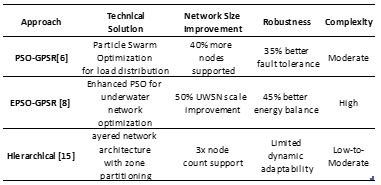
Key Results: Many GPSR adaptations are enumerated and categorized by survey. Noteworthy trends include utilization of optimization algorithms (e.g., PSO, ACO) and machine learning/AI (e.g., fuzzy logic, deep learning) for improvement in energy efficiency, fault tolerance, and security. Comparative study recognizes trade offs with other adaptation techniques. Significant challenges such as localization accuracy, computational overhead, and issues of practical deployment are expounded upon.
Conclusions: While significant progress has been made in the adaptation of GPSR to WSNs, particularly by AI- based approaches, much remains to be done from the practical implementation and verification aspects beyond simulations. This survey synthesizes current knowledge, identifies research gaps, and suggests future directions based on lightweight security, robust localization, and real-world performance evaluation of current adaptations
Yosef A. Abdulmoghni ، Sharaf A. Alhomdy، Yahya Al-Ashmoery (المؤلف) (2025). Adapting GPSR Routing Protocol in Wireless Sensor Networks: Survey. مجلة جامعة صنعاء للعلوم التطبيقية والتكنولوجيا, 1347-1357. DOI: https://doi.org/10.59628/jast.v3i6.1687
Yosef A. Abdulmoghni ، Sharaf A. Alhomdy، Yahya Al-Ashmoery (المؤلف). “Adapting GPSR Routing Protocol in Wireless Sensor Networks: Survey.” مجلة جامعة صنعاء للعلوم التطبيقية والتكنولوجيا, 2025, pp. 1347-1357. https://doi.org/10.59628/jast.v3i6.1687. Accessed 30 أكتوبر. 2026.
Yosef A. Abdulmoghni ، Sharaf A. Alhomdy، Yahya Al-Ashmoery (المؤلف). 2025. “Adapting GPSR Routing Protocol in Wireless Sensor Networks: Survey.” مجلة جامعة صنعاء للعلوم التطبيقية والتكنولوجيا : 1347-1357. DOI: https://doi.org/10.59628/jast.v3i6.1687
Yosef A. Abdulmoghni ، Sharaf A. Alhomdy، Yahya Al-Ashmoery (المؤلف) (2025) ‘Adapting GPSR Routing Protocol in Wireless Sensor Networks: Survey’, مجلة جامعة صنعاء للعلوم التطبيقية والتكنولوجيا, pp. 1347-1357. doi: 10.59628/jast.v3i6.1687
@article{jast2025_art1687,
    author  = {Yosef A. Abdulmoghni ، Sharaf  A. Alhomdy، Yahya Al-Ashmoery (المؤلف)},
    title   = {Adapting GPSR Routing Protocol in Wireless Sensor Networks: Survey},
    journal = {مجلة جامعة صنعاء للعلوم التطبيقية والتكنولوجيا},    year    = {2025},    month   = {ديسمبر},    pages   = {1347-1357},    doi     = {10.59628/jast.v3i6.1687},
    url     = {https://doi.org/10.59628/jast.v3i6.1687},}
Adapting GPSR Routing Protocol in Wireless Sensor Networks: Survey

Even though business intelligence (BI) systems are widely used by organizations across all industries, they frequently fail to yield the expected benefits because the critical success factors (CSFs) that guarantee effective adoption are not considered. Giving this field more scholarly and practical attention is essential. The purpose of this study is to identify and rank the CSFs that influence the adoption of BI. This research employed the systematic literature review methodology. The study analyzes and synthesizes 64 relevant studies to address the CSFs influencing BI adoption. The findings indicate that organizational and technological factors are the most important factors. The study also analyzes the importance of the CSFs. Finally, the study finds that top management support, organizational readiness, clear vision, information/data quality, system integration, IT infrastructure, competitive Pressure, and change management influence BI adoption.
Amira Al-adimi، Mokhtar Mohammed Ghilan، Walid Yousef (المؤلف) (2024). Business Intelligence Systems Adoption: A Systematic Literature Review. مجلة جامعة صنعاء للعلوم التطبيقية والتكنولوجيا, 527-537. DOI: https://doi.org/10.59628/jast.v2i6.1242
Amira Al-adimi، Mokhtar Mohammed Ghilan، Walid Yousef (المؤلف). “Business Intelligence Systems Adoption: A Systematic Literature Review.” مجلة جامعة صنعاء للعلوم التطبيقية والتكنولوجيا, 2024, pp. 527-537. https://doi.org/10.59628/jast.v2i6.1242. Accessed 30 أكتوبر. 2026.
Amira Al-adimi، Mokhtar Mohammed Ghilan، Walid Yousef (المؤلف). 2024. “Business Intelligence Systems Adoption: A Systematic Literature Review.” مجلة جامعة صنعاء للعلوم التطبيقية والتكنولوجيا : 527-537. DOI: https://doi.org/10.59628/jast.v2i6.1242
Amira Al-adimi، Mokhtar Mohammed Ghilan، Walid Yousef (المؤلف) (2024) ‘Business Intelligence Systems Adoption: A Systematic Literature Review’, مجلة جامعة صنعاء للعلوم التطبيقية والتكنولوجيا, pp. 527-537. doi: 10.59628/jast.v2i6.1242
@article{jast2024_art1242,
    author  = {Amira Al-adimi، Mokhtar Mohammed Ghilan، Walid Yousef (المؤلف)},
    title   = {Business Intelligence Systems Adoption: A Systematic Literature Review},
    journal = {مجلة جامعة صنعاء للعلوم التطبيقية والتكنولوجيا},    year    = {2024},    month   = {ديسمبر},    pages   = {527-537},    doi     = {10.59628/jast.v2i6.1242},
    url     = {https://doi.org/10.59628/jast.v2i6.1242},}
Business Intelligence Systems Adoption: A Systematic Literature Review
The existence of metrics for Intelligent systems is very important in order to evaluate, manage, and classify them. Intelligent information systems (IIS) have become a significant part of our daily lives, institutions, and ongoing business, and it has become necessary to have metrics for Intelligent systems in order to measure the success of organizations in using Intelligent systems. In this study, We will choose a group of metrics for intelligent systems, work to develop them, and then determine their source and method of mitigation. It defines the phrase "intelligent systems metrics" and goes over the key metrics and guidelines that can be used to define IISM as well as which metrics have the biggest influence. The significance of each metric in gauging various intelligent systems will be determined, and when these metrics have been reviewed, the effects of each criterion on IIS will be clear.
Motea.M. Aljafare، Mansoor N. Ali Marhoob (المؤلف) (2023). Development Metrics for Intelligent Systems . مجلة جامعة صنعاء للعلوم التطبيقية والتكنولوجيا. DOI: https://doi.org/10.59628/jast.v1i3.294
Motea.M. Aljafare، Mansoor N. Ali Marhoob (المؤلف). “Development Metrics for Intelligent Systems .” مجلة جامعة صنعاء للعلوم التطبيقية والتكنولوجيا, 2023, https://doi.org/10.59628/jast.v1i3.294. Accessed 30 أكتوبر. 2026.
Motea.M. Aljafare، Mansoor N. Ali Marhoob (المؤلف). 2023. “Development Metrics for Intelligent Systems .” مجلة جامعة صنعاء للعلوم التطبيقية والتكنولوجيا DOI: https://doi.org/10.59628/jast.v1i3.294
Motea.M. Aljafare، Mansoor N. Ali Marhoob (المؤلف) (2023) ‘Development Metrics for Intelligent Systems ’, مجلة جامعة صنعاء للعلوم التطبيقية والتكنولوجيا. doi: 10.59628/jast.v1i3.294
@article{jast2023_art294,
    author  = {Motea.M. Aljafare، Mansoor N. Ali Marhoob (المؤلف)},
    title   = {Development Metrics for Intelligent Systems },
    journal = {مجلة جامعة صنعاء للعلوم التطبيقية والتكنولوجيا},    year    = {2023},    month   = {سبتمبر},    doi     = {10.59628/jast.v1i3.294},
    url     = {https://doi.org/10.59628/jast.v1i3.294},}
Development Metrics for Intelligent Systems
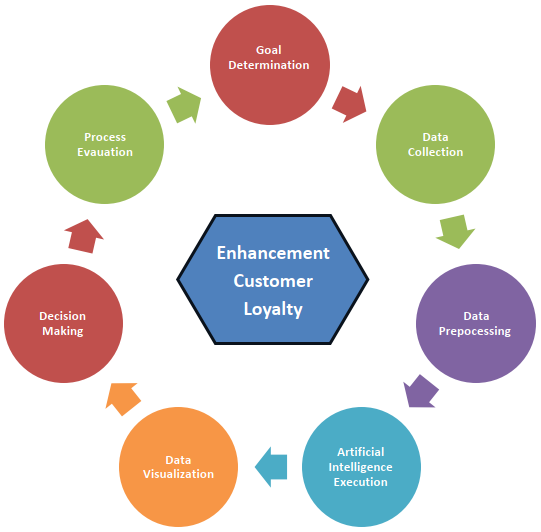
Artificial intelligence (AI) significantly enhances our daily lives, driving many service and financial institutions to seek optimal utilization of it. This paper addresses the problem, which is the inability of some institutions, such as banks, to satisfy customers using outdated methods and solely focusing on acquiring new customers instead of prioritizing customer retention that would be more effective and profitable to them. The main object of this paper is to enhance the quality of service in banks by proposing an intelligent model that leverages customer data to improve services and foster customer loyalty. This paper was motivated by the limited research on customer churn in Yemen and the scarcity of simple intelligent models globally. The methodology employed in this paper includes an in-depth analysis of existing literature on customer churn. Finally, this paper provides a comprehensive and concise conclusion based on the findings.
SULTAN AL-SULTAN، Ibrahim Ahmed Al-Baltah (المؤلف) (2024). Enhancement Customer Loyalty Via Data Mining Techniques in Yemeni Banks: Review Study. مجلة جامعة صنعاء للعلوم التطبيقية والتكنولوجيا, 348-354. DOI: https://doi.org/10.59628/jast.v2i4.1059
SULTAN AL-SULTAN، Ibrahim Ahmed Al-Baltah (المؤلف). “Enhancement Customer Loyalty Via Data Mining Techniques in Yemeni Banks: Review Study.” مجلة جامعة صنعاء للعلوم التطبيقية والتكنولوجيا, 2024, pp. 348-354. https://doi.org/10.59628/jast.v2i4.1059. Accessed 30 أكتوبر. 2026.
SULTAN AL-SULTAN، Ibrahim Ahmed Al-Baltah (المؤلف). 2024. “Enhancement Customer Loyalty Via Data Mining Techniques in Yemeni Banks: Review Study.” مجلة جامعة صنعاء للعلوم التطبيقية والتكنولوجيا : 348-354. DOI: https://doi.org/10.59628/jast.v2i4.1059
SULTAN AL-SULTAN، Ibrahim Ahmed Al-Baltah (المؤلف) (2024) ‘Enhancement Customer Loyalty Via Data Mining Techniques in Yemeni Banks: Review Study’, مجلة جامعة صنعاء للعلوم التطبيقية والتكنولوجيا, pp. 348-354. doi: 10.59628/jast.v2i4.1059
@article{jast2024_art1059,
    author  = {SULTAN AL-SULTAN، Ibrahim Ahmed Al-Baltah (المؤلف)},
    title   = {Enhancement Customer Loyalty Via Data Mining Techniques in Yemeni Banks: Review Study},
    journal = {مجلة جامعة صنعاء للعلوم التطبيقية والتكنولوجيا},    year    = {2024},    month   = {سبتمبر},    pages   = {348-354},    doi     = {10.59628/jast.v2i4.1059},
    url     = {https://doi.org/10.59628/jast.v2i4.1059},}
Enhancement Customer Loyalty Via Data Mining Techniques in Yemeni Banks: Review Study
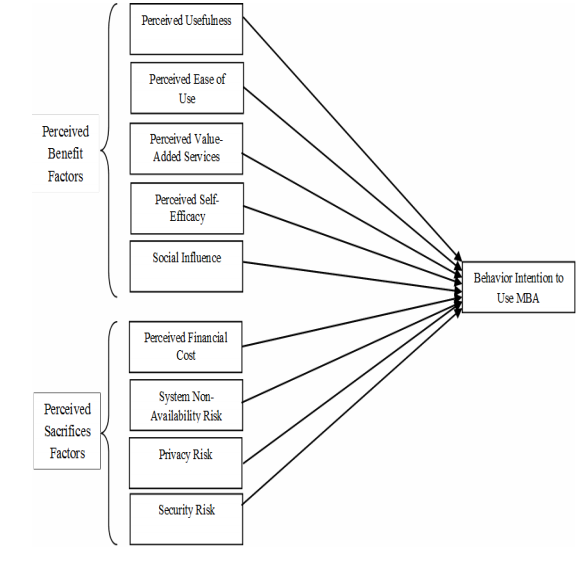
In the Yemeni environment, the adoption rate of Mobile Banking Applications (MBA) is lower than expected by banks, and there is a lack of studies that have examined MBA adoption in Yemen. The rapid development in wireless technology and the widespread use of cell phones have motivated banks to invest their budget in building Mobile Banking Applications (MBA). However, the adoption rate of MBA in Yemen falls short of banks’ expectations, and there is a scarcity of studies investigating the factors related to MBA adoption. Therefore, this study aims to extend the current understanding of MBA adoption by proposing a theoretical model to investigate the factors influencing Yemeni customers’ adoption of MBA. The proposed model extends the Technology Acceptance Model (TAM). Data were collected through a survey questionnaire completed by 473 participants. This study empirically concludes that individuals’ intention to adopt MBA is significantly and positively influencedby perceived usefulness, perceived ease of use, perceived value-added services, perceived self-efficacy, social influence, financial cost, perceived system non-availability risk, perceived privacy risk, and perceived security risk.
Ibrahim Al-Baltah، Sultan Yahya Al-Sultan، Marwa Abdulrahman Al-hadi، Ammar Thabit Zahary (المؤلف) (2024). Factors Influencing the Adoption of Mobile Banking Applications in Yemen Using an Extended Technology Acceptance Model. مجلة جامعة صنعاء للعلوم التطبيقية والتكنولوجيا, 134-146. DOI: https://doi.org/10.59628/jast.v2i2.890
Ibrahim Al-Baltah، Sultan Yahya Al-Sultan، Marwa Abdulrahman Al-hadi، Ammar Thabit Zahary (المؤلف). “Factors Influencing the Adoption of Mobile Banking Applications in Yemen Using an Extended Technology Acceptance Model.” مجلة جامعة صنعاء للعلوم التطبيقية والتكنولوجيا, 2024, pp. 134-146. https://doi.org/10.59628/jast.v2i2.890. Accessed 30 أكتوبر. 2026.
Ibrahim Al-Baltah، Sultan Yahya Al-Sultan، Marwa Abdulrahman Al-hadi، Ammar Thabit Zahary (المؤلف). 2024. “Factors Influencing the Adoption of Mobile Banking Applications in Yemen Using an Extended Technology Acceptance Model.” مجلة جامعة صنعاء للعلوم التطبيقية والتكنولوجيا : 134-146. DOI: https://doi.org/10.59628/jast.v2i2.890
Ibrahim Al-Baltah، Sultan Yahya Al-Sultan، Marwa Abdulrahman Al-hadi، Ammar Thabit Zahary (المؤلف) (2024) ‘Factors Influencing the Adoption of Mobile Banking Applications in Yemen Using an Extended Technology Acceptance Model’, مجلة جامعة صنعاء للعلوم التطبيقية والتكنولوجيا, pp. 134-146. doi: 10.59628/jast.v2i2.890
@article{jast2024_art890,
    author  = {Ibrahim Al-Baltah، Sultan Yahya Al-Sultan، Marwa Abdulrahman Al-hadi، Ammar Thabit Zahary (المؤلف)},
    title   = {Factors Influencing the Adoption of Mobile Banking Applications in Yemen Using an Extended Technology Acceptance Model},
    journal = {مجلة جامعة صنعاء للعلوم التطبيقية والتكنولوجيا},    year    = {2024},    month   = {مايو},    pages   = {134-146},    doi     = {10.59628/jast.v2i2.890},
    url     = {https://doi.org/10.59628/jast.v2i2.890},}
Factors Influencing the Adoption of Mobile Banking Applications in Yemen Using an Extended Technology Acceptance Model

في البيئات الحضرية ثلاثية الأبعاد (3D)، تعتمد دقة تخطيط التغطية لشبكات الموجات المليميترية (mm-wave) على دقة نماذج حساب احتمالية خط الرؤية line-of-sight (LoS) خصوصاً لشبكات الاتصال التي تدعم الطائرات بدون طيار (UAVs). وحيث أن الأدبيات الحالية للمراجع التي تناولت نماذج خط الرؤية لا توفر مراجعة لتلك النماذج كما لا توفر تقييم لدقة التنبؤ لتلك النماذج، تقدم هذه الورقة مراجعة للدراسات التي قدمت النماذج الرياضية لحساب احتمالية وجود خط الرؤية بإعتبار العوائق الكبيرة الثابتة. كما أن هذه الورقة تقدم تقيماً لتلك النماذج باستخدام الـ ray-tracing simulation على أربع بيئات حضرية ثلاثية الأبعاد وهي المدن ذات المباني العالية، المدن كثيفة المباني، المدن الإعتيادية، والضواحي. وقد أظهرت نتائج التقييم بأن النماذج الحالية لا توفر الدقة الكافية للتنبؤ بحالة خط الرؤية مما يستدعي بذل جهد إضافي لتطوير نموذج احتمالية LoS يتسم بتعدد المتغيرات.
Basheer Raddwan، Ibrahim Ahmed Al-Baltah (المؤلف) (2024). Line-of-Sight Probability Models for 5G/6G Millimeter-Wave Networks: A Review. مجلة جامعة صنعاء للعلوم التطبيقية والتكنولوجيا, 440-452. DOI: https://doi.org/10.59628/jast.v2i5.1054
Basheer Raddwan، Ibrahim Ahmed Al-Baltah (المؤلف). “Line-of-Sight Probability Models for 5G/6G Millimeter-Wave Networks: A Review.” مجلة جامعة صنعاء للعلوم التطبيقية والتكنولوجيا, 2024, pp. 440-452. https://doi.org/10.59628/jast.v2i5.1054. Accessed 30 أكتوبر. 2026.
Basheer Raddwan، Ibrahim Ahmed Al-Baltah (المؤلف). 2024. “Line-of-Sight Probability Models for 5G/6G Millimeter-Wave Networks: A Review.” مجلة جامعة صنعاء للعلوم التطبيقية والتكنولوجيا : 440-452. DOI: https://doi.org/10.59628/jast.v2i5.1054
Basheer Raddwan، Ibrahim Ahmed Al-Baltah (المؤلف) (2024) ‘Line-of-Sight Probability Models for 5G/6G Millimeter-Wave Networks: A Review’, مجلة جامعة صنعاء للعلوم التطبيقية والتكنولوجيا, pp. 440-452. doi: 10.59628/jast.v2i5.1054
@article{jast2024_art1054,
    author  = {Basheer Raddwan، Ibrahim Ahmed Al-Baltah (المؤلف)},
    title   = {Line-of-Sight Probability Models for 5G/6G Millimeter-Wave Networks: A Review},
    journal = {مجلة جامعة صنعاء للعلوم التطبيقية والتكنولوجيا},    year    = {2024},    month   = {أكتوبر},    pages   = {440-452},    doi     = {10.59628/jast.v2i5.1054},
    url     = {https://doi.org/10.59628/jast.v2i5.1054},}
Line-of-Sight Probability Models for 5G/6G Millimeter-Wave Networks: A Review

The rapid evolution of 5G networks introduces unprecedented high-speed communication and massive connectivity, but it also intensifies security challenges. Ensuring confidentiality, integrity, and availability of data requires robust encryption mechanisms. This study evaluates the performance and overhead of Advanced Encryption Standard (AES), Rivest–Shamir–Adleman (RSA), and Elliptic Curve Cryptography (ECC) in 5G networks using simulation-based analysis. Metrics considered include latency (ms), throughput (%), encryption/decryption time per MB, and computational cost on UE-class hardware, providing quantitative comparison across typical 5G scenarios (high mobility eMBB, URLLC, and mMTCIoT devices).
Key findings: AES achieves low latency and high throughput for bulk data; ECC provides secure, lightweight key exchange; RSA is suitable only for session key establishment due to higher computational overhead. Overall, hybrid AES+ECC provides the best tradeoff between security and performance in realistic 5G environments.
Mohamed Hankal (المؤلف) (2026). Performance of Encryption schemes in 5G Networks. مجلة جامعة صنعاء للعلوم التطبيقية والتكنولوجيا, 1959-1966. DOI: https://doi.org/10.59628/jast.v4i4.2317
Mohamed Hankal (المؤلف). “Performance of Encryption schemes in 5G Networks.” مجلة جامعة صنعاء للعلوم التطبيقية والتكنولوجيا, 2026, pp. 1959-1966. https://doi.org/10.59628/jast.v4i4.2317. Accessed 30 أكتوبر. 2026.
Mohamed Hankal (المؤلف). 2026. “Performance of Encryption schemes in 5G Networks.” مجلة جامعة صنعاء للعلوم التطبيقية والتكنولوجيا : 1959-1966. DOI: https://doi.org/10.59628/jast.v4i4.2317
Mohamed Hankal (المؤلف) (2026) ‘Performance of Encryption schemes in 5G Networks’, مجلة جامعة صنعاء للعلوم التطبيقية والتكنولوجيا, pp. 1959-1966. doi: 10.59628/jast.v4i4.2317
@article{jast2026_art2317,
    author  = {Mohamed Hankal (المؤلف)},
    title   = {Performance of Encryption schemes in 5G Networks},
    journal = {مجلة جامعة صنعاء للعلوم التطبيقية والتكنولوجيا},    year    = {2026},    month   = {أبريل},    pages   = {1959-1966},    doi     = {10.59628/jast.v4i4.2317},
    url     = {https://doi.org/10.59628/jast.v4i4.2317},}
Performance of Encryption schemes in 5G Networks
لم يتم نشر أي شيء من هذه الفئة بعد.

مجلة جامعة صنعاء
للعلوم التطبيقية والتكنولوجيا
مجلة علمية محكمة ومتاحة للجميع، تنشر أبحاثاً عالية الجودة في مجالات العلوم التطبيقية والهندسة والحاسوب منذ عام 2023.
