امن المعلومات
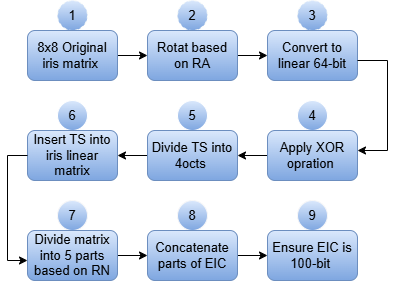
Biometric features are extensively utilized in real-time applications for unique human identification. Among these, iris recognition stands out as a highly reliable physiological biometric modality. However, traditional iris recognition systems are prone to security vulnerabilities due to their reliance on static encoding techniques. This paper proposes a dynamic iris authentication system that generates a unique One-Time Encoded Iris Code (EIC) per session by combining Gabor filters for texture enhancement and Haar wavelets for compact feature representation. The proposed (EIC) uses matrix rotation, XOR operations, random numbers, and timestamp embedding to ensure security. Formal evaluations, including FAR vs. FRR and Real-or-Random analysis, confirm the system’s resilience, with results showing 7% FAR and 11% FRR. Performance metrics indicate an average processing time of 0.067 seconds and memory usage of 2309.36 KB, demonstrating superior efficiency compared to existing schemes. This work contributes a scalable and secure solution for modern authentication needs. The proposed system offers a secure, scalable solution for applications requiring reliable user authentication, such as smart home environments and secure access systems.
Zahra M. Rajeh، A. Alhomdy A. Alhomdy، Fursan Thabit ، Khawla A. Maodah (المؤلف) (2025). A Dynamic Iris Authentication System with One-Time Encoding. مجلة جامعة صنعاء للعلوم التطبيقية والتكنولوجيا, 1266-1276. DOI: https://doi.org/10.59628/jast.v3i6.1978
Zahra M. Rajeh، A. Alhomdy A. Alhomdy، Fursan Thabit ، Khawla A. Maodah (المؤلف). “A Dynamic Iris Authentication System with One-Time Encoding.” مجلة جامعة صنعاء للعلوم التطبيقية والتكنولوجيا, 2025, pp. 1266-1276. https://doi.org/10.59628/jast.v3i6.1978. Accessed 30 أكتوبر. 2026.
Zahra M. Rajeh، A. Alhomdy A. Alhomdy، Fursan Thabit ، Khawla A. Maodah (المؤلف). 2025. “A Dynamic Iris Authentication System with One-Time Encoding.” مجلة جامعة صنعاء للعلوم التطبيقية والتكنولوجيا : 1266-1276. DOI: https://doi.org/10.59628/jast.v3i6.1978
Zahra M. Rajeh، A. Alhomdy A. Alhomdy، Fursan Thabit ، Khawla A. Maodah (المؤلف) (2025) ‘A Dynamic Iris Authentication System with One-Time Encoding’, مجلة جامعة صنعاء للعلوم التطبيقية والتكنولوجيا, pp. 1266-1276. doi: 10.59628/jast.v3i6.1978
@article{jast2025_art1978,
    author  = {Zahra M. Rajeh، A. Alhomdy A. Alhomdy، Fursan Thabit ، Khawla A. Maodah (المؤلف)},
    title   = {A Dynamic Iris Authentication System with One-Time Encoding},
    journal = {مجلة جامعة صنعاء للعلوم التطبيقية والتكنولوجيا},    year    = {2025},    month   = {ديسمبر},    pages   = {1266-1276},    doi     = {10.59628/jast.v3i6.1978},
    url     = {https://doi.org/10.59628/jast.v3i6.1978},}
A Dynamic Iris Authentication System with One-Time Encoding
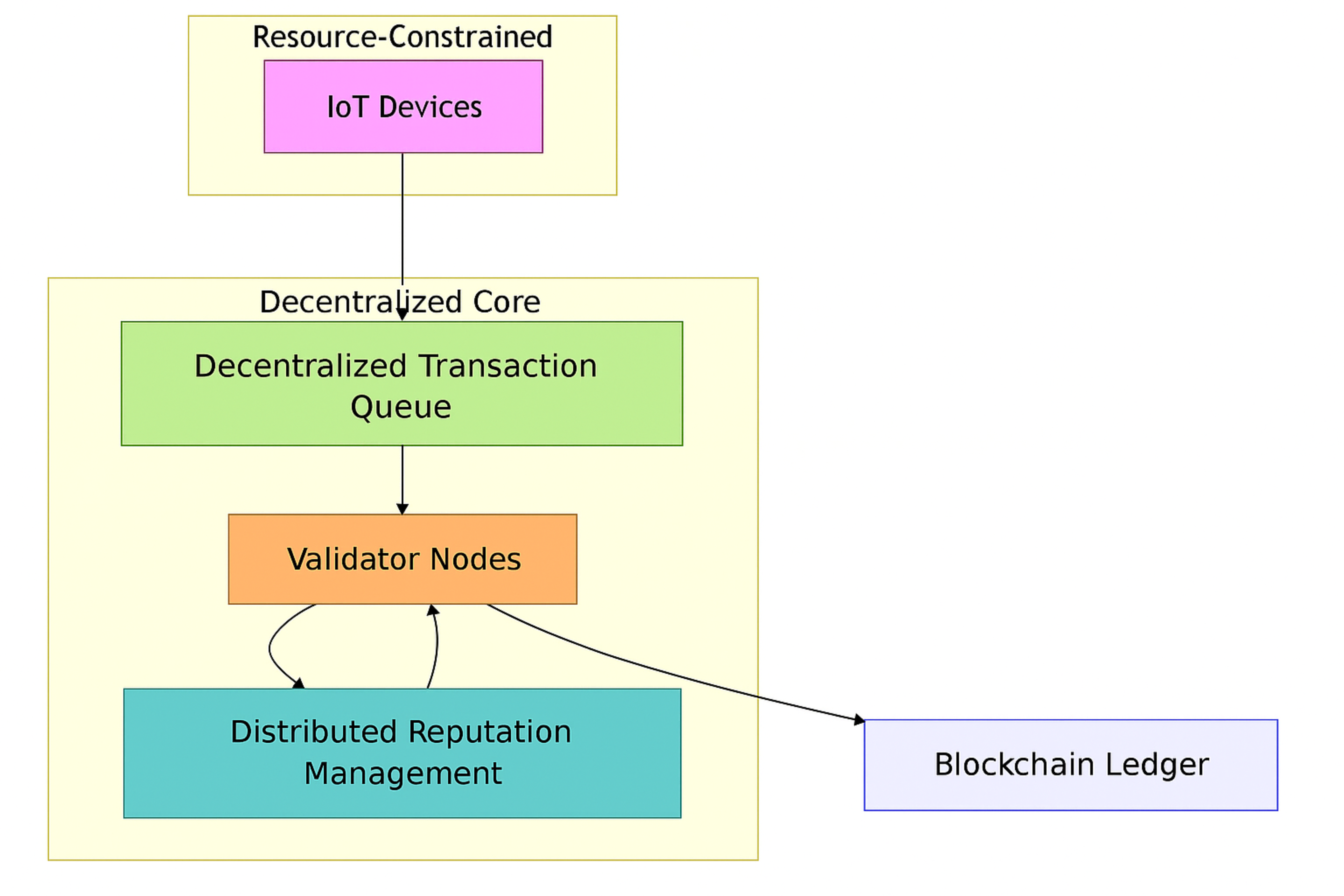
This paper proposes a hybrid consensus framework specifically designed for real-time Internet of Things (IoT) blockchain networks, where low latency, limited device capacity, and high scalability are critical requirements. Conventional approaches such as Proof of Work (PoW) and PBFT are unsuitable for IoT environments due to their computational overhead, energy consumption, and poor adaptability to heterogeneous devices. Our model integrates Proof of Validation (PoV) with Proof of Reputation (PoR) to select validators in a manner that balances efficiency, security, and decentralization. Transaction processing is modeled through M/M/1 queueing theory to enable priority handling of time-sensitive requests, while validator reputation dynamics are represented using Markov chains to capture state transitions under varying performance conditions. Practical IoT scenarios, including healthcare monitoring and smart transportation, are considered to highlight the relevance of the design. Simulation results demonstrate an average throughput of 1,995.8 transactions per block, latency of 0.0514 seconds, and energy consumption of 8.46 Wh per block. When compared with HB-IoT, HMM-Shard, and Microchain, the proposed framework achieves up to 22% lower latency, 15–30% higher throughput, and 35% better energy efficiency. These findings confirm the potential of the framework to support scalable, secure, and energy-aware blockchain infrastructures for real-time IoT applications.
Ali Ahmed Al-awamy، Nagi Al-shaibany، Eman Ahmed Alawamy (المؤلف) (2025). A Real-Time Hybrid Consensus Framework for IoT Blockchain Networks Using Validator Reputation, Markov Modeling, and Priority Queueing. مجلة جامعة صنعاء للعلوم التطبيقية والتكنولوجيا, 1277-1290. DOI: https://doi.org/10.59628/jast.v3i6.1751
Ali Ahmed Al-awamy، Nagi Al-shaibany، Eman Ahmed Alawamy (المؤلف). “A Real-Time Hybrid Consensus Framework for IoT Blockchain Networks Using Validator Reputation, Markov Modeling, and Priority Queueing.” مجلة جامعة صنعاء للعلوم التطبيقية والتكنولوجيا, 2025, pp. 1277-1290. https://doi.org/10.59628/jast.v3i6.1751. Accessed 30 أكتوبر. 2026.
Ali Ahmed Al-awamy، Nagi Al-shaibany، Eman Ahmed Alawamy (المؤلف). 2025. “A Real-Time Hybrid Consensus Framework for IoT Blockchain Networks Using Validator Reputation, Markov Modeling, and Priority Queueing.” مجلة جامعة صنعاء للعلوم التطبيقية والتكنولوجيا : 1277-1290. DOI: https://doi.org/10.59628/jast.v3i6.1751
Ali Ahmed Al-awamy، Nagi Al-shaibany، Eman Ahmed Alawamy (المؤلف) (2025) ‘A Real-Time Hybrid Consensus Framework for IoT Blockchain Networks Using Validator Reputation, Markov Modeling, and Priority Queueing’, مجلة جامعة صنعاء للعلوم التطبيقية والتكنولوجيا, pp. 1277-1290. doi: 10.59628/jast.v3i6.1751
@article{jast2025_art1751,
    author  = {Ali Ahmed Al-awamy، Nagi Al-shaibany، Eman Ahmed Alawamy (المؤلف)},
    title   = {A Real-Time Hybrid Consensus Framework for IoT Blockchain Networks Using Validator Reputation, Markov Modeling, and Priority Queueing},
    journal = {مجلة جامعة صنعاء للعلوم التطبيقية والتكنولوجيا},    year    = {2025},    month   = {ديسمبر},    pages   = {1277-1290},    doi     = {10.59628/jast.v3i6.1751},
    url     = {https://doi.org/10.59628/jast.v3i6.1751},}
A Real-Time Hybrid Consensus Framework for IoT Blockchain Networks Using Validator Reputation, Markov Modeling, and Priority Queueing

Blockchain technology is rapidly evolving, driving advancements in various sectors, most notably in securing academic credentials against forgery. Despite the critical need for tamperproof certificates, consensus remains limited regarding the most secure, cost-effective, and scalable issuance models. To address this gap, a systematic literature review was conducted, meticulously analyzing 24 practical blockchain-based credentialing models published between 2018 and 2024. The quantitative analysis revealed a significant platform dichotomy: 50% of the reviewed models utilize Ethereum, while 25% rely on Hyperledger Fabric. These architectural split highlights a fundamental critical trade-off between the desire for absolute decentralization and Self-Sovereign Identity (SSI) and the necessity for high operational efficiency and low transaction costs. The review concludes that the primary methodological barrier to widespread institutional adoption is the critical absence of empirical quantitative performance data (such as throughput, latency, and actual operational costs) across the current literature. Consequently, the study advocates for future research to focus on developing Hybrid Architectures that can effectively reconcile the core principles of decentralized trust with the demanding efficiency requirements of large educational bodies.
Nawal A. Alragwi، Ammar T. Zahary (المؤلف) (2026). A Review on Recent Advancements in Blockchain Technology for Secure Electronic Certificates. مجلة جامعة صنعاء للعلوم التطبيقية والتكنولوجيا, 1766-1780. DOI: https://doi.org/10.59628/jast.v4i2.2264
Nawal A. Alragwi، Ammar T. Zahary (المؤلف). “A Review on Recent Advancements in Blockchain Technology for Secure Electronic Certificates.” مجلة جامعة صنعاء للعلوم التطبيقية والتكنولوجيا, 2026, pp. 1766-1780. https://doi.org/10.59628/jast.v4i2.2264. Accessed 30 أكتوبر. 2026.
Nawal A. Alragwi، Ammar T. Zahary (المؤلف). 2026. “A Review on Recent Advancements in Blockchain Technology for Secure Electronic Certificates.” مجلة جامعة صنعاء للعلوم التطبيقية والتكنولوجيا : 1766-1780. DOI: https://doi.org/10.59628/jast.v4i2.2264
Nawal A. Alragwi، Ammar T. Zahary (المؤلف) (2026) ‘A Review on Recent Advancements in Blockchain Technology for Secure Electronic Certificates’, مجلة جامعة صنعاء للعلوم التطبيقية والتكنولوجيا, pp. 1766-1780. doi: 10.59628/jast.v4i2.2264
@article{jast2026_art2264,
    author  = {Nawal A. Alragwi، Ammar T. Zahary (المؤلف)},
    title   = {A Review on Recent Advancements in Blockchain Technology for Secure Electronic Certificates},
    journal = {مجلة جامعة صنعاء للعلوم التطبيقية والتكنولوجيا},    year    = {2026},    month   = {فبراير},    pages   = {1766-1780},    doi     = {10.59628/jast.v4i2.2264},
    url     = {https://doi.org/10.59628/jast.v4i2.2264},}
A Review on Recent Advancements in Blockchain Technology for Secure Electronic Certificates
استكشف التعليقات والتصحيحات والنقد والروابط العلمية الأخرى.
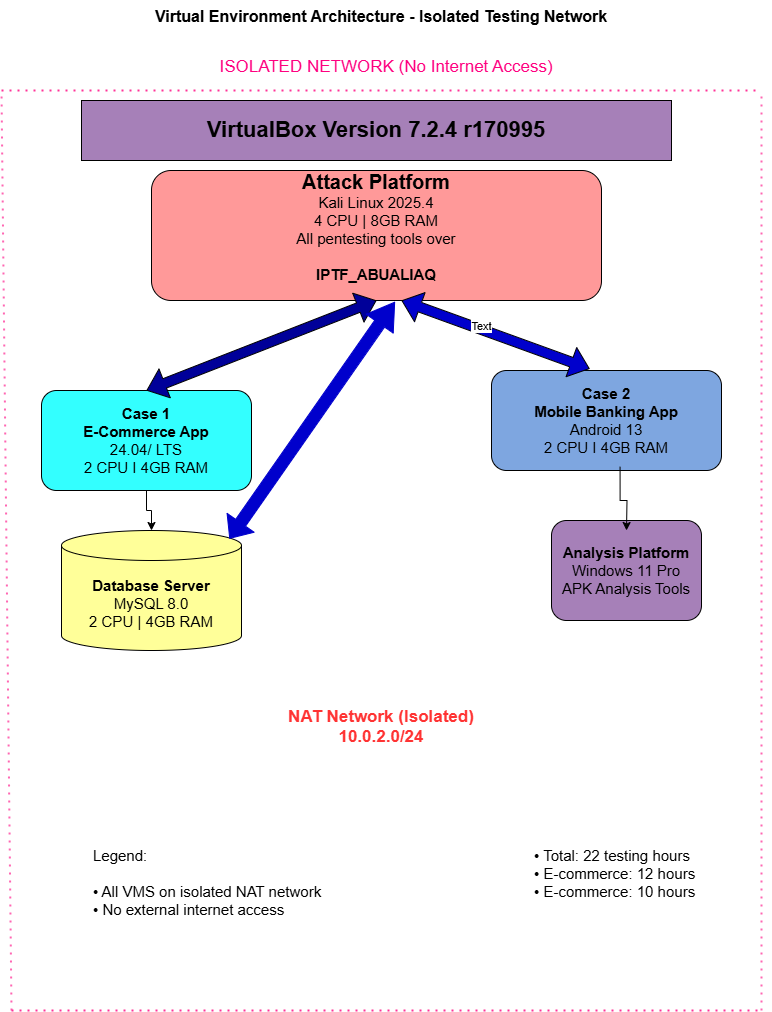
The increasing complexity of Information and Communication Technology (ICT) systems has created significant challenges for cybersecurity professionals in ensuring comprehensive security assessments. Traditional penetration testing methodologies (e.g., PTES, OWASP WSTG, NIST SP 800-115) often lack systematic integration of modern threat intelligence and fail to address the unique requirements of diverse ICT market applications. This research proposes the IPTF framework, an integrated seven-phase penetration testing methodology designed to enhance security assessment effectiveness across e-commerce web applications and mobile banking platforms. The framework integrates pre-engagement reconnaissance, threat modeling, scanning and enumeration, vulnerability assessment, exploitation, post-exploitation, and comprehensive remediation reporting into a cohesive methodology. Through practical implementation in two distinct case studies, the framework demonstrated significant improvements in vulnerability detection rates, assessment efficiency, and remediation guidance quality. Case Study 1 focused on an e-commerce web application, revealing 47 vulnerabilities including 8 critical issues spanning authentication, payment processing, injection, and access control. Case Study 2 examined an Android mobile banking application, identifying 42 vulnerabilities with 7 critical findings in secure storage and API communications. The framework achieved 94% vulnerability detection accuracy and reduced assessment time by 33% compared to traditional PT methodologies (baseline: PTF by TrustedSec, integrating PTES, OWASP WSTG, and NIST SP 800-115). This research contributes to the field by providing a practical, repeatable, and comprehensive penetration testing methodology that addresses current gaps in ICT security assessment practices. The framework’s modular design allows adaptation to various ICT market segments while maintaining methodological rigor and practical applicability.
Abdulrahman Mohammed Abdulrahman Ahmed Abutaleb (المؤلف) (2026). An Integrated Framework to Enhance Penetration Testing for ICT Market Applications. مجلة جامعة صنعاء للعلوم التطبيقية والتكنولوجيا, 2562-2574. DOI: https://doi.org/10.59628/jast.v4i9.2857
Abdulrahman Mohammed Abdulrahman Ahmed Abutaleb (المؤلف). “An Integrated Framework to Enhance Penetration Testing for ICT Market Applications.” مجلة جامعة صنعاء للعلوم التطبيقية والتكنولوجيا, 2026, pp. 2562-2574. https://doi.org/10.59628/jast.v4i9.2857. Accessed 30 أكتوبر. 2026.
Abdulrahman Mohammed Abdulrahman Ahmed Abutaleb (المؤلف). 2026. “An Integrated Framework to Enhance Penetration Testing for ICT Market Applications.” مجلة جامعة صنعاء للعلوم التطبيقية والتكنولوجيا : 2562-2574. DOI: https://doi.org/10.59628/jast.v4i9.2857
Abdulrahman Mohammed Abdulrahman Ahmed Abutaleb (المؤلف) (2026) ‘An Integrated Framework to Enhance Penetration Testing for ICT Market Applications’, مجلة جامعة صنعاء للعلوم التطبيقية والتكنولوجيا, pp. 2562-2574. doi: 10.59628/jast.v4i9.2857
@article{jast2026_art2857,
    author  = {Abdulrahman Mohammed Abdulrahman Ahmed Abutaleb (المؤلف)},
    title   = {An Integrated Framework to Enhance Penetration Testing for ICT Market Applications},
    journal = {مجلة جامعة صنعاء للعلوم التطبيقية والتكنولوجيا},    year    = {2026},    month   = {سبتمبر},    pages   = {2562-2574},    doi     = {10.59628/jast.v4i9.2857},
    url     = {https://doi.org/10.59628/jast.v4i9.2857},}
An Integrated Framework to Enhance Penetration Testing for ICT Market Applications

With the rapid developments in data volume and the complexity of cyber-attacks, attack detection systems face increasing challenges. This paper presents a model based on a Support Vector Machine (SVM) algorithm to detect attacks. To improve detection accuracy and reduce computational complexity, the Principal Component Analysis (PCA) algorithm was used as a first stage to select the most important features in the NSL-KDD dataset. The proposed model was applied to the NSL-KDD dataset. The results showed that using the SVM and PCA algorithms helps reduce the data dimensions, leading to improved classification accuracy and reduced computational complexity of the model. This model provides a machine learning-based detection system that can effectively identify attacks, which leads to enhancing network security against complex threats.
Essra Abd wazkool، Abdulrahman A. Alsabri، Suad Mohammed Othman (المؤلف) (2026). Attacks Detection Model Based on a Machine Learning Algorithm. مجلة جامعة صنعاء للعلوم التطبيقية والتكنولوجيا, 1656-1664. DOI: https://doi.org/10.59628/jast.v4i2.2270
Essra Abd wazkool، Abdulrahman A. Alsabri، Suad Mohammed Othman (المؤلف). “Attacks Detection Model Based on a Machine Learning Algorithm.” مجلة جامعة صنعاء للعلوم التطبيقية والتكنولوجيا, 2026, pp. 1656-1664. https://doi.org/10.59628/jast.v4i2.2270. Accessed 30 أكتوبر. 2026.
Essra Abd wazkool، Abdulrahman A. Alsabri، Suad Mohammed Othman (المؤلف). 2026. “Attacks Detection Model Based on a Machine Learning Algorithm.” مجلة جامعة صنعاء للعلوم التطبيقية والتكنولوجيا : 1656-1664. DOI: https://doi.org/10.59628/jast.v4i2.2270
Essra Abd wazkool، Abdulrahman A. Alsabri، Suad Mohammed Othman (المؤلف) (2026) ‘Attacks Detection Model Based on a Machine Learning Algorithm’, مجلة جامعة صنعاء للعلوم التطبيقية والتكنولوجيا, pp. 1656-1664. doi: 10.59628/jast.v4i2.2270
@article{jast2026_art2270,
    author  = {Essra Abd wazkool، Abdulrahman A. Alsabri، Suad Mohammed Othman (المؤلف)},
    title   = {Attacks Detection Model Based on a Machine Learning Algorithm},
    journal = {مجلة جامعة صنعاء للعلوم التطبيقية والتكنولوجيا},    year    = {2026},    month   = {فبراير},    pages   = {1656-1664},    doi     = {10.59628/jast.v4i2.2270},
    url     = {https://doi.org/10.59628/jast.v4i2.2270},}
Attacks Detection Model Based on a Machine Learning Algorithm

5G network slicing, Unmanned Aerial Vehicle (UAV) aided Multi-Access Edge Computing (MEC), and blockchain technology create new options for intelligent resource management. However, a major difficulty is efficiently allocating limited UAV resources to heterogeneous device demands while guaranteeing slice-specific Quality-of-Service (QoS) criteria. We develop a blockchain-empowered clustering framework that couples seven clustering algorithms (K-Means, DBSCAN, OPTICS, MeanShift, Hierarchical, Gaussian Mixture Model, and Divisive clustering) with an upgraded contextual bandit decision agent. The agent dynamically chooses between local execution and UAV offloading depending on slice characteristics, signal strength, latency constraints, and cluster homogeneity parameters. We use dual smart contracts (UserAllocation and UserOffload) on a permissioned Ganache (Ethereum) blockchain to ensure trust and transparency. An appropriate model of UAV placement considers the signal propagation effects and spatial distribution. The experimental results demonstrate that our clustering-aware method achieves significant improvement over non-clustered baselines by 27% in task offloading reward, 43% in regret reduction, and 20% in action accuracy, while maintaining high SLA requirements for all slice types (URLLC, eMBB, mMTC). The best overall performance is obtained with the MeanShift method. Dynamic device clustering is not only a data organization approach but also an excellent control mechanism for slice-aware resource orchestration in UAV-MEC systems. The combination of clustering intelligence, contextual bandit decisions, and blockchain-based trust gives a scalable, adaptable, and accountable solution for 5G/6G UAV-assisted edge networks.
Asrar Ahmed Baktayan، Ammar Thabit Zahary، Ibrahim Ahmed Al-Baltah (المؤلف) (2026). Blockchain-Enabled Clustering for Dynamic Resource Allocation and Task Offloading in UAV-Assisted MEC for 5G Network Slicing. مجلة جامعة صنعاء للعلوم التطبيقية والتكنولوجيا, 2049-2063. DOI: https://doi.org/10.59628/jast.v4i5.2655
Asrar Ahmed Baktayan، Ammar Thabit Zahary، Ibrahim Ahmed Al-Baltah (المؤلف). “Blockchain-Enabled Clustering for Dynamic Resource Allocation and Task Offloading in UAV-Assisted MEC for 5G Network Slicing.” مجلة جامعة صنعاء للعلوم التطبيقية والتكنولوجيا, 2026, pp. 2049-2063. https://doi.org/10.59628/jast.v4i5.2655. Accessed 30 أكتوبر. 2026.
Asrar Ahmed Baktayan، Ammar Thabit Zahary، Ibrahim Ahmed Al-Baltah (المؤلف). 2026. “Blockchain-Enabled Clustering for Dynamic Resource Allocation and Task Offloading in UAV-Assisted MEC for 5G Network Slicing.” مجلة جامعة صنعاء للعلوم التطبيقية والتكنولوجيا : 2049-2063. DOI: https://doi.org/10.59628/jast.v4i5.2655
Asrar Ahmed Baktayan، Ammar Thabit Zahary، Ibrahim Ahmed Al-Baltah (المؤلف) (2026) ‘Blockchain-Enabled Clustering for Dynamic Resource Allocation and Task Offloading in UAV-Assisted MEC for 5G Network Slicing’, مجلة جامعة صنعاء للعلوم التطبيقية والتكنولوجيا, pp. 2049-2063. doi: 10.59628/jast.v4i5.2655
@article{jast2026_art2655,
    author  = {Asrar Ahmed Baktayan، Ammar Thabit Zahary، Ibrahim Ahmed Al-Baltah (المؤلف)},
    title   = {Blockchain-Enabled Clustering for Dynamic Resource Allocation and Task Offloading in UAV-Assisted MEC for 5G Network Slicing},
    journal = {مجلة جامعة صنعاء للعلوم التطبيقية والتكنولوجيا},    year    = {2026},    month   = {مايو},    pages   = {2049-2063},    doi     = {10.59628/jast.v4i5.2655},
    url     = {https://doi.org/10.59628/jast.v4i5.2655},}
Blockchain-Enabled Clustering for Dynamic Resource Allocation and Task Offloading in UAV-Assisted MEC for 5G Network Slicing
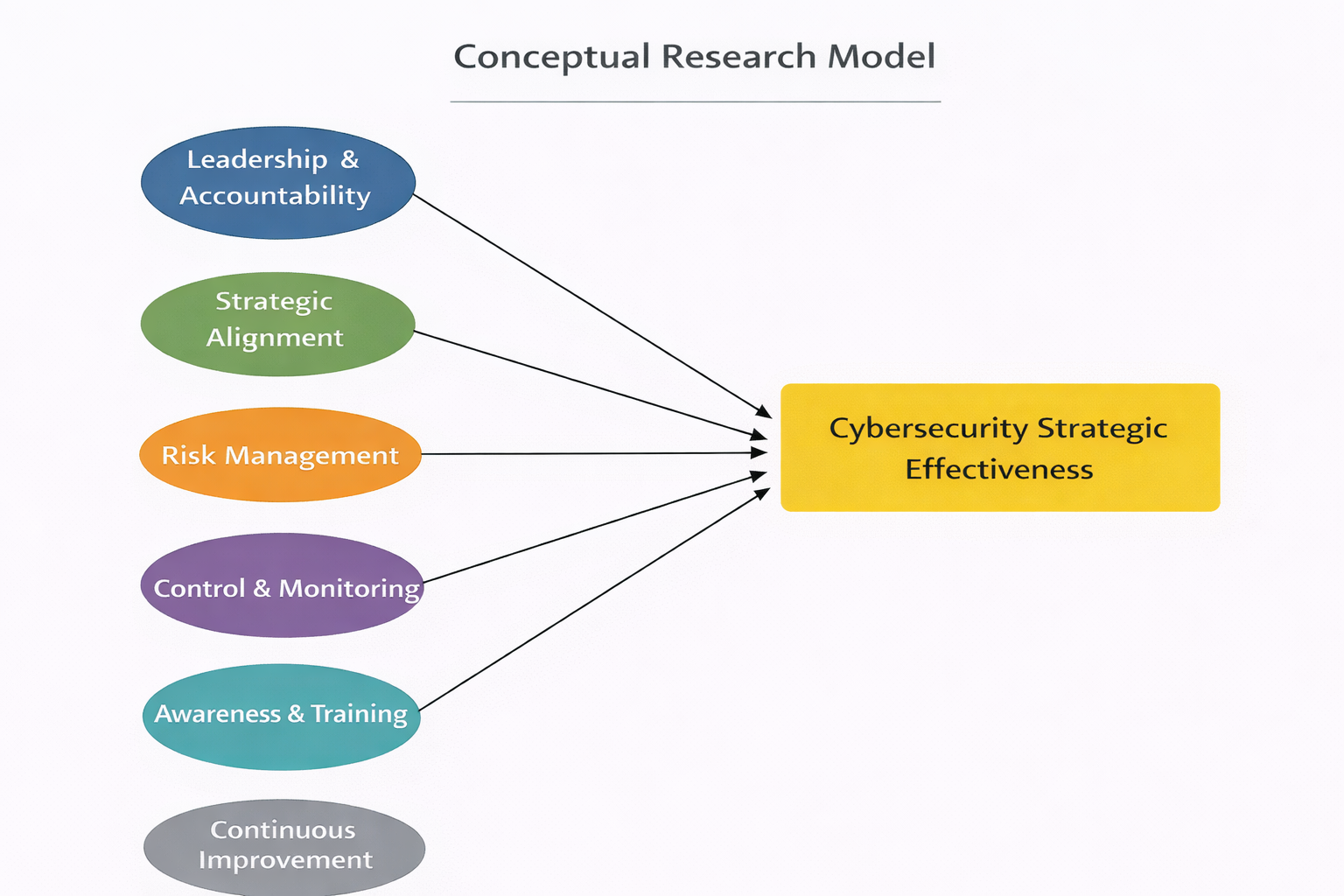
Public sector institutions in developing countries increasingly adopt cybersecurity governance frameworks, yet a persistent gap remains between formal adoption and strategic cybersecurity effectiveness. This study investigates this gap through a case study of the Ministry of Communications and Information Technology in Yemen, guided by ISO/IEC 27014. Using a descriptive-analytical approach, data were collected from 30 cybersecurity decision-makers across six governance dimensions and analyzed using PLS-SEM. The findings reveal a cybersecurity governance maturity gap, as none of the governance dimensions showed a significant impact on strategic effectiveness despite moderate to high implementation levels. Risk assessment and management exhibited a negative, non-significant relationship, indicating symbolic practices. The study proposes a context-sensitive framework to enhance strategic alignment and effectiveness. The findings offer practical guidance for policymakers in developing countries seeking to transition from compliance-oriented cybersecurity governance toward strategically integrated governance frameworks.
Riam Abdulbaset AL-Hakimi AL-Hakimi، Nagi Ali AL-Shaibany (المؤلف) (2026). Cybersecurity Governance in the Ministry of Communications and Information Technology in Yemen: Empirical Evidence and a Context-Sensitive Framework. مجلة جامعة صنعاء للعلوم التطبيقية والتكنولوجيا, 2306-2317. DOI: https://doi.org/10.59628/jast.v4i7.2763
Riam Abdulbaset AL-Hakimi AL-Hakimi، Nagi Ali AL-Shaibany (المؤلف). “Cybersecurity Governance in the Ministry of Communications and Information Technology in Yemen: Empirical Evidence and a Context-Sensitive Framework.” مجلة جامعة صنعاء للعلوم التطبيقية والتكنولوجيا, 2026, pp. 2306-2317. https://doi.org/10.59628/jast.v4i7.2763. Accessed 30 أكتوبر. 2026.
Riam Abdulbaset AL-Hakimi AL-Hakimi، Nagi Ali AL-Shaibany (المؤلف). 2026. “Cybersecurity Governance in the Ministry of Communications and Information Technology in Yemen: Empirical Evidence and a Context-Sensitive Framework.” مجلة جامعة صنعاء للعلوم التطبيقية والتكنولوجيا : 2306-2317. DOI: https://doi.org/10.59628/jast.v4i7.2763
Riam Abdulbaset AL-Hakimi AL-Hakimi، Nagi Ali AL-Shaibany (المؤلف) (2026) ‘Cybersecurity Governance in the Ministry of Communications and Information Technology in Yemen: Empirical Evidence and a Context-Sensitive Framework’, مجلة جامعة صنعاء للعلوم التطبيقية والتكنولوجيا, pp. 2306-2317. doi: 10.59628/jast.v4i7.2763
@article{jast2026_art2763,
    author  = {Riam Abdulbaset AL-Hakimi AL-Hakimi، Nagi Ali AL-Shaibany (المؤلف)},
    title   = {Cybersecurity Governance in the Ministry of Communications and Information Technology in Yemen: Empirical Evidence and a Context-Sensitive Framework},
    journal = {مجلة جامعة صنعاء للعلوم التطبيقية والتكنولوجيا},    year    = {2026},    month   = {يوليو},    pages   = {2306-2317},    doi     = {10.59628/jast.v4i7.2763},
    url     = {https://doi.org/10.59628/jast.v4i7.2763},}
Cybersecurity Governance in the Ministry of Communications and Information Technology in Yemen: Empirical Evidence and a Context-Sensitive Framework

Strong cybersecurity measures are becoming vitally crucial as cloud computing utilization rises. Advanced and dynamic cyberthreats are frequently difficult for traditional intrusion detection systems (IDS), which rely on preset signatures and rules, to identify. This study improves the detection of known and unknown intrusions in cloud systems using Machine Learning (ML) methods. The UNSW-NB15 dataset was used to train and assess a num- ber of ML classifiers, including Random Forest (RF), Decision Tree (DT), XGBoost, Naïve Bayes (NB), Support Vector Machine (SVM), Logistic Regression (LR), and Gradient Boosting (GB). It uses full feature training across several classifiers and also investigates the implications of feature reduction, in contrast to many other studies that mainly employ full feature sets to train RF alone. Critical metrics including accuracy (ACC), precision, recall, and F1-score are used to analyze classifier performance and provide a thorough evaluation of their efficacy in in- trusion detection. The findings show that using all characteristics the RF and DT obtained perfect accuracy (1.00). In the case of less characteristics when using feature selection techniques (RF-based selection, information gain, or mutual information), the RF retained the best accuracy (0.94), whereas NB performed the worst overall. This study emphasizes the significance of feature selection in enhancing IDS performance and shows that ML-based techniques may greatly increase threat detection in cloud settings, even when feature dimensionality is lowered.
Khawla Ali Maodah، Fursan Thabit، Sharaf Alhomdy (المؤلف) (2025). Enhancing Intrusion Detection System in cloud computing Using Machine Learning Techniques. مجلة جامعة صنعاء للعلوم التطبيقية والتكنولوجيا, 1203-1221. DOI: https://doi.org/10.59628/jast.v3i5.1777
Khawla Ali Maodah، Fursan Thabit، Sharaf Alhomdy (المؤلف). “Enhancing Intrusion Detection System in cloud computing Using Machine Learning Techniques.” مجلة جامعة صنعاء للعلوم التطبيقية والتكنولوجيا, 2025, pp. 1203-1221. https://doi.org/10.59628/jast.v3i5.1777. Accessed 30 أكتوبر. 2026.
Khawla Ali Maodah، Fursan Thabit، Sharaf Alhomdy (المؤلف). 2025. “Enhancing Intrusion Detection System in cloud computing Using Machine Learning Techniques.” مجلة جامعة صنعاء للعلوم التطبيقية والتكنولوجيا : 1203-1221. DOI: https://doi.org/10.59628/jast.v3i5.1777
Khawla Ali Maodah، Fursan Thabit، Sharaf Alhomdy (المؤلف) (2025) ‘Enhancing Intrusion Detection System in cloud computing Using Machine Learning Techniques’, مجلة جامعة صنعاء للعلوم التطبيقية والتكنولوجيا, pp. 1203-1221. doi: 10.59628/jast.v3i5.1777
@article{jast2025_art1777,
    author  = {Khawla Ali Maodah، Fursan Thabit، Sharaf Alhomdy (المؤلف)},
    title   = {Enhancing Intrusion Detection System in cloud computing Using Machine Learning Techniques},
    journal = {مجلة جامعة صنعاء للعلوم التطبيقية والتكنولوجيا},    year    = {2025},    month   = {أكتوبر},    pages   = {1203-1221},    doi     = {10.59628/jast.v3i5.1777},
    url     = {https://doi.org/10.59628/jast.v3i5.1777},}
Enhancing Intrusion Detection System in cloud computing Using Machine Learning Techniques
شبكة المركبات (VANET) هي أحد مكونات نظام النقل الذكي (ITS) ، لتبادل الرسائل بين المركبات والوحدات على جانب الطريق (RSU). بينما بسبب الزيادة في عدد المركبات ، كان هناك الكثير من الخصوصية والثقة والتحديات الأمنية المتعلقة بشبكة المركبات (VANET). يجب أن تكون المعلومات المتبادلة بين المركبات صحيحة لتحقيق مبدأ وكالة المخابرات المركزية. لا تنطبق حلول الثقة والخصوصية والأمان على الشبكات المركزية. الأهم من ذلك ، عدم وجود السرية والخصوصية والتوافر. في هذه الورقة ، سيتم تقديم حلول لحل المشكلات الأمنية باستخدام تقنية blockchain الهرمية. تتميز blockchain الهرمية بمزايا التأكيد بالإجماع على مصداقية الرسالة واللامركزية والتخزين غير القابل للتغيير. ستوفر كل هذه المزايا حلولًا لتلك المشاكل والتحديات المتعلقة بأمان VANETs. هذه الورقة تسعى إلى هدفين رئيسيين. الأول هو مراقبة المركبات الخبيثة وغير الضارة بواسطة الطائرات بدون طيار ، للتحقق من صحة الرسالة قبل إرسالها عبر VANET. والثاني عبارة عن مجموعة من القواعد المعقدة والحسابات المحددة للتحقق من الرسالة. تُستخدم خوارزميات الإجماع أيضًا للاتفاق بين المركبات على ما هو صحيح ، ولتقييم الأداء باستخدام المقاييس التالية (الإنتاجية ، والتسامح ، والكمون).
Firdaus AlHrazi، Malek Algabri، Abdualmajed Ahmed Al-Khulaidi (المؤلف) (2023). Hierarchical Blockchain as Line Defense of Attacks to Messages Propagation in VANET. مجلة جامعة صنعاء للعلوم التطبيقية والتكنولوجيا. DOI: https://doi.org/10.59628/jast.v1i3.370
Firdaus AlHrazi، Malek Algabri، Abdualmajed Ahmed Al-Khulaidi (المؤلف). “Hierarchical Blockchain as Line Defense of Attacks to Messages Propagation in VANET.” مجلة جامعة صنعاء للعلوم التطبيقية والتكنولوجيا, 2023, https://doi.org/10.59628/jast.v1i3.370. Accessed 30 أكتوبر. 2026.
Firdaus AlHrazi، Malek Algabri، Abdualmajed Ahmed Al-Khulaidi (المؤلف). 2023. “Hierarchical Blockchain as Line Defense of Attacks to Messages Propagation in VANET.” مجلة جامعة صنعاء للعلوم التطبيقية والتكنولوجيا DOI: https://doi.org/10.59628/jast.v1i3.370
Firdaus AlHrazi، Malek Algabri، Abdualmajed Ahmed Al-Khulaidi (المؤلف) (2023) ‘Hierarchical Blockchain as Line Defense of Attacks to Messages Propagation in VANET’, مجلة جامعة صنعاء للعلوم التطبيقية والتكنولوجيا. doi: 10.59628/jast.v1i3.370
@article{jast2023_art370,
    author  = {Firdaus AlHrazi، Malek Algabri، Abdualmajed Ahmed Al-Khulaidi (المؤلف)},
    title   = {Hierarchical Blockchain as Line Defense of Attacks to Messages Propagation in VANET},
    journal = {مجلة جامعة صنعاء للعلوم التطبيقية والتكنولوجيا},    year    = {2023},    month   = {سبتمبر},    doi     = {10.59628/jast.v1i3.370},
    url     = {https://doi.org/10.59628/jast.v1i3.370},}
Hierarchical Blockchain as Line Defense of Attacks to Messages Propagation in VANET

The rapid evolution of 5G networks introduces unprecedented high-speed communication and massive connectivity, but it also intensifies security challenges. Ensuring confidentiality, integrity, and availability of data requires robust encryption mechanisms. This study evaluates the performance and overhead of Advanced Encryption Standard (AES), Rivest–Shamir–Adleman (RSA), and Elliptic Curve Cryptography (ECC) in 5G networks using simulation-based analysis. Metrics considered include latency (ms), throughput (%), encryption/decryption time per MB, and computational cost on UE-class hardware, providing quantitative comparison across typical 5G scenarios (high mobility eMBB, URLLC, and mMTCIoT devices).
Key findings: AES achieves low latency and high throughput for bulk data; ECC provides secure, lightweight key exchange; RSA is suitable only for session key establishment due to higher computational overhead. Overall, hybrid AES+ECC provides the best tradeoff between security and performance in realistic 5G environments.
Mohamed Hankal (المؤلف) (2026). Performance of Encryption schemes in 5G Networks. مجلة جامعة صنعاء للعلوم التطبيقية والتكنولوجيا, 1959-1966. DOI: https://doi.org/10.59628/jast.v4i4.2317
Mohamed Hankal (المؤلف). “Performance of Encryption schemes in 5G Networks.” مجلة جامعة صنعاء للعلوم التطبيقية والتكنولوجيا, 2026, pp. 1959-1966. https://doi.org/10.59628/jast.v4i4.2317. Accessed 30 أكتوبر. 2026.
Mohamed Hankal (المؤلف). 2026. “Performance of Encryption schemes in 5G Networks.” مجلة جامعة صنعاء للعلوم التطبيقية والتكنولوجيا : 1959-1966. DOI: https://doi.org/10.59628/jast.v4i4.2317
Mohamed Hankal (المؤلف) (2026) ‘Performance of Encryption schemes in 5G Networks’, مجلة جامعة صنعاء للعلوم التطبيقية والتكنولوجيا, pp. 1959-1966. doi: 10.59628/jast.v4i4.2317
@article{jast2026_art2317,
    author  = {Mohamed Hankal (المؤلف)},
    title   = {Performance of Encryption schemes in 5G Networks},
    journal = {مجلة جامعة صنعاء للعلوم التطبيقية والتكنولوجيا},    year    = {2026},    month   = {أبريل},    pages   = {1959-1966},    doi     = {10.59628/jast.v4i4.2317},
    url     = {https://doi.org/10.59628/jast.v4i4.2317},}
Performance of Encryption schemes in 5G Networks
This study conducts a comprehensive analysis of different standards frameworks in cybersecurity to identify best practices and international standards. The primary objective is to propose an appropriate cybersecurity framework that aligns with global standards, effectively reducing the risks of cyberattacks and threats to data, information, networks, and devices within institutions. By enhancing cybersecurity, the framework aims to safeguard infrastructure. It further contributes to improved management of cybersecurity risks by incorporating the best global practices and local cybersecurity legislation. Through an examination of various cybersecurity frameworks, including NIST 800-53Ar4, COBIT, and ISO27002, the study finds that NIST 800-53Ar4 is the most effective framework. The researcher recommended adopting a hybrid approach that combines elements from multiple frameworks and standards.
Abdulkarem Yahya Abohatem ، Fadl M.M. Ba-Alwi، Abdualmajed Ahmed Al-Khulaidi (المؤلف) (2023). Suggestion Cybersecurity Framework (CSF) for Reducing Cyber-Attacks on Information Systems. مجلة جامعة صنعاء للعلوم التطبيقية والتكنولوجيا. DOI: https://doi.org/10.59628/jast.v1i3.248
Abdulkarem Yahya Abohatem ، Fadl M.M. Ba-Alwi، Abdualmajed Ahmed Al-Khulaidi (المؤلف). “Suggestion Cybersecurity Framework (CSF) for Reducing Cyber-Attacks on Information Systems.” مجلة جامعة صنعاء للعلوم التطبيقية والتكنولوجيا, 2023, https://doi.org/10.59628/jast.v1i3.248. Accessed 30 أكتوبر. 2026.
Abdulkarem Yahya Abohatem ، Fadl M.M. Ba-Alwi، Abdualmajed Ahmed Al-Khulaidi (المؤلف). 2023. “Suggestion Cybersecurity Framework (CSF) for Reducing Cyber-Attacks on Information Systems.” مجلة جامعة صنعاء للعلوم التطبيقية والتكنولوجيا DOI: https://doi.org/10.59628/jast.v1i3.248
Abdulkarem Yahya Abohatem ، Fadl M.M. Ba-Alwi، Abdualmajed Ahmed Al-Khulaidi (المؤلف) (2023) ‘Suggestion Cybersecurity Framework (CSF) for Reducing Cyber-Attacks on Information Systems’, مجلة جامعة صنعاء للعلوم التطبيقية والتكنولوجيا. doi: 10.59628/jast.v1i3.248
@article{jast2023_art248,
    author  = {Abdulkarem Yahya Abohatem ، Fadl M.M. Ba-Alwi، Abdualmajed Ahmed Al-Khulaidi (المؤلف)},
    title   = {Suggestion Cybersecurity Framework (CSF) for Reducing Cyber-Attacks on Information Systems},
    journal = {مجلة جامعة صنعاء للعلوم التطبيقية والتكنولوجيا},    year    = {2023},    month   = {سبتمبر},    doi     = {10.59628/jast.v1i3.248},
    url     = {https://doi.org/10.59628/jast.v1i3.248},}
Suggestion Cybersecurity Framework (CSF) for Reducing Cyber-Attacks on Information Systems
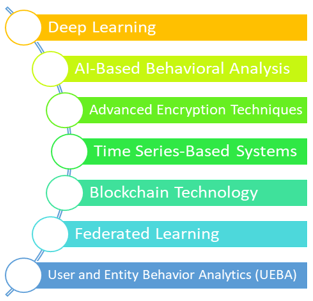
With the continued development of cloud computing environments, security measures have become more im-portant than ever. Intrusion detection systems (IDS) are considered one of the most critical security measures in cloud computing. Researchers aim to find effective technologies for detecting intrusions in cloud computing. This paper presents a comprehensive survey of the techniques used for Intrusion Detection in Cloud Computing and their classification. Specifically, it covers a range of techniques such as machine learning, and provides insights for researchers looking to develop more flexible and effective techniques for intrusion detection in cloud computing.
سعاد محمد عثمان، Adnan Yehia Al-mutawkkil، Amani Mohammed Alnashi (المؤلف) (2024). Survey of Intrusion Detection Techniques in Cloud Computing. مجلة جامعة صنعاء للعلوم التطبيقية والتكنولوجيا, 363-374. DOI: https://doi.org/10.59628/jast.v2i4.970
سعاد محمد عثمان، Adnan Yehia Al-mutawkkil، Amani Mohammed Alnashi (المؤلف). “Survey of Intrusion Detection Techniques in Cloud Computing.” مجلة جامعة صنعاء للعلوم التطبيقية والتكنولوجيا, 2024, pp. 363-374. https://doi.org/10.59628/jast.v2i4.970. Accessed 30 أكتوبر. 2026.
سعاد محمد عثمان، Adnan Yehia Al-mutawkkil، Amani Mohammed Alnashi (المؤلف). 2024. “Survey of Intrusion Detection Techniques in Cloud Computing.” مجلة جامعة صنعاء للعلوم التطبيقية والتكنولوجيا : 363-374. DOI: https://doi.org/10.59628/jast.v2i4.970
سعاد محمد عثمان، Adnan Yehia Al-mutawkkil، Amani Mohammed Alnashi (المؤلف) (2024) ‘Survey of Intrusion Detection Techniques in Cloud Computing’, مجلة جامعة صنعاء للعلوم التطبيقية والتكنولوجيا, pp. 363-374. doi: 10.59628/jast.v2i4.970
@article{jast2024_art970,
    author  = {سعاد محمد عثمان، Adnan Yehia Al-mutawkkil، Amani Mohammed Alnashi (المؤلف)},
    title   = {Survey of Intrusion Detection Techniques in Cloud Computing},
    journal = {مجلة جامعة صنعاء للعلوم التطبيقية والتكنولوجيا},    year    = {2024},    month   = {سبتمبر},    pages   = {363-374},    doi     = {10.59628/jast.v2i4.970},
    url     = {https://doi.org/10.59628/jast.v2i4.970},}
Survey of Intrusion Detection Techniques in Cloud Computing
لم يتم نشر أي شيء من هذه الفئة بعد.

مجلة جامعة صنعاء
للعلوم التطبيقية والتكنولوجيا
مجلة علمية محكمة ومتاحة للجميع، تنشر أبحاثاً عالية الجودة في مجالات العلوم التطبيقية والهندسة والحاسوب منذ عام 2023.
