شبكات الكمبيوتر

Even though 6G networks will provide not just terabit-level throughput and sub-millisecond-level latency but also connect exponentially more devices, the explosive growth of IoT applications is fueling an unprecedented demand for wireless spectrum. Traditional, static allocation schemes can’t keep up with this scale and dynamism, leading to underuse and conflict. Most blockchain solutions for dynamic spectrum access lack robust security measures against emerging quantum-era threats and do not incorporate quantum-resistant cryptography, which is essential in future 6G environments. In this research article, we propose a five-layer conceptual blockchain architecture to enable DSA in 6G cognitive radio IoT networks, combining a permissioned PBFT blockchain with quantum secure cryptography (ECC and QKD), smart contracts, edge-computing nodes, and AI-driven spectrum intelligence, the architecture integrates trust management, quantum-safe cryptography, and intelligent decision-making to ensure reliable spectrum access in future 6G environments. The system model, layered architecture, and associated security and consensus mechanisms are presented. While implementation remains future work, this conceptual design offers a strong theoretical foundation for building robust, secure, and scalable spectrum management systems in next-generation wireless networks.
NASSMAH Y. AL-MATARI ، AMMAR T. ZAHARY (المؤلف) (2025). A Conceptual Blockchain Architecture for Dynamic Spectrum Access in 6G CR-IoT Networks: An Analytical Review. مجلة جامعة صنعاء للعلوم التطبيقية والتكنولوجيا, 1467-1480. DOI: https://doi.org/10.59628/jast.v3i6.1953
NASSMAH Y. AL-MATARI ، AMMAR T. ZAHARY (المؤلف). “A Conceptual Blockchain Architecture for Dynamic Spectrum Access in 6G CR-IoT Networks: An Analytical Review.” مجلة جامعة صنعاء للعلوم التطبيقية والتكنولوجيا, 2025, pp. 1467-1480. https://doi.org/10.59628/jast.v3i6.1953. Accessed 30 أكتوبر. 2026.
NASSMAH Y. AL-MATARI ، AMMAR T. ZAHARY (المؤلف). 2025. “A Conceptual Blockchain Architecture for Dynamic Spectrum Access in 6G CR-IoT Networks: An Analytical Review.” مجلة جامعة صنعاء للعلوم التطبيقية والتكنولوجيا : 1467-1480. DOI: https://doi.org/10.59628/jast.v3i6.1953
NASSMAH Y. AL-MATARI ، AMMAR T. ZAHARY (المؤلف) (2025) ‘A Conceptual Blockchain Architecture for Dynamic Spectrum Access in 6G CR-IoT Networks: An Analytical Review’, مجلة جامعة صنعاء للعلوم التطبيقية والتكنولوجيا, pp. 1467-1480. doi: 10.59628/jast.v3i6.1953
@article{jast2025_art1953,
    author  = {NASSMAH Y. AL-MATARI ، AMMAR T. ZAHARY  (المؤلف)},
    title   = {A Conceptual Blockchain Architecture for Dynamic Spectrum Access in 6G CR-IoT Networks: An Analytical Review},
    journal = {مجلة جامعة صنعاء للعلوم التطبيقية والتكنولوجيا},    year    = {2025},    month   = {ديسمبر},    pages   = {1467-1480},    doi     = {10.59628/jast.v3i6.1953},
    url     = {https://doi.org/10.59628/jast.v3i6.1953},}
A Conceptual Blockchain Architecture for Dynamic Spectrum Access in 6G CR-IoT Networks: An Analytical Review
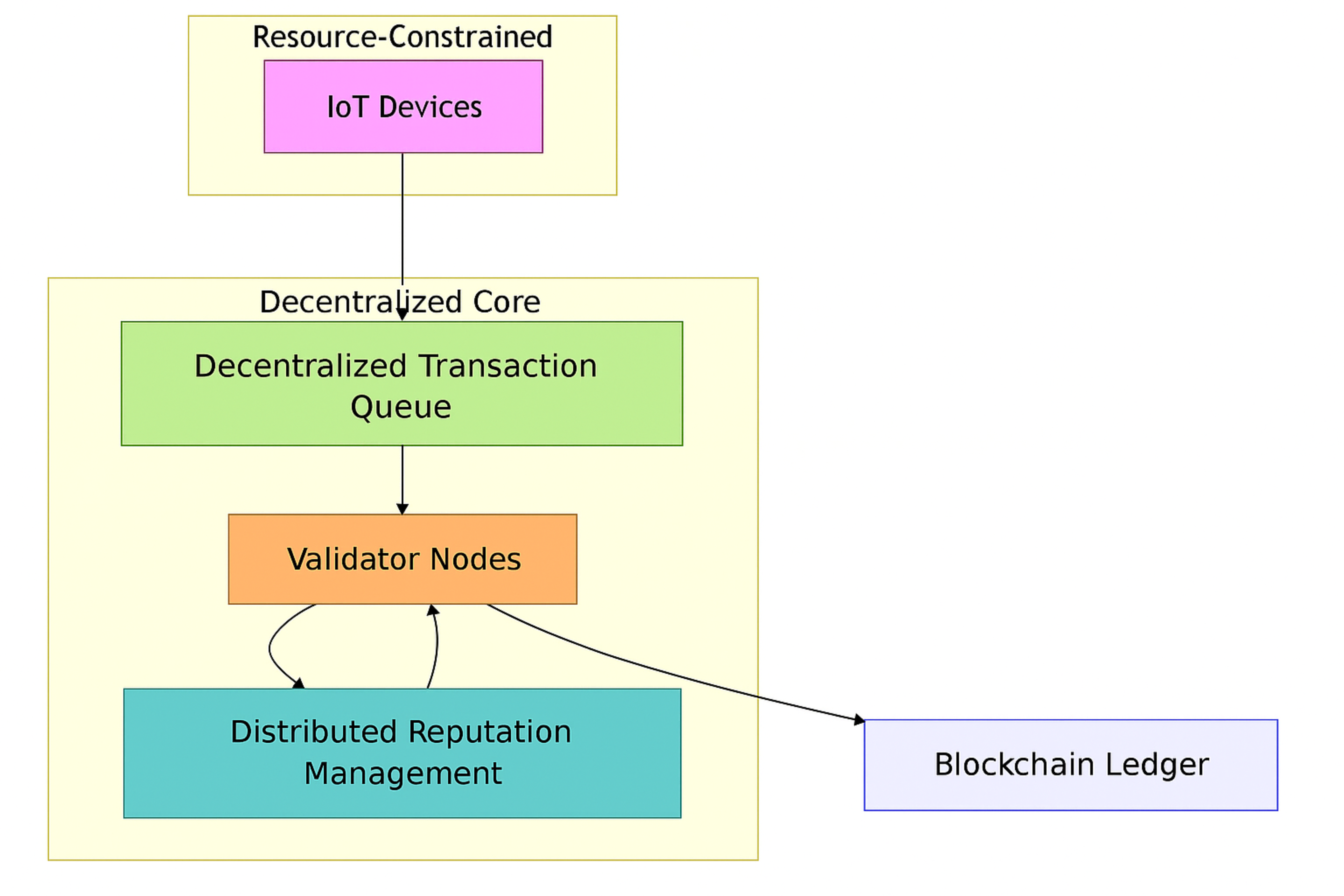
This paper proposes a hybrid consensus framework specifically designed for real-time Internet of Things (IoT) blockchain networks, where low latency, limited device capacity, and high scalability are critical requirements. Conventional approaches such as Proof of Work (PoW) and PBFT are unsuitable for IoT environments due to their computational overhead, energy consumption, and poor adaptability to heterogeneous devices. Our model integrates Proof of Validation (PoV) with Proof of Reputation (PoR) to select validators in a manner that balances efficiency, security, and decentralization. Transaction processing is modeled through M/M/1 queueing theory to enable priority handling of time-sensitive requests, while validator reputation dynamics are represented using Markov chains to capture state transitions under varying performance conditions. Practical IoT scenarios, including healthcare monitoring and smart transportation, are considered to highlight the relevance of the design. Simulation results demonstrate an average throughput of 1,995.8 transactions per block, latency of 0.0514 seconds, and energy consumption of 8.46 Wh per block. When compared with HB-IoT, HMM-Shard, and Microchain, the proposed framework achieves up to 22% lower latency, 15–30% higher throughput, and 35% better energy efficiency. These findings confirm the potential of the framework to support scalable, secure, and energy-aware blockchain infrastructures for real-time IoT applications.
Ali Ahmed Al-awamy، Nagi Al-shaibany، Eman Ahmed Alawamy (المؤلف) (2025). A Real-Time Hybrid Consensus Framework for IoT Blockchain Networks Using Validator Reputation, Markov Modeling, and Priority Queueing. مجلة جامعة صنعاء للعلوم التطبيقية والتكنولوجيا, 1277-1290. DOI: https://doi.org/10.59628/jast.v3i6.1751
Ali Ahmed Al-awamy، Nagi Al-shaibany، Eman Ahmed Alawamy (المؤلف). “A Real-Time Hybrid Consensus Framework for IoT Blockchain Networks Using Validator Reputation, Markov Modeling, and Priority Queueing.” مجلة جامعة صنعاء للعلوم التطبيقية والتكنولوجيا, 2025, pp. 1277-1290. https://doi.org/10.59628/jast.v3i6.1751. Accessed 30 أكتوبر. 2026.
Ali Ahmed Al-awamy، Nagi Al-shaibany، Eman Ahmed Alawamy (المؤلف). 2025. “A Real-Time Hybrid Consensus Framework for IoT Blockchain Networks Using Validator Reputation, Markov Modeling, and Priority Queueing.” مجلة جامعة صنعاء للعلوم التطبيقية والتكنولوجيا : 1277-1290. DOI: https://doi.org/10.59628/jast.v3i6.1751
Ali Ahmed Al-awamy، Nagi Al-shaibany، Eman Ahmed Alawamy (المؤلف) (2025) ‘A Real-Time Hybrid Consensus Framework for IoT Blockchain Networks Using Validator Reputation, Markov Modeling, and Priority Queueing’, مجلة جامعة صنعاء للعلوم التطبيقية والتكنولوجيا, pp. 1277-1290. doi: 10.59628/jast.v3i6.1751
@article{jast2025_art1751,
    author  = {Ali Ahmed Al-awamy، Nagi Al-shaibany، Eman Ahmed Alawamy (المؤلف)},
    title   = {A Real-Time Hybrid Consensus Framework for IoT Blockchain Networks Using Validator Reputation, Markov Modeling, and Priority Queueing},
    journal = {مجلة جامعة صنعاء للعلوم التطبيقية والتكنولوجيا},    year    = {2025},    month   = {ديسمبر},    pages   = {1277-1290},    doi     = {10.59628/jast.v3i6.1751},
    url     = {https://doi.org/10.59628/jast.v3i6.1751},}
A Real-Time Hybrid Consensus Framework for IoT Blockchain Networks Using Validator Reputation, Markov Modeling, and Priority Queueing

5G network slicing, Unmanned Aerial Vehicle (UAV) aided Multi-Access Edge Computing (MEC), and blockchain technology create new options for intelligent resource management. However, a major difficulty is efficiently allocating limited UAV resources to heterogeneous device demands while guaranteeing slice-specific Quality-of-Service (QoS) criteria. We develop a blockchain-empowered clustering framework that couples seven clustering algorithms (K-Means, DBSCAN, OPTICS, MeanShift, Hierarchical, Gaussian Mixture Model, and Divisive clustering) with an upgraded contextual bandit decision agent. The agent dynamically chooses between local execution and UAV offloading depending on slice characteristics, signal strength, latency constraints, and cluster homogeneity parameters. We use dual smart contracts (UserAllocation and UserOffload) on a permissioned Ganache (Ethereum) blockchain to ensure trust and transparency. An appropriate model of UAV placement considers the signal propagation effects and spatial distribution. The experimental results demonstrate that our clustering-aware method achieves significant improvement over non-clustered baselines by 27% in task offloading reward, 43% in regret reduction, and 20% in action accuracy, while maintaining high SLA requirements for all slice types (URLLC, eMBB, mMTC). The best overall performance is obtained with the MeanShift method. Dynamic device clustering is not only a data organization approach but also an excellent control mechanism for slice-aware resource orchestration in UAV-MEC systems. The combination of clustering intelligence, contextual bandit decisions, and blockchain-based trust gives a scalable, adaptable, and accountable solution for 5G/6G UAV-assisted edge networks.
Asrar Ahmed Baktayan، Ammar Thabit Zahary، Ibrahim Ahmed Al-Baltah (المؤلف) (2026). Blockchain-Enabled Clustering for Dynamic Resource Allocation and Task Offloading in UAV-Assisted MEC for 5G Network Slicing. مجلة جامعة صنعاء للعلوم التطبيقية والتكنولوجيا, 2049-2063. DOI: https://doi.org/10.59628/jast.v4i5.2655
Asrar Ahmed Baktayan، Ammar Thabit Zahary، Ibrahim Ahmed Al-Baltah (المؤلف). “Blockchain-Enabled Clustering for Dynamic Resource Allocation and Task Offloading in UAV-Assisted MEC for 5G Network Slicing.” مجلة جامعة صنعاء للعلوم التطبيقية والتكنولوجيا, 2026, pp. 2049-2063. https://doi.org/10.59628/jast.v4i5.2655. Accessed 30 أكتوبر. 2026.
Asrar Ahmed Baktayan، Ammar Thabit Zahary، Ibrahim Ahmed Al-Baltah (المؤلف). 2026. “Blockchain-Enabled Clustering for Dynamic Resource Allocation and Task Offloading in UAV-Assisted MEC for 5G Network Slicing.” مجلة جامعة صنعاء للعلوم التطبيقية والتكنولوجيا : 2049-2063. DOI: https://doi.org/10.59628/jast.v4i5.2655
Asrar Ahmed Baktayan، Ammar Thabit Zahary، Ibrahim Ahmed Al-Baltah (المؤلف) (2026) ‘Blockchain-Enabled Clustering for Dynamic Resource Allocation and Task Offloading in UAV-Assisted MEC for 5G Network Slicing’, مجلة جامعة صنعاء للعلوم التطبيقية والتكنولوجيا, pp. 2049-2063. doi: 10.59628/jast.v4i5.2655
@article{jast2026_art2655,
    author  = {Asrar Ahmed Baktayan، Ammar Thabit Zahary، Ibrahim Ahmed Al-Baltah (المؤلف)},
    title   = {Blockchain-Enabled Clustering for Dynamic Resource Allocation and Task Offloading in UAV-Assisted MEC for 5G Network Slicing},
    journal = {مجلة جامعة صنعاء للعلوم التطبيقية والتكنولوجيا},    year    = {2026},    month   = {مايو},    pages   = {2049-2063},    doi     = {10.59628/jast.v4i5.2655},
    url     = {https://doi.org/10.59628/jast.v4i5.2655},}
Blockchain-Enabled Clustering for Dynamic Resource Allocation and Task Offloading in UAV-Assisted MEC for 5G Network Slicing

Device-to-device Internet of Things (D2D_IoT) communications are promising and futuristic communications that
contribute to reducing pressure on the network. Recently, the research community proposed information-centric
networks (ICN) to achieve D2D_IoT communications. This paper will provide a qualitative comparison between
Internet Protocol (IP) and ICN networks. The paper will compare naming, messaging, routing, caching, and
security. ICN is more suitable for the D2D_IoT due to its compatibility with its design and the requirements of IoT
applications, making it a promising solution for IoT networks.
Mansoor N. Ali، Ammar T. Zahary، Manal A. Areqi (المؤلف) (2024). IP and ICN Networking in D2D_IoT Communications: A Comparative Study. مجلة جامعة صنعاء للعلوم التطبيقية والتكنولوجيا, 158-167. DOI: https://doi.org/10.59628/jast.v2i2.940
Mansoor N. Ali، Ammar T. Zahary، Manal A. Areqi (المؤلف). “IP and ICN Networking in D2D_IoT Communications: A Comparative Study.” مجلة جامعة صنعاء للعلوم التطبيقية والتكنولوجيا, 2024, pp. 158-167. https://doi.org/10.59628/jast.v2i2.940. Accessed 30 أكتوبر. 2026.
Mansoor N. Ali، Ammar T. Zahary، Manal A. Areqi (المؤلف). 2024. “IP and ICN Networking in D2D_IoT Communications: A Comparative Study.” مجلة جامعة صنعاء للعلوم التطبيقية والتكنولوجيا : 158-167. DOI: https://doi.org/10.59628/jast.v2i2.940
Mansoor N. Ali، Ammar T. Zahary، Manal A. Areqi (المؤلف) (2024) ‘IP and ICN Networking in D2D_IoT Communications: A Comparative Study’, مجلة جامعة صنعاء للعلوم التطبيقية والتكنولوجيا, pp. 158-167. doi: 10.59628/jast.v2i2.940
@article{jast2024_art940,
    author  = {Mansoor N.  Ali، Ammar T. Zahary، Manal A. Areqi (المؤلف)},
    title   = {IP and ICN Networking in D2D_IoT Communications: A Comparative Study},
    journal = {مجلة جامعة صنعاء للعلوم التطبيقية والتكنولوجيا},    year    = {2024},    month   = {مايو},    pages   = {158-167},    doi     = {10.59628/jast.v2i2.940},
    url     = {https://doi.org/10.59628/jast.v2i2.940},}
IP and ICN Networking in D2D_IoT Communications: A Comparative Study

في البيئات الحضرية ثلاثية الأبعاد (3D)، تعتمد دقة تخطيط التغطية لشبكات الموجات المليميترية (mm-wave) على دقة نماذج حساب احتمالية خط الرؤية line-of-sight (LoS) خصوصاً لشبكات الاتصال التي تدعم الطائرات بدون طيار (UAVs). وحيث أن الأدبيات الحالية للمراجع التي تناولت نماذج خط الرؤية لا توفر مراجعة لتلك النماذج كما لا توفر تقييم لدقة التنبؤ لتلك النماذج، تقدم هذه الورقة مراجعة للدراسات التي قدمت النماذج الرياضية لحساب احتمالية وجود خط الرؤية بإعتبار العوائق الكبيرة الثابتة. كما أن هذه الورقة تقدم تقيماً لتلك النماذج باستخدام الـ ray-tracing simulation على أربع بيئات حضرية ثلاثية الأبعاد وهي المدن ذات المباني العالية، المدن كثيفة المباني، المدن الإعتيادية، والضواحي. وقد أظهرت نتائج التقييم بأن النماذج الحالية لا توفر الدقة الكافية للتنبؤ بحالة خط الرؤية مما يستدعي بذل جهد إضافي لتطوير نموذج احتمالية LoS يتسم بتعدد المتغيرات.
Basheer Raddwan، Ibrahim Ahmed Al-Baltah (المؤلف) (2024). Line-of-Sight Probability Models for 5G/6G Millimeter-Wave Networks: A Review. مجلة جامعة صنعاء للعلوم التطبيقية والتكنولوجيا, 440-452. DOI: https://doi.org/10.59628/jast.v2i5.1054
Basheer Raddwan، Ibrahim Ahmed Al-Baltah (المؤلف). “Line-of-Sight Probability Models for 5G/6G Millimeter-Wave Networks: A Review.” مجلة جامعة صنعاء للعلوم التطبيقية والتكنولوجيا, 2024, pp. 440-452. https://doi.org/10.59628/jast.v2i5.1054. Accessed 30 أكتوبر. 2026.
Basheer Raddwan، Ibrahim Ahmed Al-Baltah (المؤلف). 2024. “Line-of-Sight Probability Models for 5G/6G Millimeter-Wave Networks: A Review.” مجلة جامعة صنعاء للعلوم التطبيقية والتكنولوجيا : 440-452. DOI: https://doi.org/10.59628/jast.v2i5.1054
Basheer Raddwan، Ibrahim Ahmed Al-Baltah (المؤلف) (2024) ‘Line-of-Sight Probability Models for 5G/6G Millimeter-Wave Networks: A Review’, مجلة جامعة صنعاء للعلوم التطبيقية والتكنولوجيا, pp. 440-452. doi: 10.59628/jast.v2i5.1054
@article{jast2024_art1054,
    author  = {Basheer Raddwan، Ibrahim Ahmed Al-Baltah (المؤلف)},
    title   = {Line-of-Sight Probability Models for 5G/6G Millimeter-Wave Networks: A Review},
    journal = {مجلة جامعة صنعاء للعلوم التطبيقية والتكنولوجيا},    year    = {2024},    month   = {أكتوبر},    pages   = {440-452},    doi     = {10.59628/jast.v2i5.1054},
    url     = {https://doi.org/10.59628/jast.v2i5.1054},}
Line-of-Sight Probability Models for 5G/6G Millimeter-Wave Networks: A Review

The growing complexity of remote robotic surgery (RRS) has heightened the demand for communication systems that deliver ultralow latency, high bandwidth, and stable signal transmission. Conventional optical and wireless communication architectures often fail to satisfy these stringent requirements, particularly in time critical and high-fidelity data-exchange scenarios. In this study, a simulation-based evaluation of Optical Injection Locking (OIL) was conducted to investigate its potential in enhancing the signal quality and transmission efficiency for telesurgical applications. The results demonstrated that OIL significantly improves the frequency response characteristics, with the bandwidth reaching up to 32 GHz through controlled variation of the injection ratio. Furthermore, phase-noise suppression and spectral narrowing were observed with increasing wavelength detuning, contributing to improved signal coherence and reduced dispersion. The end-to-end latency was maintained below 50 ms, satisfying the safety constraints for real-time surgical interaction. The system also exhibited a 30% reduction in power consumption compared with conventional optical fiber systems. These findings confirmed the technical feasibility of OIL as a high-performance communication approach for latency-sensitive biomedical applications. Future work will focus on the prototype development and real-world integration of OIL-based links for next generation telesurgery platforms.
Abdulsalam Tonin، Malek Algabri، Mansour N. Ali، Mossa Ghurab، Abdualmajed A. G. Al-Khulaidi، Ibrahim Ahmed Al-Balatah (المؤلف) (2025). Optical Injection Locking for Enhancing Communication Systems in Telesurgery: A Simulation-Based Study. مجلة جامعة صنعاء للعلوم التطبيقية والتكنولوجيا, 941-948. DOI: https://doi.org/10.59628/jast.v3i4.1887
Abdulsalam Tonin، Malek Algabri، Mansour N. Ali، Mossa Ghurab، Abdualmajed A. G. Al-Khulaidi، Ibrahim Ahmed Al-Balatah (المؤلف). “Optical Injection Locking for Enhancing Communication Systems in Telesurgery: A Simulation-Based Study.” مجلة جامعة صنعاء للعلوم التطبيقية والتكنولوجيا, 2025, pp. 941-948. https://doi.org/10.59628/jast.v3i4.1887. Accessed 30 أكتوبر. 2026.
Abdulsalam Tonin، Malek Algabri، Mansour N. Ali، Mossa Ghurab، Abdualmajed A. G. Al-Khulaidi، Ibrahim Ahmed Al-Balatah (المؤلف). 2025. “Optical Injection Locking for Enhancing Communication Systems in Telesurgery: A Simulation-Based Study.” مجلة جامعة صنعاء للعلوم التطبيقية والتكنولوجيا : 941-948. DOI: https://doi.org/10.59628/jast.v3i4.1887
Abdulsalam Tonin، Malek Algabri، Mansour N. Ali، Mossa Ghurab، Abdualmajed A. G. Al-Khulaidi، Ibrahim Ahmed Al-Balatah (المؤلف) (2025) ‘Optical Injection Locking for Enhancing Communication Systems in Telesurgery: A Simulation-Based Study’, مجلة جامعة صنعاء للعلوم التطبيقية والتكنولوجيا, pp. 941-948. doi: 10.59628/jast.v3i4.1887
@article{jast2025_art1887,
    author  = {Abdulsalam Tonin، Malek Algabri، Mansour N. Ali، Mossa Ghurab، Abdualmajed A. G. Al-Khulaidi، Ibrahim Ahmed Al-Balatah (المؤلف)},
    title   = {Optical Injection Locking for Enhancing Communication Systems in Telesurgery: A Simulation-Based Study},
    journal = {مجلة جامعة صنعاء للعلوم التطبيقية والتكنولوجيا},    year    = {2025},    month   = {أغسطس},    pages   = {941-948},    doi     = {10.59628/jast.v3i4.1887},
    url     = {https://doi.org/10.59628/jast.v3i4.1887},}
Optical Injection Locking for Enhancing Communication Systems in Telesurgery: A Simulation-Based Study

The rapid evolution of 5G networks introduces unprecedented high-speed communication and massive connectivity, but it also intensifies security challenges. Ensuring confidentiality, integrity, and availability of data requires robust encryption mechanisms. This study evaluates the performance and overhead of Advanced Encryption Standard (AES), Rivest–Shamir–Adleman (RSA), and Elliptic Curve Cryptography (ECC) in 5G networks using simulation-based analysis. Metrics considered include latency (ms), throughput (%), encryption/decryption time per MB, and computational cost on UE-class hardware, providing quantitative comparison across typical 5G scenarios (high mobility eMBB, URLLC, and mMTCIoT devices).
Key findings: AES achieves low latency and high throughput for bulk data; ECC provides secure, lightweight key exchange; RSA is suitable only for session key establishment due to higher computational overhead. Overall, hybrid AES+ECC provides the best tradeoff between security and performance in realistic 5G environments.
Mohamed Hankal (المؤلف) (2026). Performance of Encryption schemes in 5G Networks. مجلة جامعة صنعاء للعلوم التطبيقية والتكنولوجيا, 1959-1966. DOI: https://doi.org/10.59628/jast.v4i4.2317
Mohamed Hankal (المؤلف). “Performance of Encryption schemes in 5G Networks.” مجلة جامعة صنعاء للعلوم التطبيقية والتكنولوجيا, 2026, pp. 1959-1966. https://doi.org/10.59628/jast.v4i4.2317. Accessed 30 أكتوبر. 2026.
Mohamed Hankal (المؤلف). 2026. “Performance of Encryption schemes in 5G Networks.” مجلة جامعة صنعاء للعلوم التطبيقية والتكنولوجيا : 1959-1966. DOI: https://doi.org/10.59628/jast.v4i4.2317
Mohamed Hankal (المؤلف) (2026) ‘Performance of Encryption schemes in 5G Networks’, مجلة جامعة صنعاء للعلوم التطبيقية والتكنولوجيا, pp. 1959-1966. doi: 10.59628/jast.v4i4.2317
@article{jast2026_art2317,
    author  = {Mohamed Hankal (المؤلف)},
    title   = {Performance of Encryption schemes in 5G Networks},
    journal = {مجلة جامعة صنعاء للعلوم التطبيقية والتكنولوجيا},    year    = {2026},    month   = {أبريل},    pages   = {1959-1966},    doi     = {10.59628/jast.v4i4.2317},
    url     = {https://doi.org/10.59628/jast.v4i4.2317},}
Performance of Encryption schemes in 5G Networks
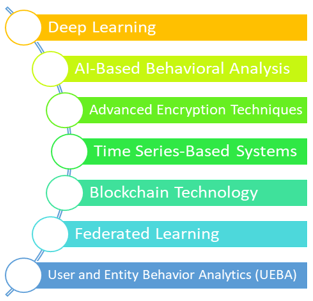
With the continued development of cloud computing environments, security measures have become more im-portant than ever. Intrusion detection systems (IDS) are considered one of the most critical security measures in cloud computing. Researchers aim to find effective technologies for detecting intrusions in cloud computing. This paper presents a comprehensive survey of the techniques used for Intrusion Detection in Cloud Computing and their classification. Specifically, it covers a range of techniques such as machine learning, and provides insights for researchers looking to develop more flexible and effective techniques for intrusion detection in cloud computing.
سعاد محمد عثمان، Adnan Yehia Al-mutawkkil، Amani Mohammed Alnashi (المؤلف) (2024). Survey of Intrusion Detection Techniques in Cloud Computing. مجلة جامعة صنعاء للعلوم التطبيقية والتكنولوجيا, 363-374. DOI: https://doi.org/10.59628/jast.v2i4.970
سعاد محمد عثمان، Adnan Yehia Al-mutawkkil، Amani Mohammed Alnashi (المؤلف). “Survey of Intrusion Detection Techniques in Cloud Computing.” مجلة جامعة صنعاء للعلوم التطبيقية والتكنولوجيا, 2024, pp. 363-374. https://doi.org/10.59628/jast.v2i4.970. Accessed 30 أكتوبر. 2026.
سعاد محمد عثمان، Adnan Yehia Al-mutawkkil، Amani Mohammed Alnashi (المؤلف). 2024. “Survey of Intrusion Detection Techniques in Cloud Computing.” مجلة جامعة صنعاء للعلوم التطبيقية والتكنولوجيا : 363-374. DOI: https://doi.org/10.59628/jast.v2i4.970
سعاد محمد عثمان، Adnan Yehia Al-mutawkkil، Amani Mohammed Alnashi (المؤلف) (2024) ‘Survey of Intrusion Detection Techniques in Cloud Computing’, مجلة جامعة صنعاء للعلوم التطبيقية والتكنولوجيا, pp. 363-374. doi: 10.59628/jast.v2i4.970
@article{jast2024_art970,
    author  = {سعاد محمد عثمان، Adnan Yehia Al-mutawkkil، Amani Mohammed Alnashi (المؤلف)},
    title   = {Survey of Intrusion Detection Techniques in Cloud Computing},
    journal = {مجلة جامعة صنعاء للعلوم التطبيقية والتكنولوجيا},    year    = {2024},    month   = {سبتمبر},    pages   = {363-374},    doi     = {10.59628/jast.v2i4.970},
    url     = {https://doi.org/10.59628/jast.v2i4.970},}
Survey of Intrusion Detection Techniques in Cloud Computing
لم يتم نشر أي شيء من هذه الفئة بعد.

مجلة جامعة صنعاء
للعلوم التطبيقية والتكنولوجيا
مجلة علمية محكمة ومتاحة للجميع، تنشر أبحاثاً عالية الجودة في مجالات العلوم التطبيقية والهندسة والحاسوب منذ عام 2023.
