
Zinc-Induced Effects on the Structural and Morphological Properties of Sn-Zn-In Triple Alloys: Insights from XRD, EDX, and SEM Analysis
Article Sidebar
Main Article Content
Abstract
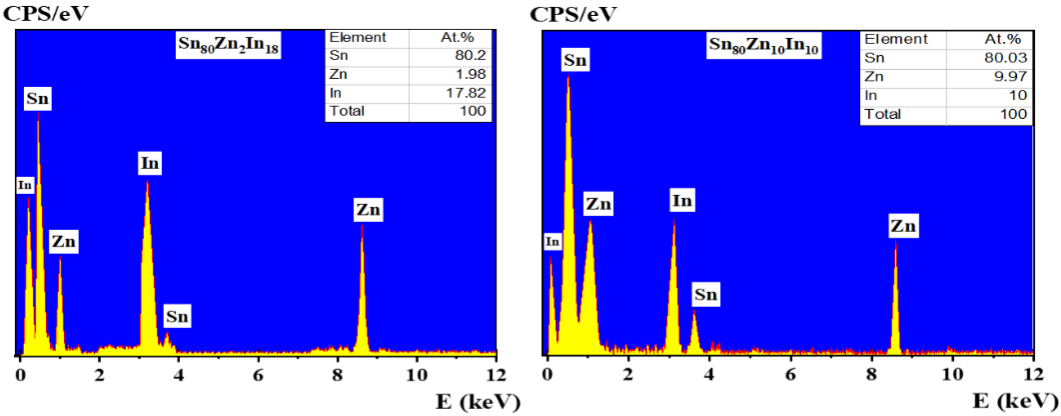
The primary objective of this study is to enhance the properties of Sn-In alloys by incorporating varying amounts of zinc (Zn) to develop alternative lead-free alloys suitable for electronic applications. The samples were synthesized using high-purity in (Sn), indium (In), and zinc (Zn). Zn was added at different weight percentages (2, 4, 6, 8, and 10 wt. %) to the Sn-In base alloy. Structural analysis was performed using X-ray diffraction (XRD) to identify the phase formation and crystalline characteristics. Scanning electron microscopy (SEM) was employed to examine the microstructure, and energy-dispersive X-ray spectroscopy (EDX) was used to determine the elemental composition and phase distribution within the samples. The XRD results indicated that the Sn-Zn-In alloys exhibited a single-phase tetragonal structure. Increasing the Zn concentrations in the Sn matrix refined the grain size of the ternary Sn-Zn-In alloy. Additionally, Zn incorporation into the Sn-In binary alloy altered the intensity of the diffraction peaks and induced shifts in the (2θ) position, particularly in the 80Sn-10Zn-10In alloy. The calculated lattice parameters closely matched the standard values reported in JCPDS PDF# 04-0673, and no new phases were detected in the ternary systems. The SEM analysis revealed the presence of three distinct regions within the alloy microstructure: a gray region rich in β-Sn, a dark region corresponding to the indium-rich phase, and a white region representing the zinc-rich phase. The EDX spectra confirmed that the elemental composition of the Sn-Zn-In alloys closely matched the nominal ratios, indicating successful alloying and homogeneous elemental distribution.
Downloads
Article Details

This work is licensed under a Creative Commons Attribution-NonCommercial-NoDerivatives 4.0 International License.