
Fatty Acid Profile and Physicochemical Properties of Yemeni Sesame Seed Oil: An Analytical Study
الشريط الجانبي للمقالة
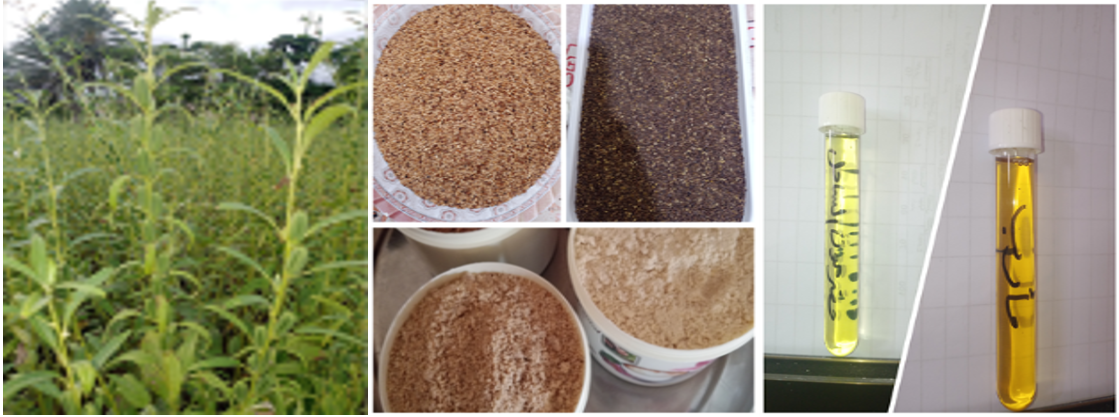
محتوى المقالة الرئيسي
الملخص
This study investigates the fatty acid profile and physicochemical properties of sesame seed oil extracted from two regions in Yemen, Marib and Hadhramaut. Oil was extracted using the Soxhlet method with n-hexane as the solvent. The physicochemical parameters analyzed included free fatty acid content (FFA%), acid value (A.V.), iodine value (I.V.), saponification value (S.V.), refractive index (R.I.), density, moisture content, specific gravity (S.g.), and viscosity at 26 °C. The oil yield was 47.5% and 48% for sesame seeds from Marib and Hadhramaut, respectively. The Marib oil exhibited FFA of 3.38 ± 0.01%, A.V of 7.41 ± 0.04 mg NaOH/g, I.V of 99.41 ± 0.10 g I2/100 g, S.g of 197.75 ± 0.50 mg KOH/g, R.I of 1.461 ± 0.01, moisture content of 0.140 ± 0.05%, density of 0.871 ± 0.02 g/mL, S.g of 0.9442 ± 0.03, and viscosity of 31.75 cP. Corresponding values for Hadhramaut oil were FFA 1.21 ± 0.03%, A.V 2.65 ± 0.02 mg NaOH/g, I.V 99.92 ± 0.03 g I2/100 g, S.V 195.93 ± 0.40 mg KOH/g, R.I of 1.477 ± 0.01, moisture content 0.015 ± 0.01%, density 0.863 ± 0.02 g/mL, S.g of 0.951 ± 0.03, and viscosity 29.72 cP. Fourier-transform infrared spectroscopy (FTIR) and gas chromatography with flame ionization detection (GC-FID) were employed to characterize the chemical composition and fatty acid profile of the oils. The findings provide valuable insights into the quality and composition of Yemeni sesame oils, highlighting regional variations that may influence their nutritional and industrial applications.
التنزيلات
تفاصيل المقالة

هذا العمل مرخص بموجب Creative Commons Attribution-NonCommercial-NoDerivatives 4.0 International License.