Outcome and Associated Factors of Abortion in Al-Sabeen Maternity and Childhood Hospital
Abstract
Background: Spontaneous miscarriage is one of the global health concerns, and Yemen has one of the highest burdens in the region. This study aimed to determine the outcomes and associated factors of spontaneous miscarriage at Al-Sabeen Hospital in Sana’a City.
Methodology: A prospective case-control study was conducted over one year, involving 216 women with spontaneous miscarriage (cases) and 216 women with viable pregnancies beyond 24 weeks (controls). Data on sociodemographic characteristics, presenting symptoms, type of miscarriage, and obstetric, medical, and anatomical factors were collected through direct interviews and medical records. SPSS software was used for data analysis, and logistic regression was applied to test the correlation between potential risk factors and miscarriage.
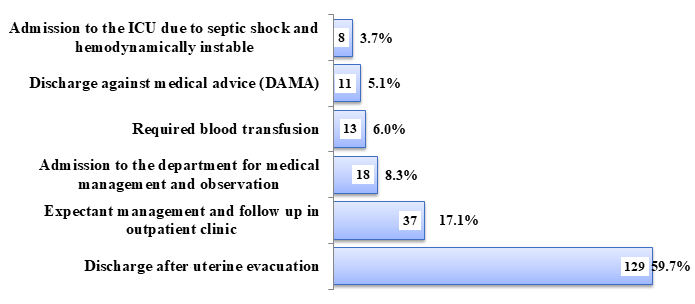
Results: The mean age of cases was 28.4±6.1 years. Missed (36.1%) and incomplete miscarriages (31.0%) were the most common types. Univariate logistic regression identified several risk factors, including rural residency (cOR: 1.78, p=0.017), khat chewing (cOR: 1.48, p=0.043), history of abortion (cOR: 1.65, p=0.028), infections (cOR: 1.51, p=0.043), hyperprolactinemia (cOR: 7.99, p=0.001), and incompetent cervix (cOR: 36.03, p<0.001). In multivariable logistic regression, an incompetent cervix was identified as the strongest predictor of miscarriage (aOR: 29.167, P =0.001). Most mothers were managed and discharged without complications. However, some serious complications occurred, including 6.0% requiring blood transfusion and 3.7% requiring ICU admission for septic shock.
Conclusion: Spontaneous miscarriage in our sample is multifactorial and strongly linked to cervical incompetence and a history of previous miscarriage. Although maternal outcomes were generally good, some severe complications were documented, indicating the urgent need for enhanced preconception counseling, early antenatal screening for high-risk pregnancies, and improved access to emergency obstetric care in the region.
![Histopathology of liver tissue from control (G1), khat extract (G2), and PO+YE (G3a,b). PAS stain [100x -400x, scale bar=50 μm]](https://journals.su.edu.ye/public/journals/1/submission_2592_2592_coverImage_en.png)