
Seasonal Evaluation of Physicochemical Parameters of Marine Sediments on the Coasts of Al-Mukalla and Broom Districts, Hadhramout, Yemen
الشريط الجانبي للمقالة
محتوى المقالة الرئيسي
الملخص
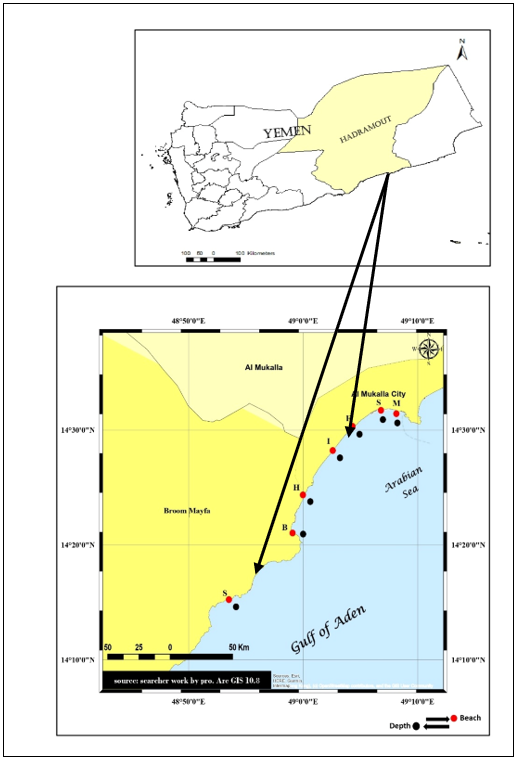
Human activities are the primary sources of pollution, the severity of which has increased significantly in recent decades, placing immense pressure on both human societies and coastal ecosystems. Seasonal conditions play a crucial role in determining the spread, dilution, or accumulation of pollutants in marine environments. Consequently, assessing seasonal variations in marine sediments subjected to sewage pollution is essential for understanding the extent of this dynamic impact, which is of paramount importance for evaluating and developing effective management and protection strategies. This study investigates seasonal variations in some of the physicochemical parameters of marine sediments along the coasts of the Al-Mukalla and Burum districts in the Hadhramaut Governorate, Yemen. A range of statistical methods were employed to analyze a comprehensive dataset on marine sediment quality over two seasons. This research aims to provide some necessary insights into the extent of pollution in coastal sediments near sewage outlets and to assess the quality of sediments that serve as habitats for a diverse array of marine organisms. The results indicated temporal and spatial variations in coastal sediment pollution in both regions during both seasons, exceeding Yemeni and international permissible limits. The concentrations of environmental parameters, such as temperature, pH, Ca2+, Mg2+, Cl-, HCO3-, and SO42- decreased during the first season compared to those during the second. This was accompanied by an increase in both EC and TDS . Overall, this variation may be attributed to its association with varying discharge rates, biological processes, and natural factors affecting the seasons. This also underscores the role of sewage as a primary cause of coastal degradation in marine ecosystems. Such pollution is expected to have significant environmental and health consequences by destroying essential habitat structures (such as coral reefs or seagrass meadows), causing toxicity, impaired growth, and disrupting reproductive processes. In turn, this negatively impacts biodiversity and ecosystem resilience.
التنزيلات
تفاصيل المقالة

هذا العمل مرخص بموجب Creative Commons Attribution-NonCommercial-NoDerivatives 4.0 International License.