
A Technology Adoption Framework for Digitally Transforming Automated Examination Systems in Resource-Limited Environments: Evidence from Yemeni Schools
Article Sidebar
Main Article Content
Abstract
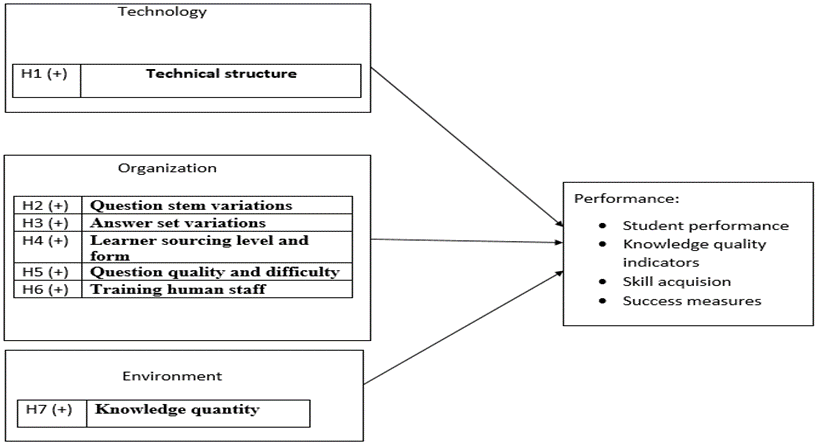
Automated Examination Systems (AES) are increasingly central to modern assessment, particularly as schools move toward broader digital transformation. Automated Exam Systems (AES) have emerged as transformative tools for improving assessment efficiency, accuracy, and transparency. This study examines how AES are adopted and used in resource-limited Yemeni schools, focusing on the technological, organizational, and environmental factors that shape their performance. It investigates the implementation of AES in Yemeni schools, highlighting applications, challenges, and prospects. A quantitative methodology was employed to collect data from 108 participants, comprising students, supervisors, technicians, and teachers, using structured questionnaires. The Technology-Organization-Environment (TOE) was applied to examine factors affecting AES adoption. Statistical analysis using SPSS, including Pearson correlation, Cronbach’s Alpha, and multiple linear regression, revealed significant relationships between technological, organizational, and human factors and the performance of AES. Key challenges, such as infrastructure limitations, inadequate training, and resistance to change, are discussed, along with practical solutions. The findings provided insights for effective AES implementation and future research directions in the Yemeni educational context.
Downloads
Article Details

This work is licensed under a Creative Commons Attribution-NonCommercial-NoDerivatives 4.0 International License.
References
Atala, M. S. Factors affecting the quality of primary education in Al-Quneitra schools in light of total quality standards (Doctoral dissertation), 2014.
Kim, S., Song, J., & Kim, Y. Assessing the quality of multiple-choice exams: A review of methods and applications. Educational Technology Research and Development, 70(2), 345–362, 2022.
Sharaf, I. Automated Exam System Implementation in Yemeni Schools (Master’s thesis, University of Sana’a), 2025.
Tornatzky, L. G., & Fleischer, M. The processes of technological innovation. Lexington Books, 1990.
Venkatesh, V., & Bala, H. Technology acceptance model 3 and a research agenda on interventions. Decision Sciences, 39(2), 273–315, 2008.
Al-Adimi, A. Research methodology. Sana’a University Press, 2010.
Salloum, S., et al. Advanced correlational research in educational studies. Academic Press, 2022.
M. S. Al-Mahmoudi, Scientific research methodologies, 3rd ed. Sana’a, Yemen: Dar Al-Kutub, 2019.
Al-Mahmoudi, H. Quantitative research methods. Yemen Publishing, 2019.
Al-Qahtani, N., et al. Content validity methods in social research. Riyadh: University Press, 2000 (1421 AH).
U. B. Sekaran, Research methods for business: A skill-building approach, 7th ed. Chichester, UK: John Wiley & Sons Ltd, 2016.
M. Amini and N. J. Javid, "A multi-perspective framework established on diffusion of innovation (DOI) theory and technology, organization and environment (TOE) framework toward supply chain management system based on cloud computing technology for small and medium enterprises," vol. 11, no. 8, 2023.
E. Emirtekin, “Large Language Model-Powered Automated Assessment: A Systematic Review,” Appl. Sci., vol. 15, no. 10, p. 5683, 2025.
D. M. Elbourhamy, “Automated evaluation systems to enhance exam quality,” Indonesian J. Learn. Adv., vol. 5, no. 2, pp. 130–145, 2025.
B. Aydın, “Automated scoring in the era of artificial intelligence,” Comput. Educ., vol. 212, p. 105987, 2025.
C. H. Sekhar, P. Deekshita, and R. Kaur, “An Automated Examination System for Evaluation of Descriptive Tests,” i-manager’s J. Comput. Sci., vol. 10, no. 1, pp. 13–20, 2022.
W. Kayanja et al., “Exploring digital transformation in higher education: the shift to fully automated and paperless systems,” Cogent Educ., vol. 12, no. 1, p. 2489800, 2025.
V. Dhameria et al., “The impact of digital transformation in higher education management,” Int. J. Educ. Qual. Quant., vol. 4, no. 1, pp. 15–24, 2025.
H. O. Shittu and L. Hassan, “Adoption challenges of digital exams in developing regions,” J. Educ. Technol. Syst., vol. 53, no. 3, pp. 349–368, 2024.
M. A. Al-Rawi and K. A. Al-Rashidi, “Adoption of educational technologies using the TOE framework in developing countries,” Educ. Inf. Technol., vol. 29, pp. 14567–14589, 2024.
T. M. Sarker and M. K. Rahman, “Digital readiness and transformation of school assessment systems,” Heliyon, vol. 11, no. 2, p. e21055, 2025.
L. Q. Nwosu, “Barriers to digital exam adoption in low-resource schools,” Int. J. Digit. Learn., vol. 13, no. 4, pp. 58–72, 2023.
K. K. Nguyen, “TOE-based analysis of e-learning and exam system adoption in public schools,” Asia Pac. Educ. Rev., vol. 25, pp. 321–337, 2024.
R. B. Patel and S. Kumar, “Technology adoption for digital assessment platforms: A TOE–DOI integrated approach,” Sustainability, vol. 16, no. 1, p. 455, 2024.