
A Systematic Review of Factors Influencing the Acceptance of Generative Artificial Intelligence Applications in Yemeni Higher Education
Article Sidebar
Main Article Content
Abstract
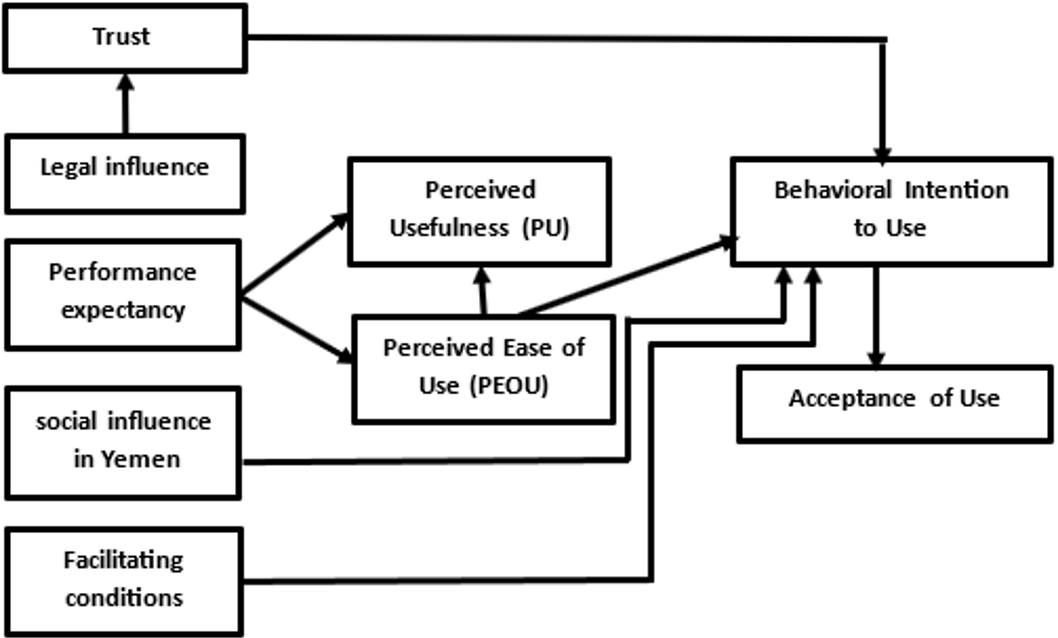
Generative AI Applications have become revolutionary technologies that can help with academic evaluation, educational decision-making, and individualized learning. However, despite their technological potential, many higher education institutions especially those in poor nations continue to struggle with faculty and student acceptance of these applications. This study offers in order to determine crucial success variables impacting the acceptance, use and difficulties of generative AI applications, a thorough analysis of the literature. Research from databases including Google Scholar, Scopus, and IEEE Explore that were published between 2021 and 2025 was chosen. A conceptual model based on organizational, individual/psychological, legal/cultural/social, and technical variables is proposed in this study. It also generates hypotheses and evaluates the importance of crucial success variables. Additionally, it outlines the main obstacles to the acceptance of generative AI applications, as well as their limitations and potential future developments, which present a plethora of chances for the creation of various solutions.
Downloads
Article Details

This work is licensed under a Creative Commons Attribution-NonCommercial-NoDerivatives 4.0 International License.
References
M. B. Oluwagbenro, "Generative AI: Definition, concepts, applications, and future prospects," Authorea Prepr, 2024.
S. Hoernig, A. Ilharco, P. T. Pereira, and R. Pereira, "Generative AI and Higher education: Challenges and opportunities," Institute of Public Policy, 2024, doi: https://www.ipp-jcs.org/wp-content/uploads/2024/09/Report-AI-in-Higher-Education-IPP-1.pdf.
A. Ganguly, A. Johri, A. Ali, and N. McDonald, "Generative artificial intelligence for academic research: evidence from guidance issued for researchers by higher education institutions in the United States," AI and Ethics, pp. 1–17, 2025, doi: https://doi.org/10.1007/s43681-025-00688-7.
L. X. Jensen, A. Buhl, A. Sharma, and M. Bearman, "Generative AI and higher education: A review of claims from the first months of ChatGPT," Higher Education, vol. 89, no. 4, pp. 1145–1161, 2025, doi: https://doi.org/10.1007/s10734-024-01265-3.
G. Kurtz et al., "Strategies for integrating generative AI into higher education: Navigating challenges and leveraging opportunities," Education Sciences, vol. 14, no. 5, p. 503, 2024, doi: https://doi.org/10.3390/educsci14050503.
D. R. Cotton, P. A. Cotton, and J. R. Shipway, "Chatting and cheating: Ensuring academic integrity in the era of ChatGPT," Innovations in education and teaching international, vol. 61, no. 2, pp. 228–239, 2024, doi: https://doi.org/10.1080/14703297.2023.2190148.
S. Yeralan and L. A. Lee, "Generative AI: Challenges to higher education," Sustainable Engineering and Innovation, vol. 5, no. 2, pp. 107–116, 2023, doi: https://doi.org/10.37868/sei.v5i2.id196
M. E. de Carvalho Souza and L. Weigang, "Grok, gemini, chatgpt and deepseek: Comparison and applications in conversational artificial intelligence," INTELIGENCIA ARTIFICIAL, vol. 2, no. 1, 2025, doi: 10.5281/zenodo.14885243.
A. Iorliam and J. A. Ingio, "A comparative analysis of generative artificial intelligence tools for natural language processing," Journal of Computing Theories and Applications, vol. 1, no. 3, pp. 311–325, 2024, doi: https://doi.org/10.62411/jcta.9447.
R. Gupta, "Comparative analysis of DeepSeek R1, ChatGPT, Gemini, Alibaba, and LLaMA: Performance, reasoning capabilities, and political bias," Authorea Preprints, 2025, doi: https://10.22541/au.173921625.50315230/v1.
X. O’Dea, "Generative AI: is it a paradigm shift for higher education?," Studies in Higher Education, vol. 49, no. 5, pp. 811–816, 2024, doi: https://doi.org/10.1080/03075079.2024.2332944.
S. H. Alshammari and M. H. Alshammari, "Factors affecting the adoption and use of ChatGPT in higher education," International Journal of Information and Communication Technology Education (IJICTE), vol. 20, no. 1, pp. 1–16, 2024, doi: https://10.4018/IJICTE.339557.
M. A. Almulla, "Investigating influencing factors of learning satisfaction in AI ChatGPT for research: University students perspective," Heliyon, vol. 10, no. 11, 2024.
A. Strzelecki and S. ElArabawy, "Investigation of the moderation effect of gender and study level on the acceptance and use of generative AI by higher education students: Comparative evidence from Poland and Egypt," British Journal of Educational Technology, vol. 55, no. 3, pp. 1209–1230, 2024, doi: https://doi.org/10.1111/bjet.13425.
R. A. Abdalla, "Examining awareness, social influence, and perceived enjoyment in the TAM framework as determinants of ChatGPT. Personalization as a moderator," Journal of Open Innovation: Technology, Market, and Complexity, vol. 10, no. 3, p. 100327, 2024, doi: https://doi.org/10.1016/j.joitmc.2024.100327.
D. Menon and K. Shilpa, "“Chatting with ChatGPT”: Analyzing the factors influencing users' intention to Use the Open AI's ChatGPT using the UTAUT model," Heliyon, vol. 9, no. 11, 2023.
A. Strzelecki, "Students’ acceptance of ChatGPT in higher education: An extended unified theory of acceptance and use of technology," Innovative higher education, vol. 49, no. 2, pp. 223–245, 2024.
T. Budhathoki, A. Zirar, E. T. Njoya, and A. Timsina, "ChatGPT adoption and anxiety: a cross-country analysis utilising the unified theory of acceptance and use of technology (UTAUT)," Studies in Higher Education, vol. 49, no. 5, pp. 831–846, 2024, doi: https://doi.org/10.1080/03075079.2024.2333937.
J. Woithe and O. Filipec, "Understanding the adoption, perception, and learning impact of ChatGPT in higher education: A qualitative exploratory case study analyzing students’ perspectives and experiences with the AI-based large language model," ed, 2023.
J.-M. Romero-Rodríguez, M.-S. Ramírez-Montoya, M. Buenestado-Fernández, and F. Lara-Lara, "Use of ChatGPT at university as a tool for complex thinking: Students’ perceived usefulness," Journal of New Approaches in Educational Research, vol. 12, no. 2, pp. 323–339, 2023, doi: https://doi.org/10.7821/naer.2023.7.1458.
A. Strzelecki, "To use or not to use ChatGPT in higher education? A study of students’ acceptance and use of technology," Interactive learning environments, vol. 32, no. 9, pp. 5142–5155, 2024, doi: https://doi.org/10.1080/10494820.2023.2209881.
A. Polyportis and N. Pahos, "Understanding students’ adoption of the ChatGPT chatbot in higher education: the role of anthropomorphism, trust, design novelty and institutional policy," Behaviour & Information Technology, vol. 44, no. 2, pp. 315–336, 2025, doi: https://doi.org/10.1080/0144929X.2024.2317364.
M. Alhwaiti, "Acceptance of artificial intelligence application in the post-covid ERA and its impact on faculty members’ occupational well-being and teaching self efficacy: a path analysis using the utaut 2 model," Applied Artificial Intelligence, vol. 37, no. 1, p. 2175110, 2023, doi: https://doi.org/10.1080/08839514.2023.2175110.
V. H. Le, H. Nguyen, T. Vo-Thanh, H. T. T. Nguyen, and T. T. D. Tran, "Generative AI, why, how, and outcomes: A user perspective," AIS-Transactions on Human-Computer Interaction, vol. 16, no. 1, 2024, doi: https://10.17705/1thci.00198.
F. G. K. Yilmaz, R. Yilmaz, and M. Ceylan, "Generative artificial intelligence acceptance scale: A validity and reliability study," International Journal of Human–Computer Interaction, vol. 40, no. 24, pp. 8703–8715, 2024, doi: https://doi.org/10.1080/10447318.2023.2288730.
J. E. Chukwuere, "Developing generative AI chatbots conceptual framework for higher education," arXiv preprint arXiv:2403.19303, 2024, doi: https://doi.org/10.48550/arXiv.2403.19303.
A. S. Almogren, W. M. Al-Rahmi, and N. A. Dahri, "Exploring factors influencing the acceptance of ChatGPT in higher education: A smart education perspective," Heliyon, vol. 10, no. 11, 2024.
M. Bouteraa et al., "Understanding the diffusion of AI-generative (ChatGPT) in higher education: Does students' integrity matter?," Computers in Human Behavior Reports, vol. 14, p. 100402, 2024, doi: https://doi.org/10.1016/j.chbr.2024.100402.
J. ALAMRI, "Antecedents of generative artificial intelligence technology adoption: Extended innovation of diffusion model with cultural dimensions and risks perceptions," JOURNAL OF ECOHUMANISM Учредители: Transnational Press London, vol. 4, no. 1, 2024, doi: https://10.62754/joe.v4i1.5992.
N. A. Dahri et al., "Extended TAM based acceptance of AI-Powered ChatGPT for supporting metacognitive self-regulated learning in education: A mixed-methods study," Heliyon, vol. 10, no. 8, 2024.
M. I. Baig and E. Yadegaridehkordi, "Factors influencing academic staff satisfaction and continuous usage of generative artificial intelligence (GenAI) in higher education," International Journal of Educational Technology in Higher Education, vol. 22, no. 1, p. 5, 2025, doi: https://doi.org/10.1186/s41239-025-00506-4.
M. Mukred, M. U. Asma, and B. Hawash, "Exploring the acceptance of ChatGPT as a learning tool among academicians: a qualitative study," J Komunikasi Malays J Commun, vol. 39, no. 4, pp. 306–323, 2023, doi: https://doi.org/10.17576/JKMJC-2023-3904-16.
H. Yilmaz, S. Maxutov, A. Baitekov, and N. Balta, "Student’s perception of chat GPT: A technology acceptance model study," International Educational Review, vol. 1, no. 1, pp. 57–83, 2023.
A. Shata and K. Hartley, "Artificial intelligence and communication technologies in academia: faculty perceptions and the adoption of generative AI," International Journal of Educational Technology in Higher Education, vol. 22, no. 1, p. 14, 2025, doi: https://doi.org/10.1186/s41239-025-00511-7.
L. Yonggang, H. Awang, and N. S. Mansor, "Exploring Barriers to the Adoption of Generative Artificial Intelligence Tools among University Students: A Perspective from Innovation Resistance Theory," Educational Research (IJMCER) Vol, vol. 6, pp. 193–201, 2024.
M. F. Shahzad, S. Xu, and I. Javed, "ChatGPT awareness, acceptance, and adoption in higher education: The role of trust as a cornerstone," International Journal of Educational Technology in Higher Education, vol. 21, no. 1, p. 46, 2024.
R. Raman, S. Mandal, P. Das, T. Kaur, S. JP, and P. Nedungadi, "University students as early adopters of ChatGPT: Innovation Diffusion Study," 2023, doi: https://doi.org/10.21203/rs.3.rs-2734142/v1.
R. Primanda, A. N. Setyaning, A. Hidayat, and S. R. Ekasasi, "The role of trust on perceived usefulness and perceived ease of use toward purchase intention among Yogyakarta’s students," INOBIS: Jurnal Inovasi Bisnis dan Manajemen Indonesia, vol. 3, no. 3, pp. 316–326, 2020, doi: https://doi.org/10.31842/jurnalinobis.v3i3.140.
C. Zhang, J. Schießl, L. Plößl, F. Hofmann, and M. Gläser-Zikuda, "Acceptance of artificial intelligence among pre-service teachers: a multigroup analysis," International Journal of Educational Technology in Higher Education, vol. 20, no. 1, p. 49, 2023.
C. Yu, J. Yan, and N. Cai, "ChatGPT in higher education: factors influencing ChatGPT user satisfaction and continued use intention," in Frontiers in Education, 2024, vol. 9: Frontiers Media SA, p. 1354929, doi: https://doi.org/10.3389/feduc.2024.1354929.
B. G. Acosta-Enriquez, M. A. Arbulú Ballesteros, O. Huamaní Jordan, C. López Roca, and K. Saavedra Tirado, "Analysis of college students' attitudes toward the use of ChatGPT in their academic activities: effect of intent to use, verification of information and responsible use," BMC psychology, vol. 12, no. 1, p. 255, 2024.
D. Gefen, E. Karahanna, and D. W. Straub, "Trust and TAM in online shopping: An integrated model," MIS quarterly, pp. 51–90, 2003, doi: https://doi.org/10.2307/30036519.
D. H. Mcknight, M. Carter, J. B. Thatcher, and P. F. Clay, "Trust in a specific technology: An investigation of its components and measures," ACM Transactions on management information systems (TMIS), vol. 2, no. 2, pp. 1–25, 2011, doi: https://doi.org/10.1145/1985347.1985353.
V. Venkatesh, M. G. Morris, G. B. Davis, and F. D. Davis, "User acceptance of information technology: Toward a unified view," MIS quarterly, pp. 425–478, 2003, doi: https://doi.org/10.2307/30036540.
G. B. Batucan, G. G. Gonzales, M. G. Balbuena, K. R. B. Pasaol, D. N. Seno, and R. R. Gonzales, "An extended UTAUT model to explain factors affecting online learning system amidst COVID-19 pandemic: The case of a developing economy," Frontiers in Artificial Intelligence, vol. 5, p. 768831, 2022, doi: https://doi.org/10.3389/frai.2022.768831.
A. Tarhini, M. El-Masri, M. Ali, and A. Serrano, "Extending the UTAUT model to understand the customers’ acceptance and use of internet banking in Lebanon: A structural equation modeling approach," Information Technology & People, vol. 29, no. 4, pp. 830–849, 2016, doi: https://doi.org/10.1108/itp-02-2014-0034.
H. F. Zaher, "Cultural Impact on Environmental Sustainability Practices: a Comparative Study using Hofstede's Cultural Dimensions," Chemical Engineering Transactions, vol. 107, pp. 157–162, 2023, doi: https://10.3303/CET23107027.
C. Y. Joa and K. Magsamen-Conrad, "Social influence and UTAUT in predicting digital immigrants’ technology use," Behaviour & Information Technology, vol. 41, no. 8, pp. 1620–1638, 2022, doi: https://doi.org/10.1080/0144929X.2021.1892192.
O. Akpobome, "The impact of emerging technologies on legal frameworks: A model for adaptive regulation," International Journal of Research Publication and Reviews, vol. 5, no. 10, pp. 5046–5060, 2024, doi: https://doi.org/10.55248/gengpi.5.1024.3012.
L. Carter and F. Bélanger, "The utilization of e‐government services: citizen trust, innovation and acceptance factors," Information systems journal, vol. 15, no. 1, pp. 5–25, 2005, doi: https://doi.org/10.1111/j.1365-2575.2005.00183.x.
F. Alduais and M. O. Al-Smadi, "Intention to use E-payments from the perspective of the unified theory of acceptance and use of technology (UTAUT): evidence from Yemen," Economies, vol. 10, no. 10, p. 259, 2022, doi: https://doi.org/10.3390/economies10100259.
M. M. Abbad, "Using the UTAUT model to understand students’ usage of e-learning systems in developing countries," Education and information technologies, vol. 26, no. 6, pp. 7205–7224, 2021, doi: https://doi.org/10.1007/s10639-021-10573-5.
H. Wang, A. Dang, Z. Wu, and S. Mac, "Generative AI in higher education: Seeing ChatGPT through universities' policies, resources, and guidelines," Computers and Education: Artificial Intelligence, vol. 7, p. 100326, 2024, doi: https://doi.org/10.1016/j.caeai.2024.100326.
X. Weng, X. Qi, M. Gu, K. Rajaram, and T. K. Chiu, "Assessment and learning outcomes for generative AI in higher education: A scoping review on current research status and trends," Australasian Journal of Educational Technology, 2024, doi: https://doi.org/10.14742/ajet.9540.
S. Kutty et al., "Generative AI in higher education: Perspectives of students, educators and administrators," Journal of Applied Learning & Teaching, vol. 7, no. 2, pp. 47–60, 2024, doi: https://doi.org/10.37074/jalt.2024.7.2.27.
M. Bobula, "Generative artificial intelligence (AI) in higher education: A comprehensive review of challenges, opportunities, and implications," Journal of Learning Development in Higher Education, no. 30, 2024, doi: https://doi.org/10.47408/jldhe.vi30.1137.
B. Ogunleye, K. I. Zakariyyah, O. Ajao, O. Olayinka, and H. Sharma, "Higher education assessment practice in the era of generative AI tools," arXiv preprint arXiv:2404.01036, 2024, doi: https://doi.org/10.37074/jalt.2024.7.1.28.
C. Gallent Torres, A. Zapata-González, and J. L. Ortego-Hernando, "The impact of Generative Artificial Intelligence in higher education: a focus on ethics and academic integrity," RELIEVE. Revista ELectrónica de Investigación y EValuación Educativa, 2023, vol. 29, num. 2, p. 1-19, 2023, doi: http://hdl.handle.net/11201/163285.
Y. Jiayu, "Challenges and opportunities of generative artificial intelligence in higher education student educational management," Advances in Educational Technology and Psychology, vol. 7, no. 9, pp. 92–96, 2023, doi: https://10.23977/aetp.2023.070914
W. Pang and Z. Wei, "Shaping the future of higher education: A technology usage study on generative AI innovations," Information, vol. 16, no. 2, p. 95, 2025, doi: https://doi.org/10.3390/info16020095.
A. A. Joubin, "Enhancing the trustworthiness of generative artificial intelligence in responsive pedagogy in the context of humanities higher education," in General Aspects of Applying Generative AI in Higher Education: Opportunities and Challenges: Springer, 2024, pp. 207–220.
A. Yusuf, N. Pervin, and M. Román-González, "Generative AI and the future of higher education: a threat to academic integrity or reformation? Evidence from multicultural perspectives," International Journal of Educational Technology in Higher Education, vol. 21, no. 1, p. 21, 2024, doi: https://doi.org/10.1186/s41239-024-00453-6.