
The Prevalence of Anemia and its Associated Risk Factors among Malnourished Children under Five Years Age attending to Al-wahdah University Teaching Hospital in Thamar, Yemen
Article Sidebar
Main Article Content
Abstract
Background: Anemia is a major public health concern, particularly among malnourished children in lowresource settings. Despite this burden, limited data are available from Yemen. This study aimed to determine the prevalence of anemia and identify its associated risk factors among malnourished children under five years
of age attending Al-Wahdah University Teaching Hospital in Thamar, Yemen.
Subjects and Methods: A cross-sectional study was conducted among 278 malnourished children under five years. Sociodemographic, clinical, and feeding information were collected using a structured questionnaire. Blood samples were analyzed for hemoglobin and red cell indices. Anemia was defined according to the
WHOcriteria (Hb < 11 g/dL). Logistic regression analysis was used to identify the factors associated with anemia.
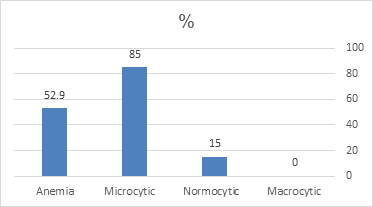
Results: The overall prevalence of anemia was 52.9% (95% CI: 47 -59%). Mild anemia was the most common (50.3%), followed by moderate (46.3%) and severe (3.4%) anemia. Microcytic anemia predominated (85%), with normocytic anemia accounting for the remaining 15%. Multivariate logistic regression showed that male sex (AOR = 2.35, 95% CI: 1.43–3.87, P = 0.001) and presence of edema (AOR = 3.57, 95% CI: 1.85–6.91, P = 0.001) were significantly associated with anemia.
Conclusion: Anemia is highly prevalent among malnourished children under-five children in Thamar, Yemen, with microcytic anemia as the dominant type. Male sex and edema were independent predictors of anemia. Targeted nutritional and clinical interventions are urgently needed to address this challenge.
Downloads
Article Details

This work is licensed under a Creative Commons Attribution-NonCommercial-NoDerivatives 4.0 International License.