Clinical Features, Prevalence, and Bacterial Etiology of Abscess Disease in Sheep and Goats in Sana’a Province, Yemen
Abstract
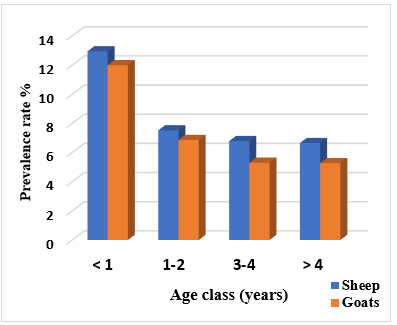
Abscess disease (caseous lymphadenitis and Morel’s disease) is a chronic bacterial infection affecting sheep and goats, causing significant economic losses in small ruminant production worldwide. This study investigated the prevalence, clinical features, and bacterial etiology of abscess disease in sheep and goats in Sana’a Province. A total of 6,119 sheep and 2,974 goats were examined from March 2023 to February 2024. Clinical examinations were performed, and data on species, sex, age, and abscess location were recorded. Additionally, 86 pus samples (55 from sheep and 31 from goats) were collected for bacteriological analysis. Data were analyzed using SPSS version 25, and associations were evaluated using chi-squared (χ2) test at P<0.05. The overall prevalence was 7.51%, with higher rates in sheep (7.82%) than goats (6.86%). Males showed significantly higher infection rates than females (P<0.05). Younger animals (<1 year) had the highest prevalence, followed by those aged 1–2 years, while animals older than four years had the lowest rates (P<0.05). Clinically, animals exhibited superficial lymph node abscesses of varying sizes, sometimes associated with wool or hair loss, while vital signs remained normal. The most commonly affected lymph nodes were parotid and prescapular in sheep, and prescapular, precrural, and parotid in goats. Bacterial growth was detected in 82.55% of samples. Staphylococcus aureus subsp. anaerobius was predominant isolate (40.84%), followed by Corynebacterium pseudotuberculosis (14.08%). Other pyogenic bacteria were identified, including S.aureus, Streptococci, P.aeruginosa, A.pyogenes and Proteus. These findings provide important epidemiological and clinical insights to support effective control strategies for abscess disease in Yemen.
![Geological map of the study area and its surroundings [20].](https://journals.su.edu.ye/public/journals/5/submission_2366_2366_coverImage_en.png)