Background: Mosquitoes carry the illness known as chikungunya, which is becoming more common throughout Yemen. It is a serious matter concerning public health. In the hospitals located in AI-Thawrah, AI-Amal, and AI-Aqsa in AI-Hodayda city, Yemen, feverish patients seeking treatment were the subjects of this study, which aimed to investigate host and environmental risk factors.
Methods: Patients with fever were enrolled in the trial at the authorized hospitals in AI-Hodayda city between June and June 2023. For febrile patients, a set of questionnaires was employed to collect clinical, sociodemographic, and related risk factors. Using an enzyme-linked immunosorbent assay, patients were tested for chikungunya antibodies as well as immunoglobulin M (IgM) and G (IgG). Reverse transcriptase polymerase chain reaction (RT-PCR), which searches for CHIK viral RNA, was used to confirm the findings.
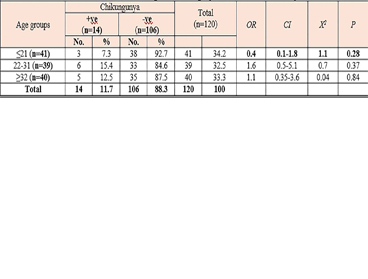
Results: In all, 120 patients with fever were included in the research. According to RT-PCR, ELISA, and/or RDTs, the total prevalence of chikungunya infection was 14 (11.7%). The study found a correlation between gender and chikungunya infection, with males having a slightly higher rate (12.2%) compared to females (10.9%). The age group of 22-31 years had a higher rate (15.4%) than the ≤21 (7.3%) and a slightly higher (12.5%) group of ≥32 years. The study also identified risk factors associated with chikungunya infections in individuals experiencing fever in Hodiedah city. These included living in a rural area, living in a bog, lacking sewage in homes, failing to use a bed net, having an exposed water tank, not having a window screen, not wearing full body cloths, having trash around or near the patients' houses, and having another ill person with a fever of unknown origin in the patients' houses.
Conclusions: The research involved 120 patients with fever, revealing a 11.7% prevalence of chikungunya infection. Gender was found to be a significant factor, with males having a slightly higher rate. Age groups 22-31 had a higher rate than other age groups. Risk factors associated with chikungunya infections included rural living, bog living, lack of sewage, bed net use, exposed water tanks, and trash.